
Control framework
Given the scope of CGT governance, internal control measures are embedded and governed across multiple areas of the organisation.
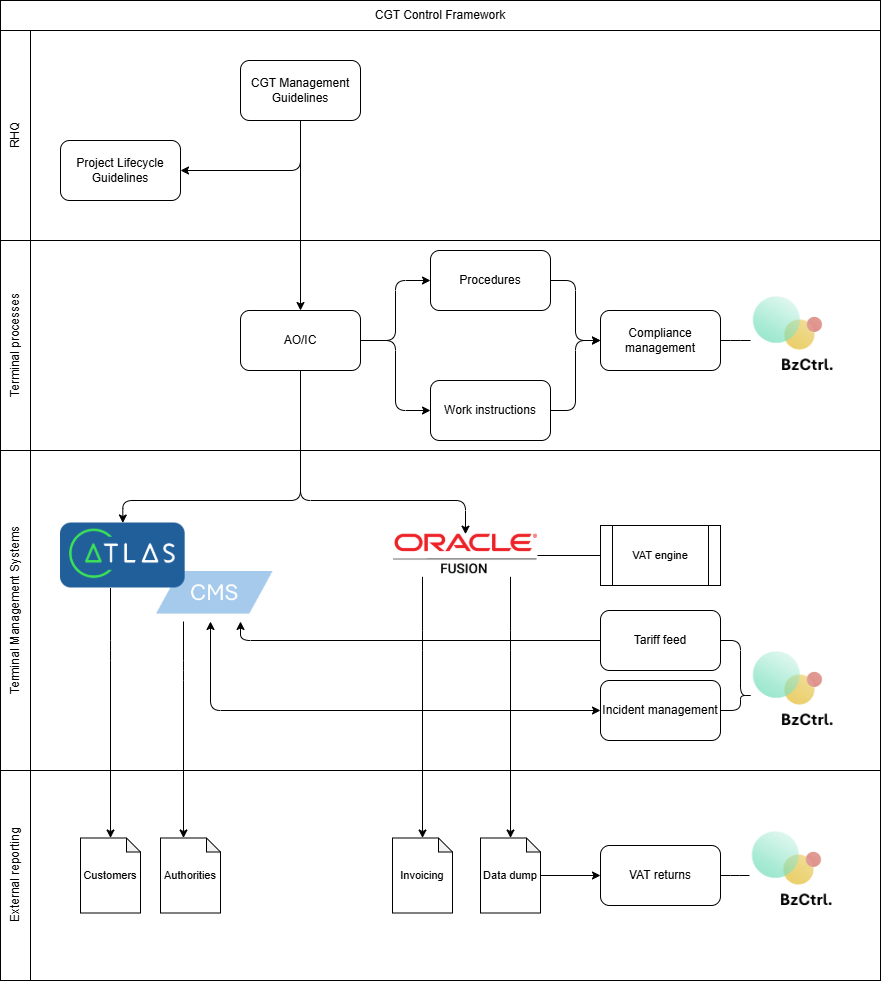
CGT team
For the CGT team, maintaining strong working relationships with local management is essential to identify CGT optimization opportunities and to ensure quality assurance. The CGT team proactively engages with local management to confirm that appropriate control measures are in place and that local management is aware of where to seek support on CGT-related matters. In addition, the CGT team provides functional direction to customs employees at the terminals and facilitates training and instruction for Customer Service (CS), Operations (OPS), and Finance teams. Functional and professional expertise, advice, and support are provided to the terminal(s) both proactively and upon request, with the objective of optimizing terminal performance and ensuring regulatory compliance.
Network and Up-to-Date Knowledge
The CGT team actively builds, maintains, and develops a professional network comprising industry professionals, customers, and relevant authorities to remain informed of CGT developments that may impact VTTI’s business. Relevant knowledge and functional developments are proactively translated into VTTI’s business practices.
Knowledge of legislative changes and relevant case law is kept up to date through this professional network and via a knowledge database maintained by the Federation of European Tank Storage Associations (FETSA) through BzCtrl.
BzCtrl is used to provide local managers and professionals with easy access to applicable legislation, policies, guidance documents, and training materials.
Industry Associations
The CGT team is proactively involved in industry associations where such involvement is deemed to deliver clear business value. To remain well informed and to anticipate regulatory and market developments affecting VTTI’s business, it is VTTI policy to participate in industry associations that are considered influential and relevant.
The CGT team’s involvement includes, but is not limited to, the following associations and working groups:
-
Trade Contact Group (European Commission – Customs)
-
Excise Contact Group (European Commission – Excise)
-
FETSA (Federation of European Tank Storage Associations – Chairing role)
-
CEDWG (Customs and Excise Data Working Group, with industry stakeholders including UPEI and FuelsEurope)
-
VOTOB (Netherlands Tank Storage Association)
-
BATO (Belgian Tank Storage Association – Member)
Engagement at the European level is of particular importance due to the Union Customs Code, which has been applicable across the European Union since May 2016 and has a significant impact on VTTI’s EU operations. The implementation and ongoing interpretation of this regulation will continue to require focused attention over the coming decade.
Rotterdam HQ (RHQ)
In addition to its supporting role for projects and terminals, HQ is itself impacted by CGT-related matters. This impact primarily relates to the VTTI group structure.
Projects
The timely involvement of the CGT team in projects is governed by the VTTI Project Lifecycle Guidelines, from the business development stage through to project commissioning or acquisition by VTTI. The latest version of the VTTI Project Lifecycle Guidelines is available in the QOL database.
Terminals
The impact of CGT on terminal operations varies depending on the jurisdiction in which a terminal is located. Globally, EU terminals are the most significantly impacted, primarily due to customs-related requirements. Taxes applicable to the goods stored and handled, as well as to the services provided, are material to VTTI’s operations.
Failure to obtain and maintain the appropriate permits can directly impact operational continuity. Conversely, having the required permits in place generally enables regulatory simplifications and may result in financial benefits.
Contracts
Given the substantial fiscal liabilities involved, VTTI’s General Terms and Conditions (GT&Cs) include shared responsibility between VTTI and its customers to ensure that all goods and activities related to the services provided are covered by the appropriate customs permits.
In general, VTTI terminals operate under one of the following models:
-
Customer-managed customs formalities
The customer is responsible for customs formalities. VTTI has a derived responsibility to align its operational processes and record-keeping to support the customer’s compliance with applicable customs requirements. -
VTTI-managed customs formalities
VTTI is fiscally responsible for all customs formalities and holds the required permits.
All contracts must be reviewed and approved by the Legal team. For CGT-related matters, essential compliance provisions are embedded in the GT&Cs to ensure adherence to applicable customs and tax regulations.
Day-to-Day Operations
Depending on the extent to which CGT impacts terminal operations, an umbrella document—the Description of the Administrative Organization and Internal Control Measures (AO/IC)—is in place. This document describes how the terminal is organized from a CGT perspective and covers, among others, the organizational setup, roles and responsibilities, required competence levels and how these are ensured, the activities performed and goods handled, applicable permits, and internal control measures. The AO/IC forms the basis for licenses and license applications.
Terminal operations include inbound, storage, blending, and outbound activities. All such operations are governed by permits that require VTTI to be in control of its processes. This includes ensuring full visibility of the goods handled and their customs status (e.g. domestic versus bonded, excise-controlled versus non-excise-controlled).
A fundamental principle applicable to all terminals is that customers nominate the requested manipulations. Customers are responsible for providing complete and accurate data in a timely manner. This information is critical to ensure that validations and determinations are performed on the correct basis.
Customer Service (CS) teams receive the nominations, validate and enter the data into Tomcat/ATLAS, and prepare the Order/Activity such that all required information is available prior to execution. Based on the data included in the Order/Activity, Operations (OPS) teams perform a gatekeeper role by validating that the data aligns with the documentation accompanying the cargo.
Based on the validated input data, products and activities are assessed against the applicable permits in Tomcat/ATLAS, and the required customs and tax declarations are submitted.
In addition to the AO/IC, detailed procedures and work instructions are in place to safeguard compliance. Business controls are implemented to verify that procedures are followed and that they achieve the intended control objectives.
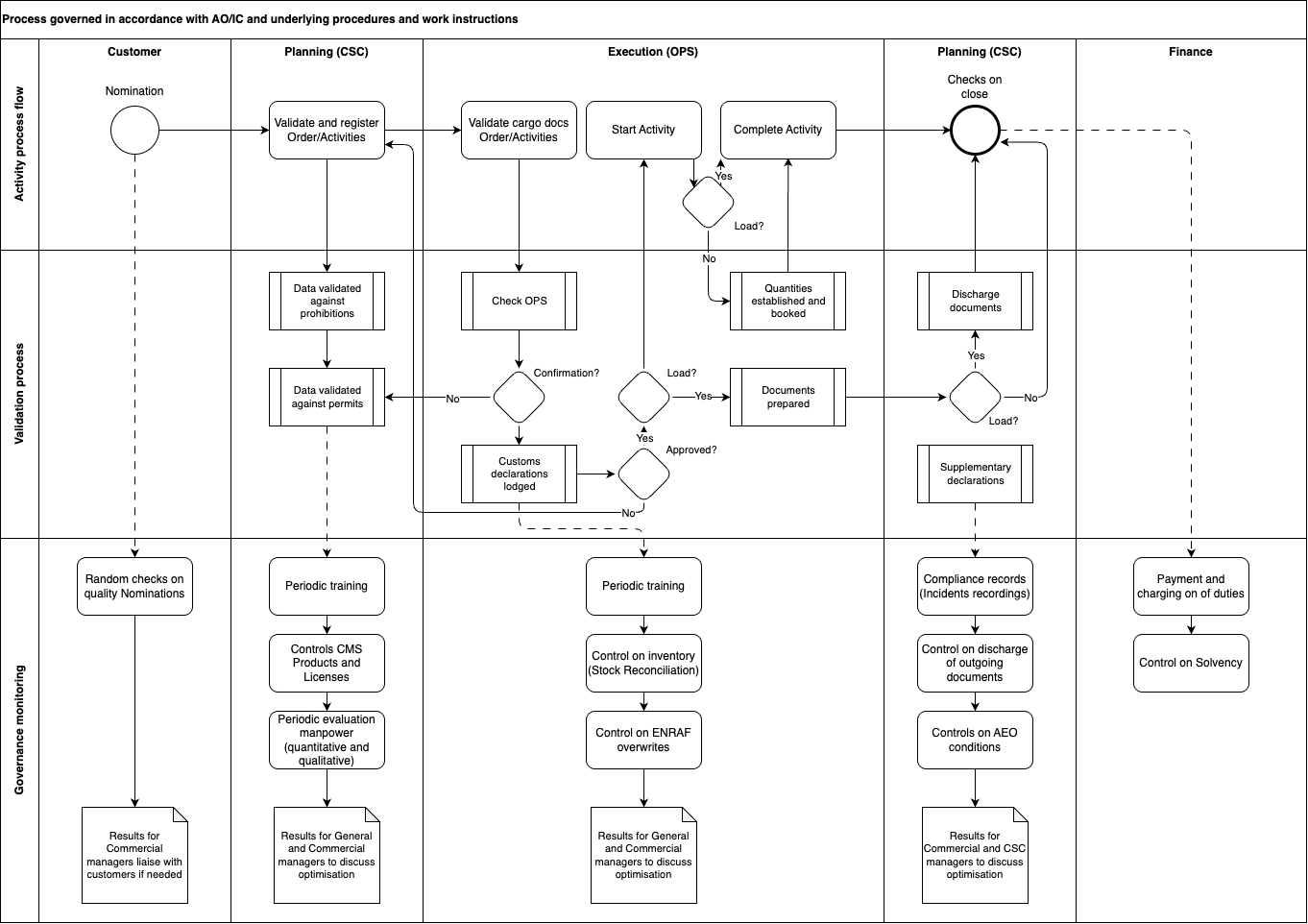
Terminal Management System – Tomcat/ATLAS
To reduce dependency on human resources, mitigate the risk of human error with potentially significant financial consequences, and optimise business processes, VTTI strives to automate operational and compliance processes wherever possible. In light of the global trend toward increased automation by authorities in control and declaration processes, a strong focus on robust IT systems and appropriately skilled IT resources is essential.
To maximize synergies and minimize the resources required, VTTI aims to centralise electronic communication with authorities as much as possible. Given the critical role of IT systems in supporting CGT compliance and enabling uninterrupted 24/7 terminal operations, VTTI has elected to develop the required software in-house. This approach also reflects the absence of suitable off-the-shelf solutions capable of meeting VTTI’s global customs requirements.
ATLAS consists of in-house developed modules, complemented by integrated third-party solutions such as Oracle Fusion Cloud. The system is designed to achieve a high level of integration and automated control measures, thereby reducing reliance on specialized manual expertise. Where manual input remains necessary, or where data is dependent on third-party information, business controls are applied to ensure data accuracy and the effective functioning of the control measures embedded within Tomcat/ATLAS.
The ATLAS modules relevant to CGTs include:
-
Contracts & Invoicing
-
Planning & Execution
-
Inventory
-
Product Management
-
Operations
All modules are linked to, and interact with, the Compliance Managament System (CMS). Data captured and procedures executed within the operational modules feed the rules and controls embedded in the Customs module, which in turn provides validated outputs back to the related modules.
No Comments