
Pratical examples
Shared pipelines
"Physical identification is not possible at all times, (...).”

- Starting position: Tank 1 contains Union goods (T2), Tank 2 contains the same product as non-Union goods (T1), and the shared pipeline contains a known T1 linefill.
- Allocation restricted to a single tank: The T1 linefill reaches the barge before the T2 product from Tank 1. Consequently, loading cannot proceed as the nominated T2 loading without additional measures.
- Accounting segregation at storage-site level: Before loading, the quantity in the pipeline is administratively reallocated from T1 to T2, and an identical quantity in Tank 1 is reallocated from T2 to T1. The total T1 and T2 quantities remain unchanged before loading, and all T1 goods remain under customs supervision.
Tank heel resulting in a loss of customs status
“Physical identification (...) would only be possible at disproportionate cost.”
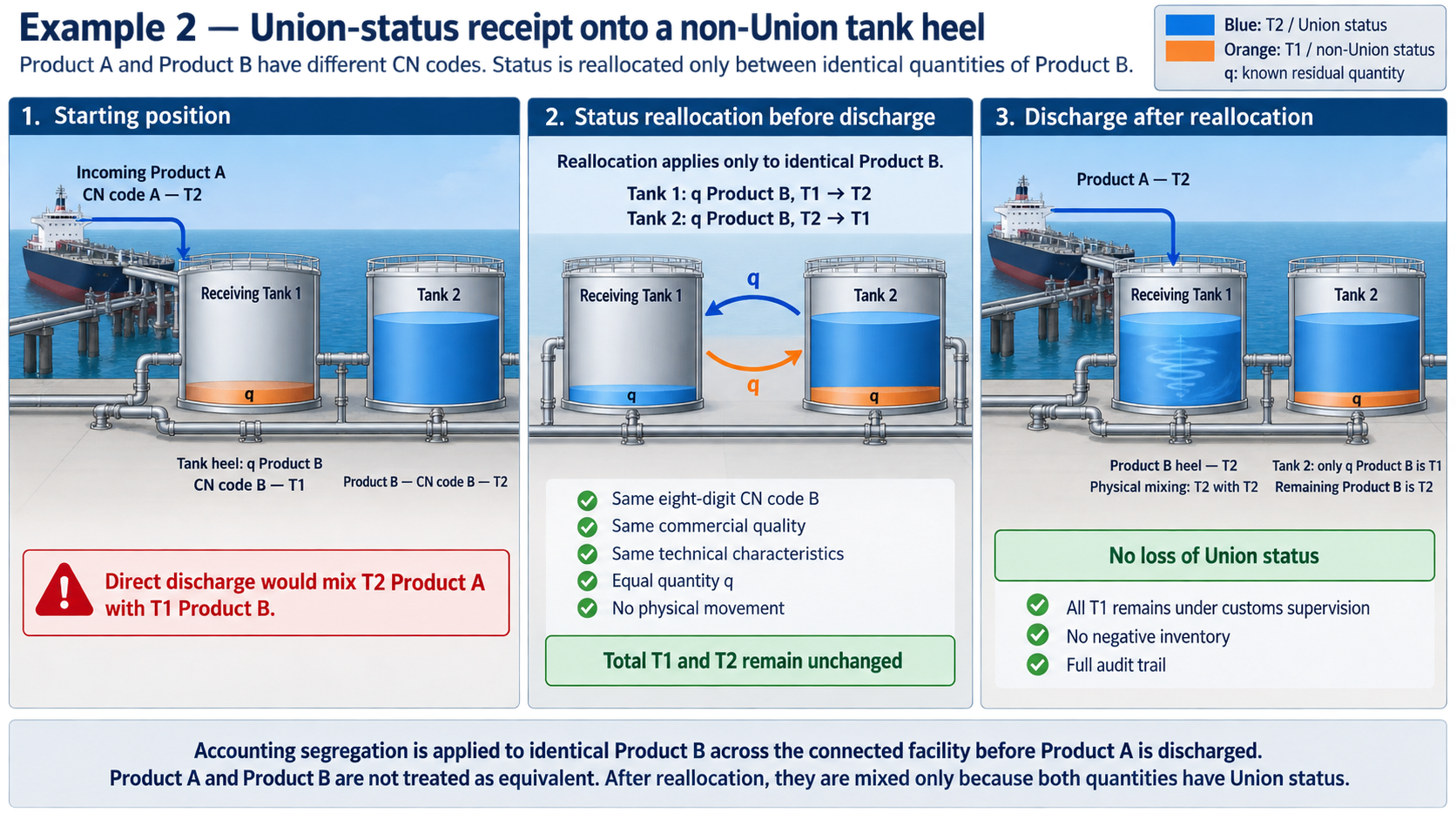
- Starting position: T2 product A, classified under CN code A, is to be received into Tank 1, which still contains a heel of T1 product B, classified under CN code B.
- Reallocation: This takes place exclusively between identical quantities of product B:
- Tank 1: A quantity of product B is reallocated from T1 to T2.
- Tank 2: The same quantity of product B is reallocated from T2 to T1.
- Discharge: Product A is subsequently discharged as T2 onto the heel of product B, which has by then also been recorded as T2. In Tank 2, only the corresponding quantity is recorded as T1; the remaining stock remains T2.
The illustration emphasises that products A and B are not treated as equivalent. Reallocation takes place exclusively between the two identical quantities of product B. As a result, the subsequent physical mixing is between T2 goods and T2 goods, and all T1 goods remain under customs supervision. The alternative would require the goods to remain physically separated, meaning that physical identification would only be possible at disproportionate cost.
No unnecessary physical operations solely for administrative purposes
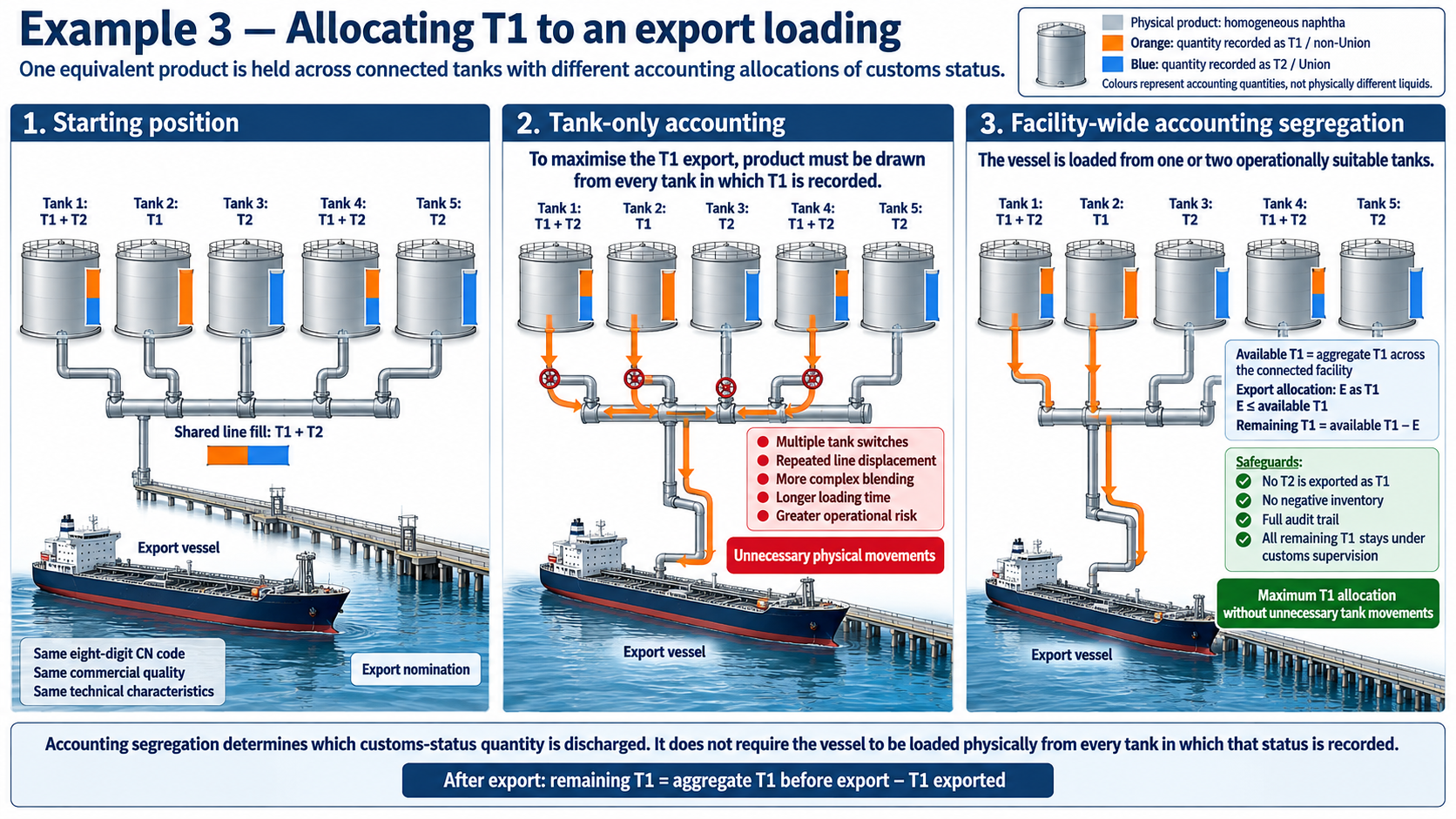
- Starting position: The same equivalent product is distributed across five connected tanks. Some tanks contain quantities administratively recorded as both T1 and T2, while others contain only T1 or T2. The known linefill also comprises quantities administratively recorded as T1 and T2.
- Tank-specific accounting: To export as much T1 as possible, product must physically be loaded from several tanks. This requires switching between tanks, displacing line contents and a more complex loading operation.
- Facility-wide accounting segregation: The vessel is physically loaded from one or two operationally suitable tanks. The export is administratively allocated to the total available T1 stock within the connected facility.
No Comments