
Customs Procedure Operation
Each Parcel may require a different customs treatment, depending on the type of Operation performed. For that purpose, the first assessment done by CMS is determining the Customs procedure applicable to the Operation. This is done on the following basis:
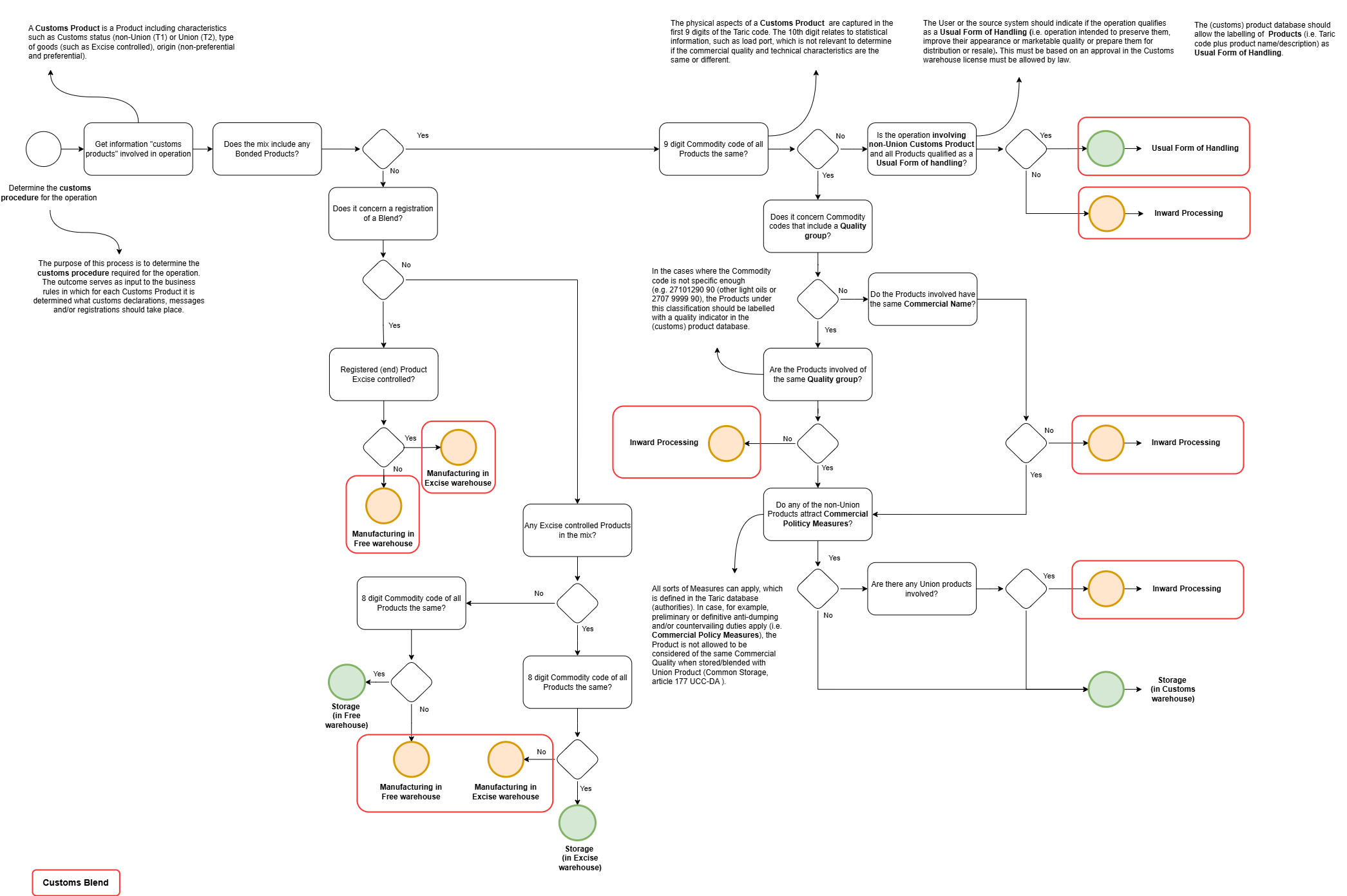
Basically, when two Products mix, a distinction is made between Blends that involve Bonded goods and Blends that don't.
Blends not involving Bonded Product
In this case, the determination of whether the Operation concerns a Blend depends on whether or not the 8-digit Commodity Code of the products involved is the same. If yes, then the Operation relates to manufacturing. The type of manufacturing is dependent on the Customs status / Type of goods, where, when it involves Excise controlled Product, it is considered Manufacturing under Excise warehouse. When it involves only Domestic (i.e. not Excise controlled) Product then it is considered manufacturing under Free warehouse.
Upon registration of the Blend, the Customs status / Type of goods of the end Product determine the qualification of Manufactured under Excise warehouse for Excise controlled or Manufactured under Free warehouse for Domestic.
Blends including Bonded product
When a Blend does involve Bonded product, a check is done on the Commodity code on a 9-digit level. The reason for looking at the first 9 digits is that this relates to physical characteristics of Products that say something about the quality. For example, 2710 1948 10 versus 2710 1948 90 is different on the basis of sulphur content. 2710 1942 21 versus 2710 1942 29 is, respectively, "Consigned from Canada" and "other". Both paraffinic gas oils. Hence, the 10th digit relates to statistical information and not the physical characteristics.
When the Commodity codes are not the same on a 9-digit level, the Customs Procedure Operation is Inward processing, or, in specific cases a Usual Form of Handling. A Usual Form of Handling requires both the base Product and the Additive to be marked in the product database of CMS as Usual form of Handling.
When the 9-digit Commodity codes are the same, it could still be that the products involved are considered Products of a different quality. This is identified by Quality groups assigned to Products in the Product database in CMS. These quality groups are indicated by the Customer, the owner of the product, having extensive knowledge on quality. In case there are Quality groups assigned to the Parcels involved, then in case they are different, the result is a Blend and the customs procedure Inward Processing applies. In case no Quality Groups are available, the distinction is made on the basis of the (commercial / operational) Product name.
In case the Commodity code on 9-digit level is the same AND the Quality Groups (or Product names) of the Parcels are the same, then, in principle, the result is the Customs procedure Storage for the Operation. An exception to this rule is when it concerns both Bonded and non-Bonded / Union (i.e., Excise controlled or Domestic) Products AND the Bonded Products are subject to preliminary or definitive Anti-Dumping or Countervailing duties. In that case the Products, by law, may not be considered the same Commercial quality and hence it results in a Blend. As a result, the customs procedure Inward processing applies.
In any case, where the result of the assessment is a Customs Blend, where it involves both Bonded and non-Bonded, the User is informed that the operation will result in all Union goods becoming Bonded and the User must actively confirm its intentions.
No Comments