Methodology selection
Step 1: Assess if pragmatic approach may be applied
The Dutch Customs Authorities have agreed that VTTI may use the market value of a product as the customs value in the import declaration in situations where the customs value has no impact on the amount of duties payable. First step in the valuation procedure is to determine whether this pragmatic approach can be applied.
When a product arrives at the terminal and a parcel is registered in ERP, the value of the product is recorded by CS in line with the market value at the time of registration. The market value is usually provided by the customer, or otherwise obtained by CS from publicly available market data sources.
When the customer sends a nomination to bring the product into free circulation, CS registers an import service in ERP. The import service requires a value, which is used in the import declaration.
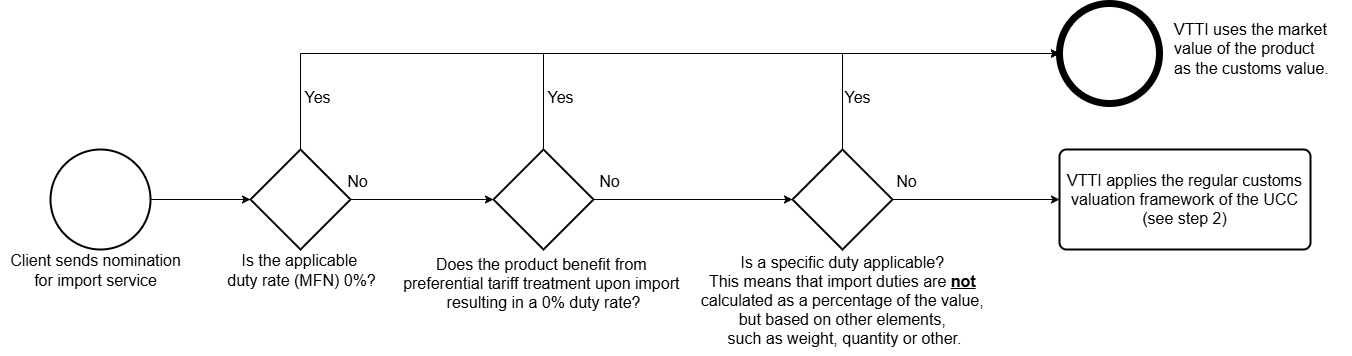
Where the applicable import duty rate is 0%, the goods qualify for preferential treatment upon import, or where a specific duty applies (i.e., duties are not calculated over the value but over another factor such as weight), the customs value declared serves a purely statistical purpose and has no financial impact. In such cases, the customs authorities have approved that VTTI applies the “reasonable means” method as an alternative method of customs valuation, in accordance with Article 74(3) of the UCC. More specifically, the market value that was registered at the time the parcel was created is used as the customs value in the import declaration.
If the import duty rate exceeds 0%, no preferential treatment applies and customs duties due are calculated on an ad valorem basis, the regular customs valuation framework of the UCC will be applied to determine the customs value.
This approach can be schematically displayed as follows:
Step 2: Assess applicability of transaction value method
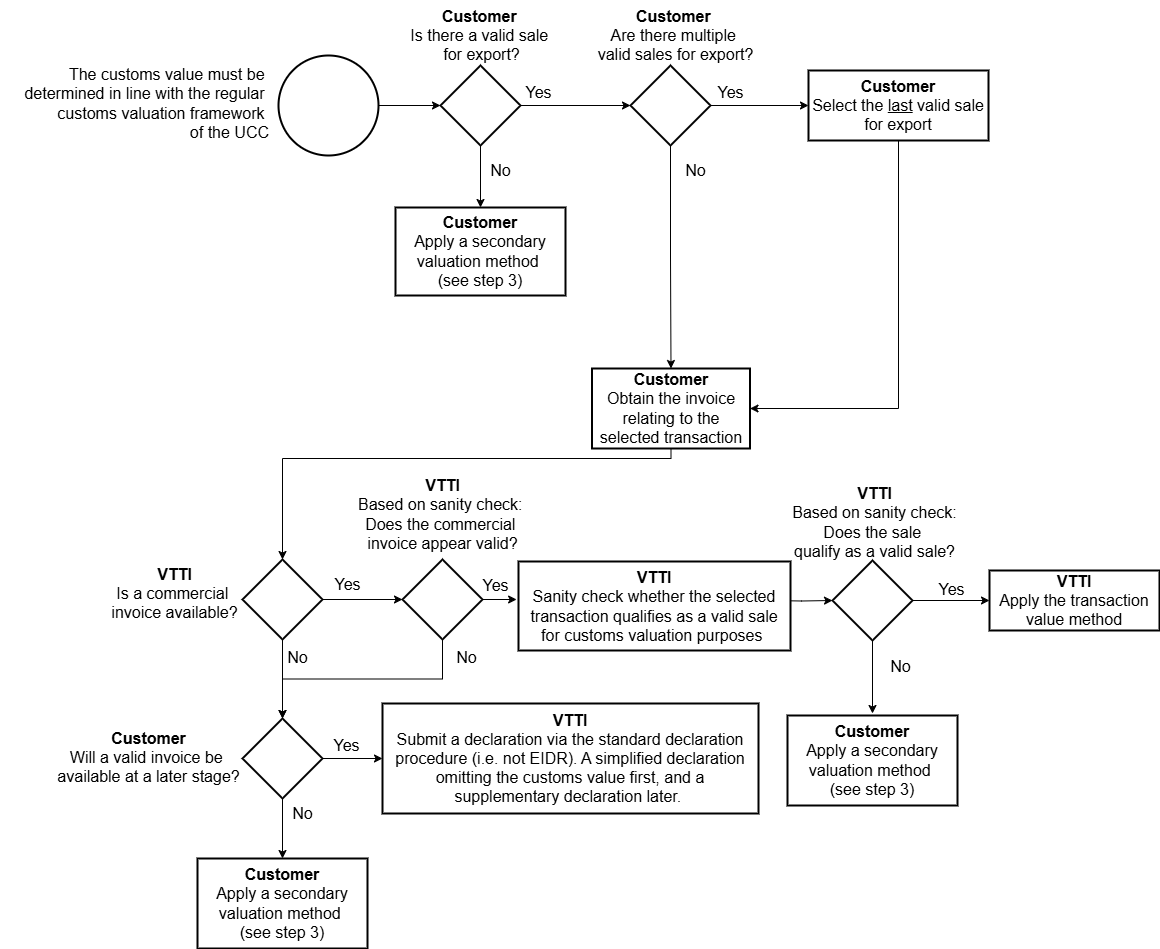
If Step 1 results in the customs value being determined under the regular customs valuation framework of the UCC, the next step is to assess whether the transaction value method can be applied. As this is the primary customs valuation method, the assessment should determine whether the method is available and, if so, which transaction forms the basis for the customs value. The assessment framework is set out below.
Step 2.1: Identification of a qualifying sales transaction
The transaction value method can only be applied if the goods are sold for export to the EU. This means that ownership of the product is transferred from the seller to the buyer, and that, at the time of the sale, it is clear that the product is intended for export to the EU.
If the product is not sold prior to its physical entry into the EU, but while in temporary storage, under external transit, in a customs warehouse or under inward processing, such a sale may also qualify as a "sale for export" on which the transaction value can be based.
If the product is sold multiple times prior to its arrival in the EU (i.e., more than one sale qualifies as "sale for export"), the transaction value must be based on the last sale, i.e. the sale concluded immediately before the goods enter the EU.
As VTTI has limited insight in the supply-chain and the underlying transactions, the customer indicates whether or not a sale for export exists and which sale qualifies as the last sale for export. The customer provides CS with the relevant information regarding that sale, including the commercial invoice.
If the customer indicates that no sale for export exists, the value must be determined in line with one of the secondary valuation methods, briefly described below under step 3. This scenario is extremely rare in the energy products market.
Step 2.2: Review of the commercial invoice
The commercial invoice which relates to the declared transaction value is required as a supporting document. It is the responsibility of the customer to provide CS with a valid commercial invoice. CS performs a sanity check on the invoice.
In exceptional cases, where a final commercial invoice is not available, alternative supporting documents (such as a pro forma invoice, “for customs purposes only” invoice, or other preliminary invoice) may be accepted, provided that they accurately reflect the transaction value and this value can be substantiated by the underlying commercial documentation. CS will consult the customs specialists at the terminal or VTTI HQ before using such alternative supporting document for customs valuation.
In case it can be concluded from the sanity check that the invoice appears valid, CS will proceed to step 2.3 as described below. Otherwise, CS will reach out to the customer to discuss findings.
If it appears that no valid invoice is available, the transaction value method cannot be applied. CS will then proceed to step 3.
Step 2.3: Assessment whether the transaction value method can be applied
Following a successful conclusion of the sanity check in step 2.2, CS will accept the invoice. If CS has no access to the commercial invoice relating to the transaction, and the customer can also not provide that invoice at a later stage, the transaction value method cannot be applied and a secondary valuation method must be selected (see step 3). This scenario is extremely rare.
If CS does not have access to the commercial invoice relating to the relevant transaction, but the customer is able to provide the invoice at a later stage, CS will submit a simplified customs declaration in accordance with Article 166 UCC using a provisional customs value based on the information available at the time of importation. Once the invoice becomes available, CS will determine the final customs value in accordance with the transaction value method and submit a supplementary declaration pursuant to Article 167 UCC.
A sale cannot be considered a valid transaction for valuation purposes in the following situations:
Restrictions on use or resale - If the buyer is restricted in how they can use or resell the goods, except for standard restrictions (e.g. legal requirements, geographical resale limits, or restrictions that do not affect the value of the goods).
Price depends on unclear conditions - If the agreed price is influenced by conditions or arrangements for which no clear value can be determined (for example: unknown future compensations, or non-quantifiable obligations).
Proceeds flow back to the seller - If the seller receives (directly or indirectly) part of the proceeds from the buyer’s resale or use of the goods, and this cannot be properly adjusted in the customs value.
Relationship influences the price - If the buyer and seller are related and there are indications that this relationship has affected the agreed price.
As VTTI has limited insight in the supply-chain, the underlying chain of transactions and the contractual circumstances surrounding the sale, it is the responsibility of the customer to assess whether the sale is valid for customs valuation purposes. CS performs a sanity check based on the information available.
The sanity checks conducted by CS are incorporated in a checklist in BzCtrl and included here.
If the sanity check raises any doubt regarding the acceptability of the invoice price, CS will contact the customer to obtain clarification before lodging the declaration.
Step 2 can be schematically displayed as follows:
Step 3: Assess applicability of secondary valuation methods
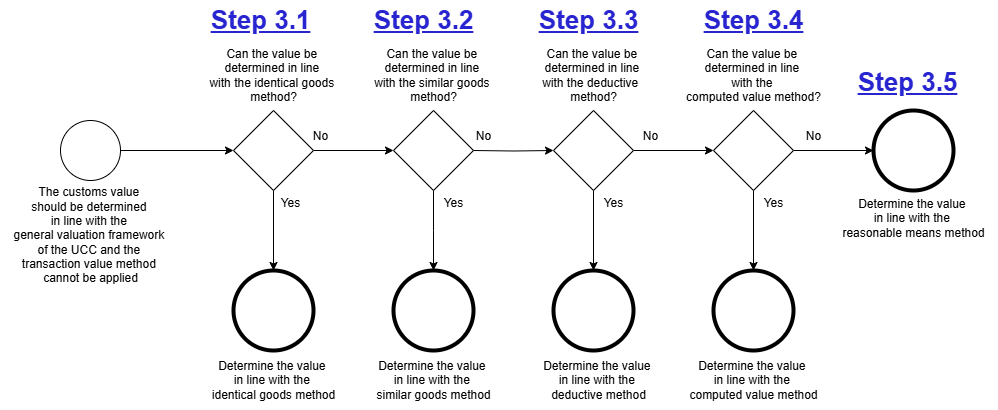
Once it is clear that the customs value must be determined in line with the regular customs valuation framework of the UCC, and its clear that the transaction value method cannot be applied, next step is to assess which of the secondary valuation methods can be applied. In this respect, the following hierarchy must be followed:
Step 3.1: assessment of identical goods method
If possible, the customs value must be based on the transaction value of identical product sold for export to the EU and exported at or about the same time as the product being valued.
In practice, in the supply chains in which VTTI is involved, it is never possible to apply this method, as there is hardly ever such a transaction of identical product available at or about the same time as the product being valued, or the data of that transaction is not available. As such, this secondary valuation method is in practice never applied.
Step 3.2: assessment of similar goods method
If the identical goods method cannot be applied, the customs value should be based on the transaction value of similar product sold for export to the EU and exported at or about the same time as the product being valued.
In practice, in the supply chains in which VTTI is involved, it is never possible to apply this method, as there is hardly ever such a transaction of similar goods available at or about the same time as the goods being valued, or the data of that transaction is not available. As such, this secondary valuation method is in practice never applied.
Step 3.3: assessment of deductive method
If the similar goods methods cannot be applied, the value must in principle be based on the deductive method. The UCC allows for the computed value method to be applied first upon request; however, VTTI does not make use of this option.
Under the deductive method is based on the unit price at which the imported product, or identical or similar imported product, is sold within the customs territory of the Union in the greatest aggregate quantity to persons not related to the sellers. In the supply chains in which VTTI is involved, it is hardly ever possible to apply this method, as VTTI almost never has access to the data required for this valuation method.
Step 3.4: assessment of computed value method
If the deductive method cannot be applied, the customs value should be based on the Computed value method. Under the computed value method, the customs value is calculated as the sum of:
The cost or value of materials, fabrication and other processing employed in producing the imported goods,
An amount for profit and general expenses equal to that usually reflected in sales of goods of the same class or kind as the goods being valued which are made by producers in the country of export for export to the Union and
The cost of transport and insurance and loading and handling charges associated with the transport of the imported product, up to the place where the product is brought into the customs territory of the EU.
Same as with the former secondary valuation methods, it is hardly ever possible to apply this method, due to a lack of data.
Step 3.5: assessment of reasonable means method
If none of the former secondary valuation methods can be applied, the customs value should be determined in line with the reasonable means method. Under this method, the value should be determined on the basis of data available in the customs territory of the EU, using reasonable means consistent with the principles and general provisions of WTO legislation and the UCC. Chapter 5 contains a description of value determination under the reasonable means method.
Conclusion step 3
In conclusion, where the customs value must be determined in accordance with the standard valuation framework of the UCC and the transaction value method cannot be applied, CS will, together with the customer, explore at a high level whether the identical goods, similar goods, deductive or computed value method may be applied. However, based on experience, and given the nature of the liquid bulk industry as well as VTTI’s role in the supply chain, it is in practice rarely possible to apply any of these methods. Consequently, the fallback (“reasonable means”) method will generally be applied.
Where it is determined, following alignment with the customer, that one of the alternative methods can be applied, CS will agree with the customer how that method is to be applied in practice. This will be documented by CS in a client-specific work instruction.
Step 3 can be schematically displayed as follows:


2 Comments