
Parcel administration
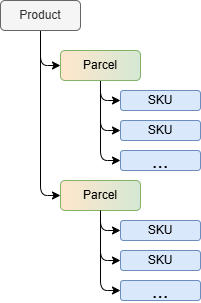
The parcel administration model distinguishes between three separate business concepts: Product, Parcel, and Stock Keeping Unit (SKU). Although a Parcel may in some situations correspond to a single SKU, these concepts are fundamentally different and can not be treated as interchangeable within the system.
The three layers are defined as follows:
- Product – The physical commodity handled at the terminal, such as gas oil, gasoline, or naphtha.
- Parcel – The administrative representation of a physical product. A Parcel records characteristics such as commodity code, customs status, origin, cargo documents and, where applicable, consignor or consignee information.
- Stock Keeping Unit (SKU) – An administrative unit used for inventory management and record-keeping purposes. SKUs support stock administration but do not define the legal or logistical identity of a Parcel.
Parcel creation for incoming products
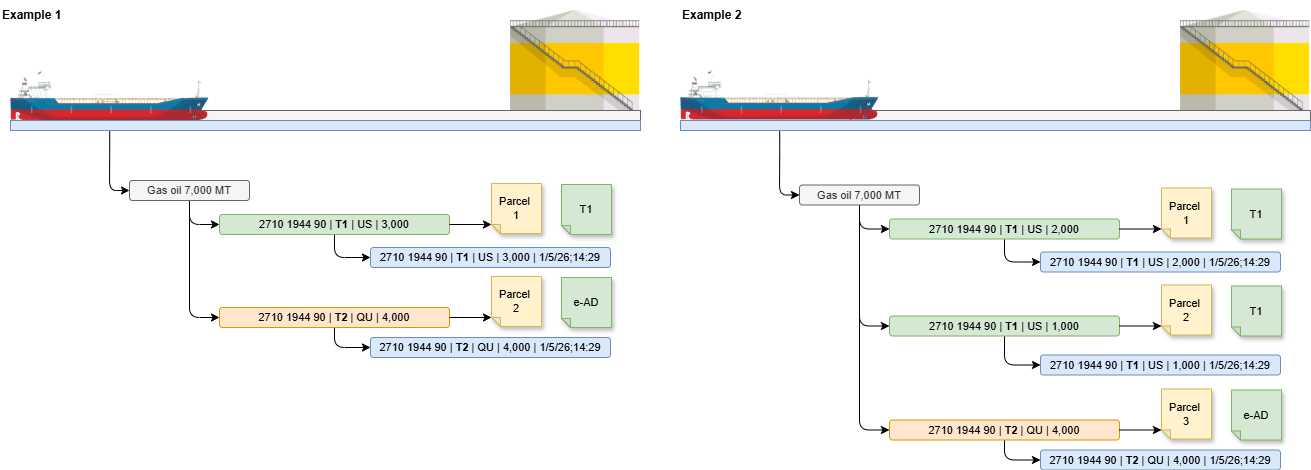
For incoming products, the User registers the received physical product by creating one or more Parcels. Each Parcel serves as an administrative reflection of the product and captures attributes such as the commodity code, customs status, and origin.
These attributes alone do not determine the number of Parcels that must be created. Even where multiple quantities of product share identical administrative characteristics, the User may decide to register them as separate Parcels. Consequently, the creation and granularity of Parcels for incoming receipts are driven by the User's administrative requirements rather than solely by the product characteristics.
Parcel creation for outgoing products
The same principle applies to the dispatch of goods. When product is loaded for shipment, the User creates one or more Parcels to represent the administrative distribution of the physical product.
For example, 9,000 MT of gasoil with a T2 (Union) - Excise controlled customs status may be loaded (Movement), where the Product is destined for 3 different destinations (Departure). Although all quantities have the same commodity code, customs status, and origin, separate Parcels are created because they are intended for different consignees. The User determines the required Parcel structure based on the operational and documentary requirements of the shipment.
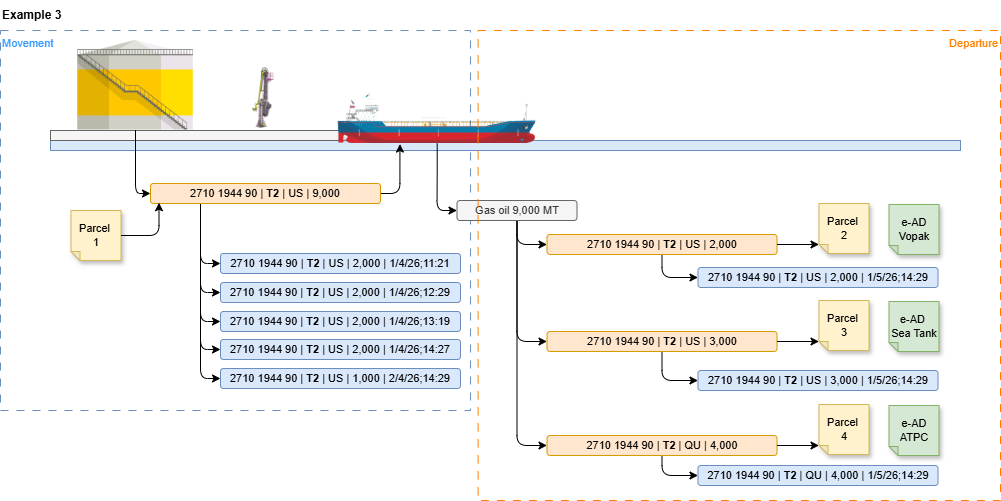
The Parcel is defined when Products are registered by the User as these are carried by the Means of Transport including administrative characteristics such as Commodity code, customs status, origin, cargo documents, consignee, etc.
Parcel Administration During Product Movements
For product handling, the creation and movement of Parcels is driven by the physical product being processed and its customs status. In these scenarios, the IT system determines the Parcels based on the administrative composition of the stock being moved.
For example, a Vessel or a tank containing 7,000 MT of gasoil may consist of 3,000 MT with T1 customs status and 4,000 MT with T2 customs status. When more than 4,000 MT is moved, the operation results in the movement of two separate Parcels, reflecting the two different customs statuses.
Where a Parcel contains multiple underlying SKUs, such as SKUs with different origins, the associated SKUs follow the Parcel movement according to the First In, First Out (FIFO) allocation methodology. As a result, the Parcel defines the administrative movement of the product, while the SKUs are allocated within that Parcel in FIFO order to maintain accurate inventory records and traceability.
The administration of Parcels for liquid bulk operations requires a dynamic approach because the physical quantity moved during an operation is not known until the operation has been completed. At the same time, customs legislation requires that goods are declared and presented before the operation takes place, as subsequent blending or commingling may make it impossible to distinguish the originally declared goods.
Parcel and SKU Allocation During Product Movements
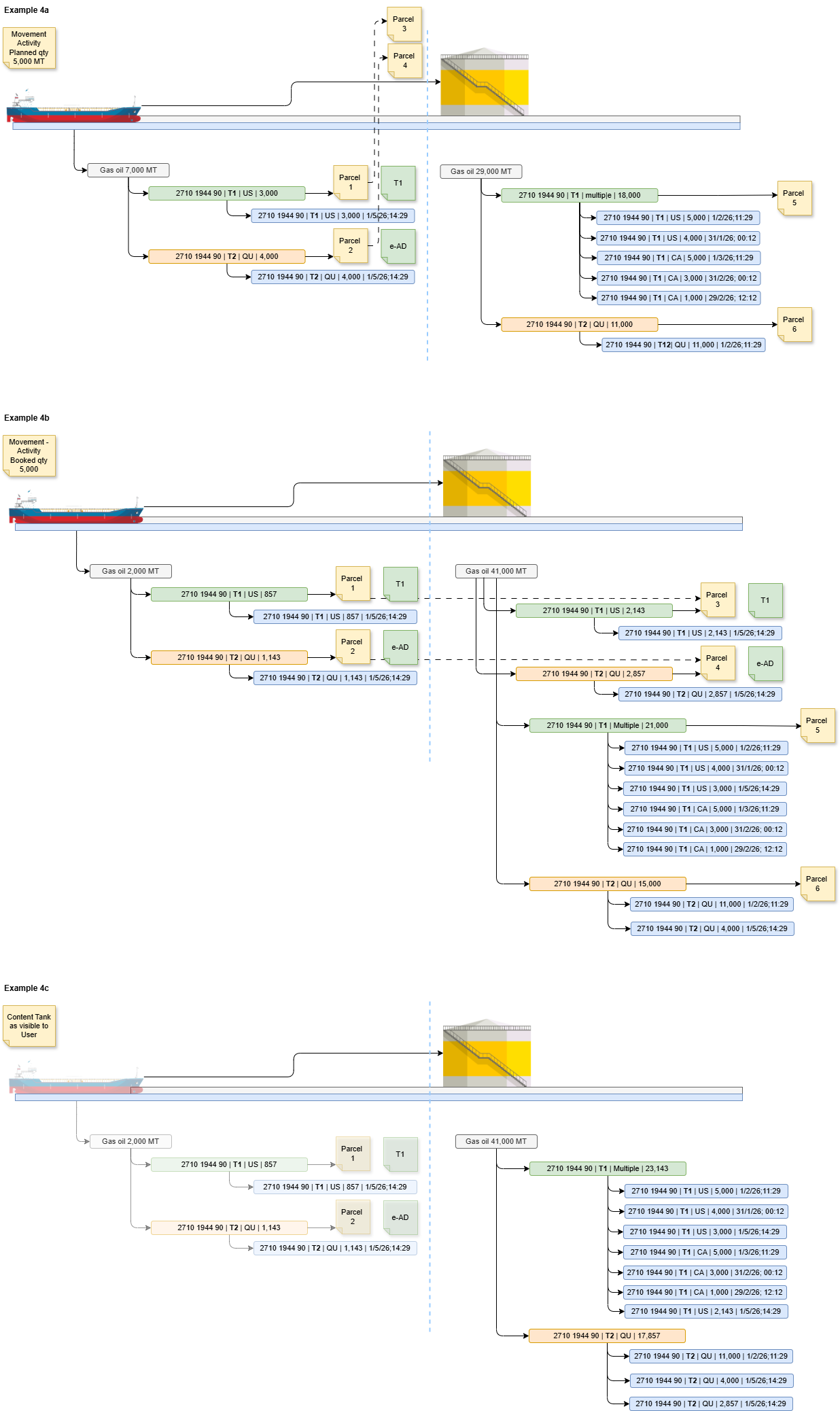
Once Product has been booked into a Storage Unit, it may consist of multiple Parcels. For operational purposes, the User views the available physical Product by customs status. When a subsequent movement is planned, physical Product is allocated based on customs status, determining whether the movement involves one or multiple Parcels.
Each selected Parcel is linked to one or more SKUs that meet the applicable customs status and FIFO criteria, unless a preference is indicated on the basis of, for example, origin. The newly created Parcel or Parcels resulting from the movement maintain a relationship with the originating Parcels and the underlying SKUs from which they are derived.
This relationship can be established in two ways:
By selecting the originating Parcel or Parcels based on customs status and FIFO rules, after which the underlying SKUs are allocated accordingly; or
By allocating SKUs directly based on the planned quantity, customs status, and FIFO criteria, after which the corresponding Parcel relationships are derived from the selected SKUs.
As Parcels are composed of SKUs, both approaches result in the same traceability between the new Parcel(s), the originating Parcel(s), and the underlying inventory records.
Customs Procedure Traceability
Where a Parcel has been placed under a customs procedure, the underlying SKUs comprising that Parcel are considered to be under the same customs procedure. Conversely, where SKUs are identified as being under a customs procedure, this status can be attributed to the Parcel to which those SKUs belong.
For the purpose of determining whether a Product has already been declared for a specific customs procedure, traceability may be maintained in two ways:
Through the SKUs, which maintain the relationship to the originating and subsequent Parcels; or
Through the Parcels, which maintain the relationship to the underlying SKUs.
As the relationship between Parcels and SKUs is preserved throughout the allocation process, both approaches provide a valid mechanism for determining whether Product is already covered by a particular customs procedure and therefore whether additional customs declarations are required.
Initial Parcel determination
Prior to the start of a movement, the IT system determines the Product and the corresponding Parcel or Parcels based on the planned quantity. The determination is performed using the inventory position as it exists immediately before the operation commences.
At this point, the system queries the record keeping to identify all relevant Parcels and their administrative characteristics, including customs status. Based on this assessment, the required customs declarations can be prepared and lodged before the physical movement starts.
The quantity used during this initial assessment is an estimated or planned quantity. The actual transferred quantity cannot yet be established.
Determination of the actual quantity
In liquid bulk operations, the actual moved quantity is established only after completion of the physical operation. The quantity may be determined through:
- Tank measurements before and after the operation;
- Flow meter readings; or
- Weighbridge measurements.
Only after these measurements have been completed can the definitive quantity of Product and the corresponding Parcel allocation be determined.
Retrospective Parcel validation
Once the actual moved quantity is known, the IT system performs a retrospective validation of the Parcel administration. This validation reassesses which Parcels should have been moved based on the inventory situation that existed immediately before the operation started, rather than the inventory situation at the time the reassessment is executed.
This temporal consistency is essential because customs declarations are based on the goods that were presented immediately prior to the operation. Consequently, the reassessment must use the same point-in-time inventory snapshot as the initial determination.
In practice, the Product already present in the receiving tank is treated as a fixed condition that existed before the movement and therefore remains unchanged for purposes of the reassessment.
Once the moved quantity has been measured, the final quantity is established and the circumstances of the Activity are reassessed retrospectively based on the situation as it existed at the start of execution.
Movement Data Communication and Final Booking
When a Movement is executed, all Parcels and the associated SKUs involved in the operation are communicated to CMS. This includes the Product to be moved from the source Storage Unit, the Product already present in the receiving Storage Unit, and, where applicable, any additional Product simultaneously moving towards the same destination Storage Unit at the start of the Movement (referred to as Related Activity).
For each Movement, the exact composition of Parcels involved can only be determined with full certainty at the moment of final booking, when all actual figures have been established. The final booking is therefore only executed once the Movement and all related Activities have been completed and fully registered.
At that point, the definitive Parcel and SKU allocation is confirmed and recorded in CMS based on the validated operational outcome.
Related Activities are concurrent operations moving Product to the same destination Storage Unit at the start of a Movement and must be included in the Movement’s CMS communication and booking scope.
Parcel identity and corrections
Each Parcel must have a unique reference that identifies the represented Product and its associated customs status. This unique reference should remain unchanged between the initial assessment before the operation and the retrospective validation after completion.
In most cases, the retrospective validation will confirm the initial Parcel determination, with only the moved quantity requiring adjustment. In exceptional circumstances, however, the final measured quantity may lead to a different Parcel composition than originally anticipated. For example, an operation initially expected to involve a single Parcel may ultimately require two Parcels because the final quantity spans different customs status boundaries, or vice versa. As a result, customs declarations may in some cases not be lodged prior to the start of the operation, or may in hindsight have been created when they were not required.
In such cases, the IT system must correct the Parcel administration and any associated customs declarations while preserving the original assessment timestamp representing the moment immediately before the operation commenced. This ensures both an accurate inventory administration and a legally consistent customs audit trail.
Customs compliance risk is controlled at Product entry (license validation), while operational accuracy is ensured retrospectively through measured quantities and Parcel reconciliation.
In the near future it is expected that declarations for certain Products must be declared real-time via the Normal procedure instead of by means of Entry Into the Declarants Record (EIDR). In that case correction will be more cumbersome!