
Scope definition import

6851f7e0-acf7-4275-8626-d18d3fc15bb9_en
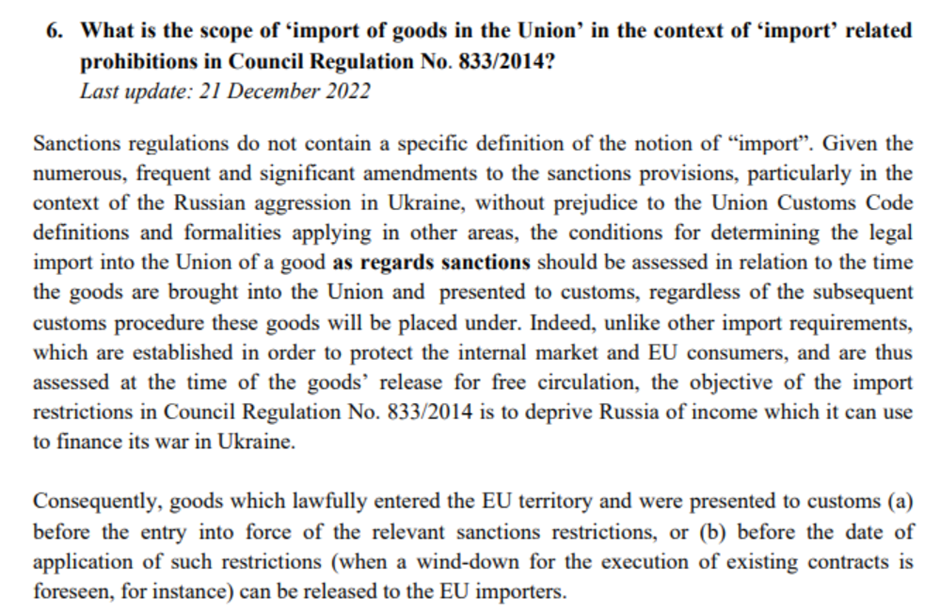
The Regulation itself does not define “import”. In the above passage from the Commission guidance (FAQ, 21 Dec 2022) it can be concluded that “Import” for sanctions purposes is assessed at the moment goods are physically brought into the Union and presented to customs authorities, regardless of the subsequent customs procedure (free circulation, inward processing, warehousing, etc.).
The purpose of the sanctions import ban is to prevent economic access to the EU market by prohibited goods, not to prohibit every customs act. In that regard, economic availability and potential access to the EU market are deemed decisive factors.
Concretely this would mean that placing goods under customs procedures such as Customs warehouse, Inward Processing and, most clearly, the Release for free circulation are considered “Import” as defined in Article 3ma. This is supported by the fact that mid 2025 by accident the Measure was enforced in the customs systems and both declarations for the Release for free Circulation and Inward Processing failed because of a missing statement.
Transit is deemed not to fall within the scope of the Import definition as it does not lead to economic use in the EU. Even though goods are presented when placing goods under transit, that moment merely calls for an assessment as stated in the Guidance. This is also supported by the fact that when transit is banned as well, it is explicitly mentioned in the Regulation. Furthermore, the Import control Measure effectuating the control does not include the NCTS system.
In the respective customs declarations for placing goods under the mentioned customs procedures in scope it should be stated on what grounds the ban does not apply. Below an overview of the respective codes.
Practical considerations. When the Measure apply a declaration will be rejected if no Y code is provided. In a real time declaration process this impacts operations directly, but at the same time offers a safeguard (i.e. on applying a Y code, not perse application of the correct code).
In declaration processes where a simplified manner applies, such as Entry Into the Declarants Record (EIDR) there is no real-time communication. In case of Customs warehousing also no supplementary declaration is required where a check is performed by the system of the customs authorities, unlike the supplementary declaration process for, for example, Inward Processing or the Release for Free Circulation.
This specific ban is limited to petroleum products falling under CN code 2710. Common in our industry is the handling of goods classified under CN code 2707 9999. This classification is primarily based on the aromatic content being > 50%. In most cases the aromatic content is the determining factor for classifying under Tariff Heading 2707 (i.e, > 50%) or Tariff Heading 2710 (i.e. ≤ 50%). Although the practical impact is unclear, two points of attention:
- There might be increased controls on customs declarations lodged for goods under CN code 2707 9999. This may cause operational interruptions. We understand that establishing the aromatic content is a relatively time-consuming process;
- Different methods lead to different results. In practice we have seen examples where different approved methods applied to determine the aromatic content lead to different outcomes and since this is the determining factor applied in the EU to determine the classification, there is an increased risk in non compliance.
No Comments