
Non-Preferential origin
Non-preferential rules of origin
There are 3 rules that determine the non-preferential origin of a product. The 3rd rule is a residual rule that applies if rule 1 and rule 2 do not apply.
Rule 1
Goods are of non-preferential origin in the single country or territory where these goods are wholly obtained. This reference to country or territory includes territorial waters. It also includes the seabed or subsoil beneath the seabed to which a country has exclusive exploitation rights.
Some examples:
- Crude produced in the USA is of USA origin
- Crude produced outside The UK, from seabed or subsoil beneath the seabed to which The UK has exclusive exploitation rights, is of UK origin
- Diesel produced in Norway out of crude of Norwegian origin is of Norwegian origin under this rule as the product is wholly obtained in a single country
Rule 2
Rule 2 applies to goods produced in more than 1 country or territory.
Goods originate in the country or territory in which
- they underwent their last substantial, economically justified processing or working
- in an undertaking equipped for that purpose
- resulting in the manufacture of a new product or representing an important stage of manufacture
A processing or working is not considered to be substantial, economically justified if it is a minimal operation. Article 34 of the UCC-DA lists the minimal operations:
- Operation to ensure preservation during transport or storage
- Simple operations consisting of removal of dust, sifting or screening, sorting, classifying, matching, washing, cutting up.
- (changes of) packing, assembly, other simple packaging operations
- Putting up goods in sets or ensembles
- Affixing marks, labels, etc.
- Assembly of parts into complete product
- Disassembly
- A combination of the above
If goods are listed in Annex 22-01 to the UCC-DA then the last substantial, economically justified working or processing is the one mentioned in this Annex. The country or territory where this working or processing has taken place is where these goods originate. Currently this Annex 22-01 doesn't apply to mineral oils, (bio)ethanol and biodiesel.
A refinery process ticks all 3 boxes. It is a substantial, economically justified processing or working. It takes place in an undertaking equipped for that purpose and it results in the manufacture of a new product or it represents an important stage of manufacture.
A blend process is less clear in terms of non-preferential origin. Not every blend process will make the origin change. If you're blending different fuel oil grades in order to change viscosity, this might not be sufficient to result in a different origin. if you're blending biodiesel with diesel into B7, arguably this changes the origin based on rule 2.
Residual rule
If the activity does not result in a change of origin following rule 1 or rule 2 while the activity entails more than a minimal operation then the residual rule applies. This rule is usually referred to as majority rule although calling it the major portion rule would be more accurate.
Under this residual rule the country of origin is the country where the major portion of the components used in the activity originate. The major portion is determined on the basis of:
- The weight of the used components; HS chapters 1-29 and 31-40
- The value of the used components; HS chapters 30 and 41-97
Our products generally fall under chapter 27 and sometimes chapter 22 (ethanol), 29 (butane) or 38 (FAME)
Proof of origin
The non-preferential origin is demonstrated via a Certificate Of Origin (COO). Each EU Member State decides on the competent authority for issuing COOs. In most EU Member States the Chamber of Commerce or a similar body is competent to issue a COO.
A COO is only issued when evidence of compliance with the rules of origin is provided
- Details of the blend
- Details of the operation (proof it is economically justified etc.)
- Evidence of the origin of the blend components in case the majority rule applies
- Evidence of the weight of the blend components in case the majority rule applies

Some examples
Example 1
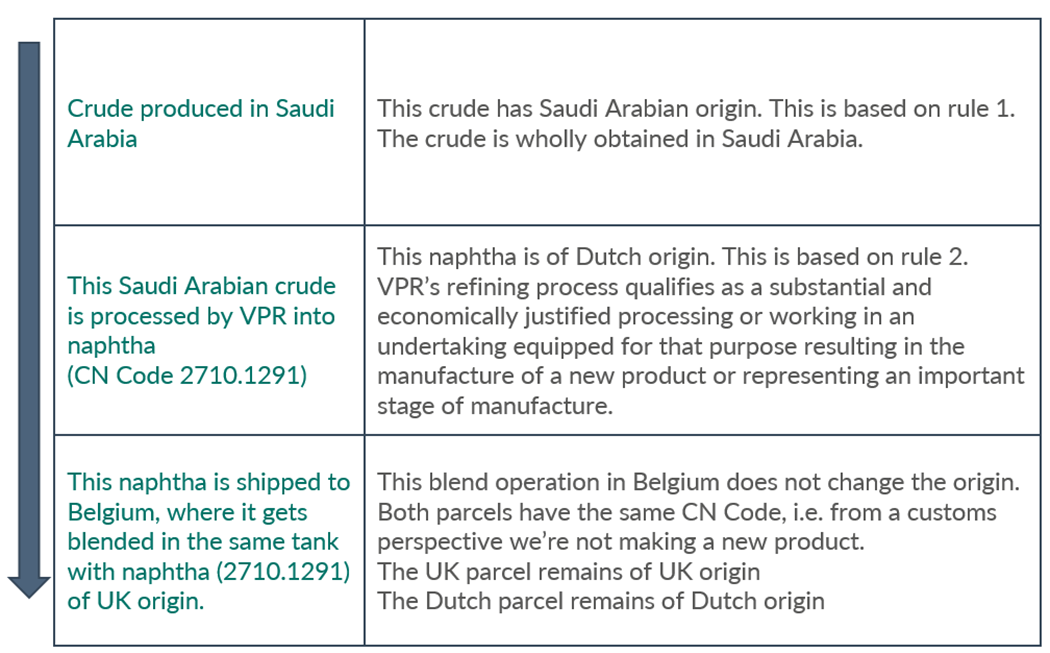
Example 2
We?re blending gasoline for export to West Africa in Amsterdam. All components have a different CN Code. The blend consists of the following components:
- Component A / Dutch origin / Value of USD 500,000 / Weight 4kt
- Component B / Norwegian origin / Value of USD 600,000 / weight 8kt
- Component C / UK origin / Value of USD 700,000 / weight 6kt
- Component D / Norwegian origin / Value of USD 200,000 / weight 1kt
-
We have two options to determine the origin of this blend
- This is an economically justified processing or working. The blend has Dutch origin as that?s the country where this activity takes place.
- This is not an economically justified working or processing. The ?majority rule? applies. Based on the weight, the major portion of the components used have Norwegian origin. The full blend is considered to be of Norwegian origin.
No Comments