Context and objective of article 177 DA UCC
Customs status: the starting point
The starting point is the distinction between Union and non-Union goods under Article 5(22)–(24) of Regulation (EU) No 952/2013 establishing the Union Customs Code (“UCC”). Article 5(23) defines the categories of goods qualifying as Union goods, including imported goods released for free circulation and goods obtained or produced in the Union exclusively from the Union-status goods specified in that provision. Goods falling outside those categories are non-Union goods under Article 5(24). Accordingly, where mixing Union and non-Union goods produces a resulting product incorporating non-Union material that has not been released for free circulation, that product does not qualify as Union goods merely because some of its constituent material had Union status. Subject to any applicable special arrangements, the resulting product is non-Union goods. UCC, Article 5

Common storage and accounting segregation
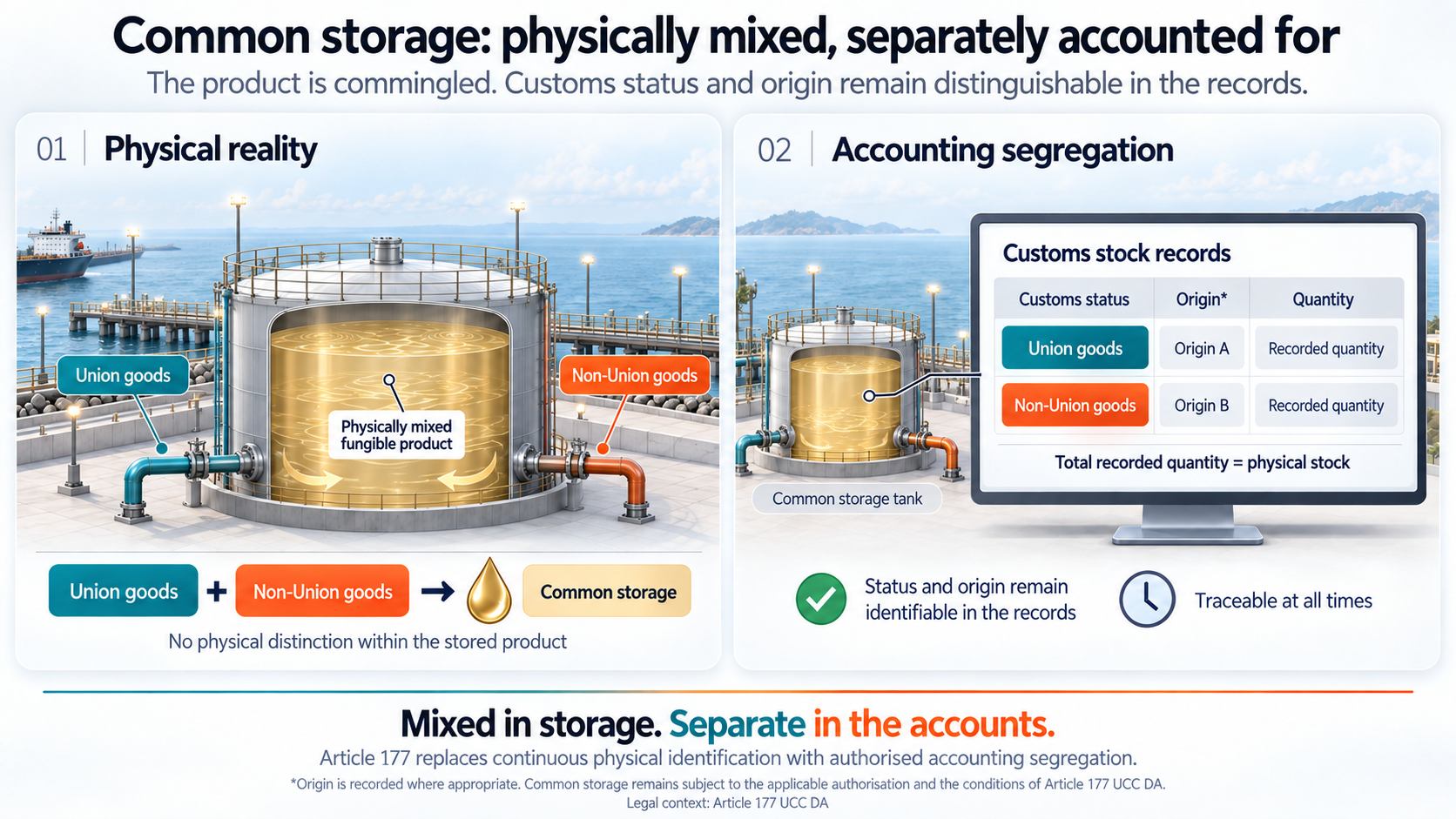
Article 177 of Commission Delegated Regulation (EU) 2015/2446 (“UCC DA”) establishes a specific framework for common storage of Union and non-Union goods in customs warehousing facilities. Where it is impossible, or possible only at disproportionate cost, to identify each type of goods at all times, the customs warehousing authorisation must require accounting segregation by type of goods, customs status and, where appropriate, origin. The provision thus permits accounting segregation to replace individual physical identification, subject to the applicable conditions. UCC DA, Article 177, as replaced by Regulation (EU) 2020/877
The purpose of this arrangement is to facilitate bulk storage without eliminating the legal distinction between Union and non-Union quantities. Article 237(3) UCC expressly provides that Union goods authorised to be stored in a customs warehousing facility are not regarded as being under the customs warehousing procedure. Consistently with that distinction, the Dutch Customs Handbook explains that the records for common storage must establish the quantities having Union and non-Union status. Authorised common storage should therefore not be characterised as an arrangement under which the entire stock necessarily becomes non-Union goods upon commingling. UCC, Article 237(3) Dutch Customs Handbook, sections 6.1–6.4
The broader wording applicable from 1 May 2016
Before the UCC framework became applicable on 1 May 2016, Article 534(2) of Regulation (EEC) No 2454/93 expressly required goods placed in common storage to share the same eight-digit Combined Nomenclature (“CN”) code, commercial quality and technical characteristics. Those three express conditions were omitted from the original wording of Article 177 UCC DA. Although the requirement for accounting segregation remained, the new provision was therefore textually broader than its predecessor. The subsequent Commission working paper records this difference, but does not establish that the omission reflected a deliberate policy decision to permit unrestricted mixing of different products. European Commission working paper, 25 October 2017, pp. 2–4
The consequences of that omission were expressly addressed in the Commission’s working paper Common storage, accounting segregation and usual forms of handling (UHF) in Special Procedures, dated 25 October 2017. The paper noted that several requirements under the former legislation no longer appeared in Article 177, specifically the requirements concerning CN classification, commercial quality and technical characteristics. It identified a potential for misuse where Union goods were stored together with non-Union goods subject, for example, to anti-dumping duties, and proposed restoring the former safeguards. The concern was therefore not simply that goods would physically mix. Physical commingling is an ordinary feature of bulk storage. The concern was that accounting segregation could be applied to goods whose differences mattered for their customs treatment, potentially producing fraud risks or unjustified import-duty advantages. European Commission working paper, pp. 2–4
Restoration of the safeguards in 2020
Commission Delegated Regulation (EU) 2020/877 replaced Article 177 with effect from 16 July 2020. The rationale is stated expressly in recital 30:
“In order to avoid any possible misuse of those rules, the storage of Union and non-Union goods together in a storage facility for customs warehousing (common storage) should only be allowed where the goods have the same CN code, commercial quality and technical characteristics.”
Article 177(2) accordingly restored the requirement that the Union and non-Union goods share the same eight-digit CN code, commercial quality and technical characteristics. The amendment thus reinstated the principal product-identity safeguards that had appeared in the pre-UCC legislation. Regulation (EU) 2020/877, recital 30 and Articles 1(25) and 4
The replacement provision also introduced specific safeguards concerning trade-defence measures. Under Article 177(3), non-Union goods subject to the specified duties or measures at the intended time of common storage are deemed not to have the same commercial quality as the Union goods. Article 177(4) provides an exception where the Union goods to be stored with them were previously released for free circulation and the relevant duties were paid. The provision therefore does not impose an unqualified prohibition on common storage involving goods subject to trade-defence duties; its operation depends on the conditions laid down in those paragraphs. Regulation (EU) 2020/877, Article 1(25)
Interpretative significance
The legislative history supports reading Article 177 as a controlled facilitation of common storage, rather than a general authorisation to blend different products or interchange their customs status. Its purpose is to accommodate the practical realities of bulk storage while preserving, through accounting segregation, the quantities attributable to each customs status and safeguarding the customs treatment applicable to the goods concerned.
The relevant distinction is therefore between, on the one hand, a resulting product incorporating non-Union material whose status must be assessed under Article 5 UCC and, on the other hand, goods held within a valid common-storage arrangement under Article 177 UCC DA. In the latter case, physical commingling does not, by itself, require the entire stock to be treated as non-Union goods. Whether a particular operation falls within that framework depends on the applicable authorisation, the characteristics of the goods and compliance with the accounting-segregation requirements.
Conclusion: the objective of Article 177 UCC DA
Article 177 UCC DA should be understood in the context of the UCC’s objectives of facilitating legitimate trade and simplifying customs administration while safeguarding the financial interests of the Union and its Member States. Recital 10 emphasises effective administrative simplification, while recitals 11 and 15 address the protection of financial interests and the fight against fraud. Article 3 gives operative expression to this balance by requiring customs authorities to protect those financial interests while maintaining a proper balance between customs controls and the facilitation of legitimate trade. UCC, recitals 10, 11 and 15 and Article 3
The wording of Article 177(1) reflects that balance. The reference to “a disproportionate cost” expressly recognises that maintaining individual identification may be technically possible but economically unreasonable. The provision is therefore not confined to cases of absolute impossibility. The words “at all times” refer to the continuity of identification during storage, rather than merely the ability to identify goods upon receipt or withdrawal. Read together, these expressions support the conclusion that the provision accommodates storage arrangements in which continuous individual identification cannot reasonably be maintained, by requiring accounting segregation as the alternative means of distinguishing the relevant quantities by type of goods, customs status and, where appropriate, origin. Article 177(1) UCC DA, as replaced by Regulation 2020/877
This facilitation does not dispense with customs supervision or the substantive conditions governing common storage. Rather, it changes the means by which the necessary distinctions are maintained: from individual physical identification to an authorised and verifiable accounting system. The product-identity conditions and trade-defence safeguards in Article 177(2)–(4) limit the arrangement to prevent misuse, as expressly stated in recital 30 of Regulation 2020/877. The legitimate cost savings arising from common storage must therefore be distinguished from unjustified customs-duty advantages obtained through misuse of accounting segregation. Regulation 2020/877, recital 30 and Article 1(25)