Origin procedure
This document contains a description of VTTI's procedure applied at the terminals for determining, registering and applying the origin of goods.
- Scope and purpose
- Risk and responsibility
- General introduction - Origin
- 1. Non-preferential origin of incoming goods
- 2. Preferential origin of incoming goods
- 3. Non-preferential origin of product at the terminal
- 4. Outbound - Preferential origin
Scope and purpose
This Origin Procedure sets out the framework and practical steps to be followed by VTTI when recording, reviewing, determining and substantiating the origin of goods handled at its terminals.
The purpose of this procedure is to support the consistent and compliant treatment of preferential and non-preferential origin in accordance with the Customs Legislation applicable in the European Union and the applicable preferential arrangements. It provides guidance to relevant VTTI personnel on the origin information to be recorded, the checks to be performed, the circumstances in which an origin determination is required and the documentation to be retained.
This procedure applies to inbound and outbound flows of goods handled at VTTI terminals where origin information is required for customs or related commercial purposes. It covers:
- the recording and retention of non-preferential origin information for inbound parcels;
- the receipt, review and retention of proofs of origin and other relevant supporting documentation;
- the use of preferential origin when goods are released for free circulation;
- the treatment of origin where goods leave the terminal unchanged;
- the determination of preferential or non-preferential origin following processing or blending at the terminal;
- the issuance, making out or facilitation of proofs of origin;
- the escalation process where clarification or specialist support is required; and
- the documentation and record-keeping requirements supporting an origin determination or claim.
This procedure serves as a practical reference for VTTI personnel involved in registering parcels, handling origin documentation, preparing customs declarations, determining the origin of outbound goods or facilitating the issuance of origin documentation.
Risk and responsibility
Where VTTI lodges a customs declaration or issues or makes out origin documentation, VTTI bears a responsibility towards the customs authorities regarding the accuracy and completeness of the information provided and the authenticity, accuracy and validity of supporting documents submitted or used.
As VTTI is not the producer or owner of the goods and generally has limited visibility of the supply chain, production process and sourcing of the materials before they arrive at the terminal, VTTI relies on the origin information and supporting documentation provided by the customer for information relating to that stage. VTTI does, however, have visibility of the movements and operations involving the goods at the terminal, including any processing or blending performed there. Where relevant, this operational information is taken into account when determining the origin of an outbound product.
Under the contractual arrangements between VTTI and the customer, the customer is responsible for providing accurate and complete information and all supporting documentation relating to the goods and materials before their arrival at the terminal. VTTI is responsible for accurately recording the relevant movements and operations performed at the terminal and for taking that information into account when it determines or substantiates the origin of an outbound product.
VTTI will not claim preferential tariff treatment or issue, make out or facilitate a proof of preferential origin where material concerns regarding originating status or the supporting documentation remain unresolved.
General introduction - Origin
- Incoming goods phase: the phase during which the product arrives at the terminal for the first time. During this phase, VTTI relies entirely on origin information provided by the customer, as this is the only source of origin-related data available to VTTI during that phase. The information is subject to a reasonableness check before being recorded in the terminal's ERP system.
- Storage, processing and outgoing goods phase: the subsequent phase, during which the product has already been stored at the terminal, may have undergone processing activities, such as blending and may be nominated an outgoing shipment. During this phase, VTTI relies on both the origin information recorded during phase 1 and its own records of any processing activities performed while the product was under its control.
1. Non-preferential origin of incoming goods
Registration of the country of non-preferential origin of inbound parcels
When sending a nomination for an inbound shipment, the customer must indicate the non-preferential country of origin of the product. This information is required before the goods can be accepted at the terminal. VTTI does not permit the discharge of product for which the non-preferential country of origin is unknown.
When CS registers the incoming parcel in the terminal’s ERP system, the non-preferential country of origin stated in the nomination is recorded with the relevant parcel. The recorded origin remains linked to the parcel and forms part of the origin audit trail maintained in the ERP system.
Purpose and use
The non-preferential origin recorded for an inbound parcel forms part of the customs data VTTI maintains for the goods. The information enables VTTI to trace the origin information received from the customer throughout the storage period and to use it, where relevant, for customs declarations, reporting and statistical purposes, and in connection with audits or controls by the customs authorities.
The recorded inbound origin may also be relevant when goods are subsequently processed or blended at the terminal. In such cases, the origin information relating to the individual input materials is used, together with the operational and inventory data available in VTTI’s systems, to determine or substantiate the origin of the resulting outbound product.
More information on origin determination by VTTI is included in the Outbound section of this procedure.
Receipt and storage of supporting documentation
Where the customer provides supporting documentation in relation to the non-preferential origin (such as a certificate of origin or a supplier's declaration) for an incoming shipment, CS stores that document in the Document Management System (part of VTTI's ERP) with a reference to the respective parcel. CS records the relevant document data in the Cargo Documents module in ERP.
Reasonableness check
CS performs a reasonableness check on the country of origin indicated by the customer and the related supporting documentation provided.
- Whether the country of origin indicated by the customer is consistent with the other information and documentation available for the shipment. This includes, where relevant, the product information, transport documentation and any origin-related supporting documentation provided by the customer.
- Whether the supporting origin documentation appears complete, meets the applicable formal requirements and can reasonably be linked to the goods concerned.
The checklist for the reasonableness check is available here.
Follow-up and escalation
If the reasonableness check gives rise to any doubt, ambiguity or apparent error, CS will request clarification, correction or additional supporting documentation from the customer.
Where the matter cannot be resolved by CS or requires further customs expertise, CS will involve the terminal’s customs specialist. Depending on the complexity, potential financial impact or wider compliance implications of the matter, the terminal’s customs specialist may request support from CGT.
VTTI will not rely on the origin information or supporting documentation concerned for customs or compliance purposes while material concerns remain unresolved.
2. Preferential origin of incoming goods
Receipt of a nomination indicating preferential status
Purpose and use
If the MFN rate exceeds 0%, CS will assess if preferential treatment can be claimed.
Reasonableness check
To assess if preferential treatment can be claimed, CS performs a reasonableness check. As part of this check, CS assesses the following:
- Whether a free trade agreement or similar preferential arrangement applies between the European Union and the stated country or territory of origin;
- Whether the product concerned is eligible for preferential tariff treatment under the applicable trade agreement, based on its commodity code;
- Which form of proof is required under the applicable trade agreement;
- Whether the proof of origin provided meets the applicable requirements; and
- Whether the proof of origin can reasonably be linked to the goods concerned.
The reasonableness check is based on the information and documentation available to VTTI and does not constitute an independent audit of the production process, supply chain or originating status of the good.
The checklist for reviewing origin-related supporting documentation is available here.
Storage and registration in ERP
Where the proof of preferential origin provided by the customer is approved following the reasonableness check, CS stores the document in the Document Management System (part of VTTI's ERP) with a reference to the respective parcel. The data in the document that is needed in VTTI's business process is registered by CS in the Cargo Documents module in ERP.
Follow-up and escalation
Product eligible for preferential treatment is in principle directly brought into free circulation, as there is in principle no (financial) benefit in storing the product under the customs warehouse procedure.
Any doubt, ambiguity or apparent error identified during the reasonableness check is followed up with the customer. CS requests clarification, correction or additional supporting documentation as appropriate and does not rely on the proof of origin while material concerns remain unresolved.
Where the matter cannot be resolved by CS or requires further customs expertise, CS involves the terminal’s customs specialist. Depending on the complexity, potential financial impact or wider compliance implications of the matter, the terminal’s customs specialist may request support from CGT.
3. Non-preferential origin of product at the terminal
Introduction
- For customs declarations, for example on release for free circulation from the customs warehouse or on export;
- For the application of commercial policy measures such as anti-dumping duties and sanctions; and
- Where a customer requests non-preferential origin documentation.
- where the product leaves the terminal unchanged, its origin follows the origin recorded for the relevant inbound parcel(s);
- where the product has been blended or otherwise processed, its origin is established in accordance with the steps set out below.
Origin determination for goods that remained unchanged during their stay at the terminal
Before the origin information of an unchanged product is used for a customs declaration, origin document or other customs or compliance purpose, CS verifies that:
- the outbound product can be traced to the relevant inbound parcel(s); and
- no operation has taken place that may have affected its origin.
- operations limited to the storage and preservation of the product, such as circulation or heating in the tank;
- "minimal operations" listed in article 34 UCC-DA, the following of which may be relevant for VTTI's business:
- operations to ensure the preservation of products in good condition during transport and storage or operations facilitating shipment or transport of the product;
- simple operations consisting of the removal of dust, sifting, screening or washing;
- Changes of packing and the breaking-up of consignments, the simple placing in bottles, cans, flasks and all other simple packaging operations;
- Marking;
- Change of use;
- A combination of two or more of the above operations.
- "simple processes" specified in the Commission's list rules. For example, for products of Chapter 27, the following operations are regarded as simple processes not conferring origin:
- cleaning;
- decantation;
- desalination;
- water separation;
- filtering;
- colouring;
- marking;
- or any combination of the above.
Origin determination following blending or processing
From a system perspective, this is triggered as follows: When an activity at the terminal results in registration of a new parcel, the country of origin of that parcel is registered in VTTI's ERP system as "QU", meaning "countries and territories not specified". The use of "QU" reflects that no specific country of non-preferential origin has yet been established. It does not constitute an origin determination and must not be used as the country of origin in a customs declaration, origin document or other external communication.
Before the non-preferential origin is required for placing the product under a subsequent customs procedure, or for another customs or compliance purpose, the origin of the resulting product is established by CS, assisted by the customs specialist at the terminal. This assessment is conducted on the basis of the information provided by the customer in combination with the information available in VTTI's systems.
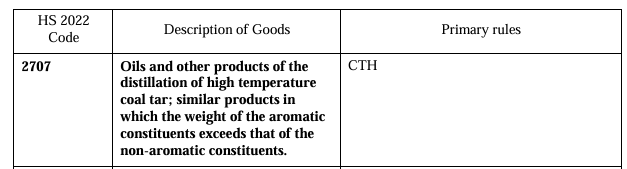
- a chemical reaction;
- atmospheric or vacuum distillation, or extraction by means of selective solvents (applicable to headings 2707, 2710 to 2713 and 2715);
- processing resulting in a change of tariff heading, where the heading rule so provides; or
- deliberate and proportionally controlled mixing or blending of materials to conform to predetermined specifications, resulting in a product with physical or chemical characteristics that are relevant to its purposes or uses and different from those of the input materials.
- Blending towards a specification. Components are blended in controlled proportions to obtain a product that meets a specification the components did not meet individually. This indicates origin-conferring blending.
- Addition to a base product. Product is added to a base product that already meets the relevant specification, for example to optimise margin, and the resulting product still meets the same specification. No new product is created, so the operation does not confer origin.
- Change of product description or CN code. A resulting product with a different product description or CN code than the major part of the components (by quantity) is a strong indication of origin-conferring blending.
- Same CN code. The fact that the components and the resulting product fall under the same CN code does not exclude origin-conferring blending, provided the resulting product has technical characteristics it did not have before blending.
Completion
- the outcome and basis of the determination, together with the relevant supporting information;
- the customer's nomination;
- the information provided by the customer on the specification and origin consequences of the blend; and
- the outcome of the reasonableness check.
Non-preferential origin documentation
At the request of a customer, VTTI can provide or facilitate non-preferential origin documentation for an outbound shipment. Two types are used:
- a Certificate of origin issued by the competent authority (in the Netherlands, the Chamber of Commerce (KVK)) at the request of the exporter. VTTI provides the information and supporting documentation required for the application;
- Terminal Origin Declaration issued by VTTI.
Before providing or facilitating either document, CS verifies that the non-preferential origin has been properly established.
A Terminal Origin Declaration:
- identifies the terminal, the outbound product, quantity and shipment;
- states that it concerns non-preferential origin determined in accordance with Articles 59 and 60 UCC, on the basis of information provided by the customer and VTTI's own records;
- states that it is not a proof of preferential origin and cannot be used to claim preferential tariff treatment;
- is signed by a person authorised to do so; and
- is never titled "statement on origin" or "certificate of origin", to avoid confusion with preferential proofs of origin and official certificates.
Any document prepared or facilitated by VTTI must be consistent with the origin information recorded in the ERP system. VTTI will not provide, facilitate or support an origin document where the non-preferential origin has not been established or material concerns remain unresolved.
A checklist that supports CS in issuing non-preferential origin documentation is included here
Follow-up and escalation
Any doubt concerning any of the following must be resolved before the origin is used for customs or compliance purposes:
- the origin of the input materials;
- the customs classification of the relevant products;
- the nature and purpose of the operations performed;
- the applicable non-preferential origin rule.
The terminal's customs specialist requests any clarification or additional information required from CS, the relevant operational personnel or the customer. In case of doubt. the customs specialist will request support from CGT.
VTTI will not use or communicate a country of non-preferential origin while material concerns regarding the determination remain unresolved.
Recording and retention
A copy of any origin document issued or facilitated, the underlying determination and the relevant supporting documentation are stored in the Document Management System and linked to the outbound parcel or shipment. CS records the relevant document data in the Cargo Documents module in ERP. Records are retained for at least seven years.
4. Outbound - Preferential origin
Introduction
Preferential origin of an outbound product becomes relevant where the customer requests a proof of preferential origin for an outbound shipment. With such a proof, the product can be imported into the country of destination at a lower (often 0%) import duty rate under a trade agreement between the EU and that country.
Before performing an assessment, CS identifies:
- the product and quantity concerned;
- the country of destination; and
- the trade agreement under which the preferential origin is to be assessed.
Whether VTTI can facilitate a proof of preferential origin depends on the destination and the trade agreement concerned. Requests are assessed case by case by the customs specialist at the terminal, who checks which proof of origin is required under the relevant trade agreement.
This section only applies where the customer requests VTTI to make out or obtain a proof of preferential origin for an outbound shipment. Where the customer makes out a proof of preferential origin itself, this falls outside the scope of this procedure. In that case, VTTI has no role in the origin assessment or the proof of origin, bears no responsibility for it and performs no checks.
Required information and documentation
It is the responsibility of the customer to provide the terminal with the supporting information and documentation to substantiate a preferential origin claim. If insufficient information is provided, VTTI will not issue or request any proof of origin. VTTI keeps a record of all supporting evidence provided by the customer.
For product originating in the EU, the supporting documentation is a supplier's declaration (SD) or a long-term supplier's declaration (LTSD). In this signed declaration, the supplier of the product confirms that the goods originate in the EU under the rules of origin of the relevant trade agreement. An LTSD covers all shipments of the product during a specified period of up to 24 months. The official template for the relevant trade agreement must be used.
Upon receipt of an SD or LTSD, CS checks:
- whether the country of origin is mentioned for each parcel;
- whether all combinations of CN code and product description that may be dispatched under the trade agreement are covered by a valid SD or LTSD. If not, CS requests the missing declaration from the customer as soon as possible;
- whether the SD or LTSD is still valid;
- whether the correct wording for the relevant trade agreement is used. This is checked upon receipt of each new or renewed declaration;
- whether the declaration is signed. The declaration must bear a handwritten signature. However, where both the declaration and the invoice are drawn up electronically, the declaration may be electronically authenticated, or the supplier may give a written undertaking accepting full responsibility for each declaration that identifies it as if it had been signed by hand.
CS stores the SD or LTSD in the Document Management System (part of VTTI's ERP) with a reference to the respective parcel(s), and records the relevant document data in the Cargo Documents module in ERP. The latest version of each declaration is always kept on file.
Goods leaving the terminal unchanged
Where the goods leave the terminal unchanged, VTTI relies on the SD or LTSD recorded for the relevant inbound parcel(s). CS verifies that the outbound goods can be traced to the relevant inbound parcel(s) and are covered by the available documentation.
A load is only eligible for a proof of preferential origin if all parcels included in the load are of preferential origin under the relevant trade agreement. For shipments to the UK under the TCA, this means that only parcels of EU or UK origin can be included. If a parcel of any other origin is included in the load, for example Norway, no proof of preferential origin can be issued, even if supporting documentation for that parcel is available.
In case of doubt, CS reaches out to the customs specialist at the terminal.
Goods blended or processed at the terminal
Where the goods have undergone blending or processing at the terminal, the preferential origin of the resulting product must be assessed under the relevant trade agreement. This assessment is based on the information provided by the customer in combination with the information available in VTTI's systems. The customs specialist at the terminal performs the assessment based on:
- the relevant product-specific origin rule included in the FTA;
- the originating status of the input materials; and
- the operations performed at the terminal.
Proof of preferential origin
Where the originating status of an outbound product has been established, the customs specialist at the terminal determines which form of proof may be used under the relevant trade agreement and whether VTTI is entitled to issue, make out or facilitate that proof.
VTTI will only issue, make out or facilitate a proof of preferential origin where:
- the originating status of the product has been established and substantiated;
- the required form of proof is permitted under the relevant trade agreement;
- the relevant formal requirements are met; and
- the proof can be linked to the relevant outbound product, quantity and shipment.
Where VTTI makes out a statement on origin, it does so in its own name, stating VTTI's REX number (Registered Exporter number). In that case, the customer provides VTTI with all supporting documentation required to prove the origin of the product upon request, for example in the event of a verification by the customs authorities.
Where a proof must be issued or endorsed by a customs authority or another competent body, VTTI may facilitate the application based on the completed origin assessment and the available supporting documentation.
Where no proof of preferential origin can be issued, for example because not all parcels in the load are of preferential origin, the customer may request a Terminal Origin Declaration. A Terminal Origin Declaration is not a proof of preferential origin and cannot be used to claim preferential tariff treatment.
Recording and retention
The origin assessment, its outcome and the supporting documentation are retained as part of the origin audit trail. Any proof of origin issued, made out or facilitated for the outbound shipment is stored in the Document Management System and linked to the relevant parcel or shipment. CS records the relevant document data in the Cargo Documents module in ERP. Records are retained for at least seven years.
Follow-up and escalation
Any doubt regarding any of the following must be resolved before preferential origin is documented:
- the relevant trade agreement;
- the originating status of the input materials;
- the applicable origin rule; or
- the required proof.
In case of doubt, CS reaches out to the customs specialist at the terminal. Where the matter is complex, has a potentially material financial or compliance impact or requires engagement with a competent authority, the customs specialist requests support from CGT.
VTTI will not issue, make out or facilitate a proof of preferential origin while material concerns regarding the originating status of the product or the supporting documentation remain unresolved.