Origin and Proof of Union status
- Understanding Origin in International Trade
- Preferential origin
- Preferential origin - Specific EU - UK TCA Procedures
- EU-UK TCA for Tariff Heading 2710 - Terminal operations
- Statement on origin
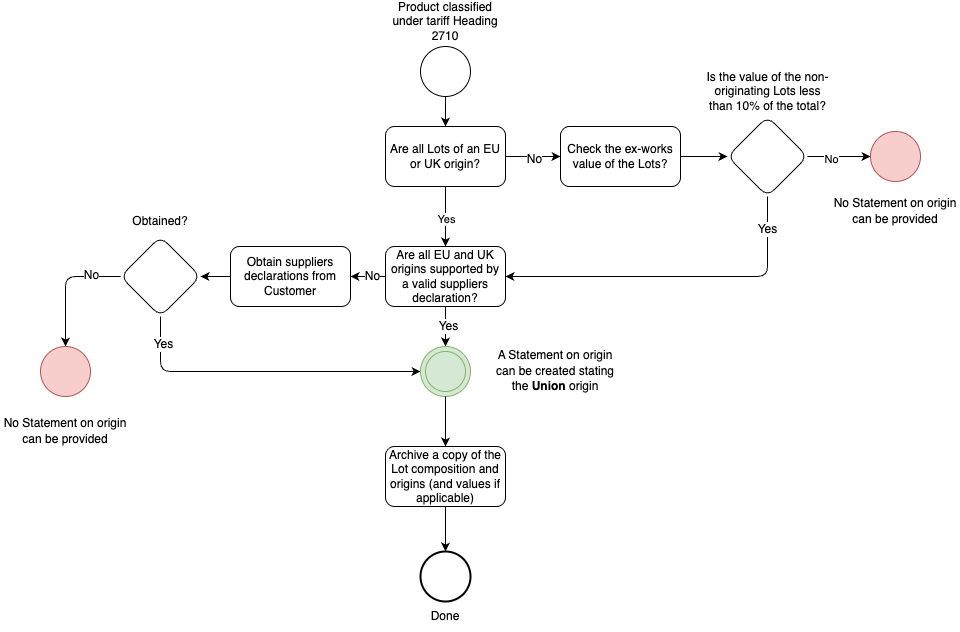
- SOP - Decision flow Preferential origin EU - UK TCA tariff Heading 2710
- Decision flow Preferential origin EU - UK TCA tariff Heading 2710
- Template preferential origin (long term) supplier declaration
- Non-Preferential origin
- General principles
- General Procedure: Determination of Non-Preferential Origin
- Case law
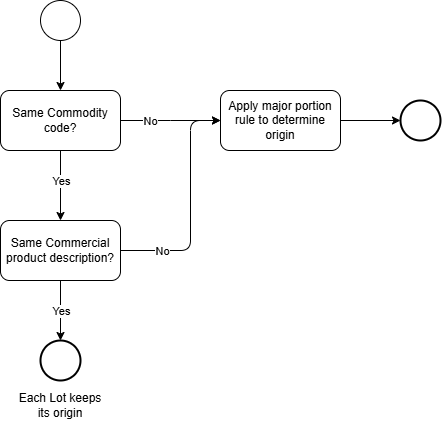
- Decision flow non-preferential origin
- Template non-preferential origin (long term) supplier declaration
- Verification of Supplier's Declaration - Non-Preferential Origin
- Issue ITR Declaration of Origin
- Work instruction (commercial incentive)
- Work instruction (simplified process)
- Proof of Union status
Understanding Origin in International Trade
Introduction
1 Definition and Importance of Origin
In international trade, the term origin refers to the economic nationality of a product — that is, the country where it was produced or underwent its last substantial transformation. Determining a product’s origin is fundamental to the application of customs duties, trade policy measures, import and export documentation, and statistical reporting.
The rules governing origin ensure that the benefits or restrictions applied to goods (such as duty preferences, quotas, or trade defence measures) are correctly attributed to the appropriate country.
Origin is therefore a cornerstone of fair and transparent trade, preventing circumvention of customs rules and ensuring the proper functioning of trade agreements.
2 Types of Origin
There are two principal types of origin used in international trade:
-
Non-Preferential Origin, and
-
Preferential Origin.
Although both determine a product’s economic nationality, they serve different purposes and are based on distinct legal frameworks.
2.1 Non-Preferential Origin
Non-preferential origin is used for the application of general trade policy measures that are not linked to preferential tariff treatment.
It determines a product’s “normal” origin under the World Trade Organization (WTO) framework and the Union Customs Code (UCC).
Non-preferential origin is relevant for:
-
The application of Most Favoured Nation (MFN) customs duties;
-
Trade defence measures such as anti-dumping or countervailing duties;
-
Quantitative restrictions, embargoes, and import/export licensing;
-
Marking of origin (“Made in …”) and statistical purposes.
The rules for determining non-preferential origin generally depend on:
-
Whether the goods are wholly obtained in one country (e.g. minerals extracted, agricultural products harvested); or
-
Where more than one country is involved, the country where the product underwent its last substantial transformation, defined by a change in tariff classification, value added, or specific processing.
2.2 Preferential Origin
Preferential origin, on the other hand, applies specifically in the context of preferential trade agreements (PTAs), free trade agreements (FTAs), or unilateral preference schemes such as the EU’s Generalised Scheme of Preferences (GSP).
Its primary purpose is to determine whether a product qualifies for reduced or zero customs duties when traded between countries that have concluded such agreements.
To benefit from preferential treatment, goods must meet the rules of origin set out in the specific agreement. These rules ensure that only products genuinely produced or substantially transformed within the territories of the contracting parties receive preferential tariff benefits.
Typical preferential origin requirements include:
-
Being wholly obtained in one of the partner countries (e.g., natural products); or
-
Being sufficiently worked or processed according to the Product-Specific Rules (PSR) detailed in the agreement (e.g., change in tariff heading, maximum non-originating material content, or specific manufacturing process).
3. Key Distinction Between Preferential and Non-Preferential Origin
| |||||||||||||||||||||
4. The Role of Origin in Compliance
Understanding the distinction between preferential and non-preferential origin is essential for customs compliance and duty optimisation.
Exporters and importers must apply the correct origin determination method depending on the trade context:
-
If goods are exported under an FTA, the preferential origin rules are applied;
-
If goods are traded outside such an agreement, non-preferential origin applies.
Incorrect origin declaration can result in:
-
Denial of preferential duty benefits;
-
Recovery of duties with interest;
-
Administrative penalties or reputational risk.
Establishing clear procedures and robust documentation controls is therefore vital to ensure the accuracy, traceability, and defensibility of all origin claims.
Preferential origin
Preferential origin refers to the economic nationality of a product as determined under the terms of a preferential trade agreement (PTA) between two or more countries. It establishes whether a product qualifies for preferential (reduced or zero) customs duties upon importation into a partner country.
Unlike non-preferential origin, which determines general origin for trade statistics or labelling, preferential origin is specifically used to access preferential tariff treatment under free trade agreements (FTAs), association agreements, or economic partnership agreements.
General principles
Introduction and Context
1 Meaning of Preferential Origin
Preferential origin refers to the economic nationality of a product as determined under the terms of a preferential trade agreement between two or more countries. It establishes whether a product qualifies for preferential (reduced or zero) customs duties upon importation into a partner country.
Unlike non-preferential origin, which determines general origin for trade statistics or labelling, preferential origin is specifically used to access preferential tariff treatment under free trade agreements (FTAs), association agreements, or economic partnership agreements.
To obtain preferential origin, a product must either:
-
Be wholly obtained in one of the partner countries; or
-
Be sufficiently worked or processed according to the Product-Specific Rules (PSR) set out in the agreement.
The rules ensure that only goods genuinely produced within the parties' economies benefit from preferential tariff treatment.
2 Direct Transport Requirement
Under most FTAs, goods claiming preferential origin must be transported directly between the territories of the contracting parties (e.g. from the EU to the UK, or vice versa) to qualify for preferential treatment. This rule ensures that the goods are not altered, substituted, or traded through third countries in a way that could compromise their originating status. Temporary storage, transshipment, or splitting of consignments in a third country is generally permitted only if the goods remain under customs supervision and do not undergo any operation other than unloading, reloading, or other actions necessary to preserve their condition.
To substantiate compliance, traders must be able to provide documentary evidence demonstrating the continuity and integrity of transport. Typical proofs include:
-
Transport documents such as bills of lading, airway bills, or CMR consignment notes showing the direct routing between the two FTA territories;
-
Through bills of lading covering the entire route;
-
Customs control certificates or warehouse records proving the goods remained under customs supervision when transiting through a third country;
-
In some cases, a commercial invoice or shipping company statement confirming that no alteration occurred during transit.
Maintaining these documents is essential to uphold preferential origin claims during customs verification.
3 Purpose of Preferential Origin Procedures
The purpose of establishing and verifying preferential origin is to:
-
Ensure correct application of preferential duty rates;
-
Prevent abuse of trade preferences through simple transshipment or minor processing;
-
Guarantee fair competition between partner countries;
-
Provide customs authorities with a verifiable framework for origin determination;
-
Enable exporters and importers to confidently claim tariff preferences.
4 Legal Basis
For the European Union, preferential origin is governed by:
-
The individual trade agreements concluded by the EU (e.g. the EU–UK TCA, a full list of a list can be accessed here);
-
Articles 60–68 of the Union Customs Code (Regulation (EU) No 952/2013);
-
Relevant implementing and delegated acts.
General Procedure: Determination of Preferential Origin
Step 1 - Identify Applicable Agreement
Determine whether a preferential trade agreement exists between the exporting and importing countries.
If such an agreement exists, it provides the basis for preferential tariff treatment.
Step 2 - Determine Tariff Classification
Identify the product's tariff classification at the HS 6- or 8-digit level. The tariff heading determines which Product-Specific Rule (PSR) applies.
Step 3 - Consult the Product-Specific Rule (PSR)
Locate the relevant PSR in the annex to the applicable agreement. Typical PSR formats include:
-
Wholly obtained requirement;
-
Change in Tariff Heading (CTH);
-
Value limitation rule (maximum % of non-originating materials);
-
Specific manufacturing process.
Step 4 - Identify and Value Materials
-
List all originating and non-originating materials used in production.
-
Calculate the ex-works price of the final product.
-
Apply the PSR to verify compliance.
Step 5 - Apply Cumulation (if permitted)
Cumulation allows originating materials or processing from another partner country to count as originating.
-
Bilateral cumulation: between the two agreement partners.
-
Diagonal or full cumulation: only if explicitly allowed (e.g. not in the EU-UK TCA).
Step 6 - Verify Beyond Minimal Operations
Check that the processing carried out exceeds the - minimal operations - defined in the agreement (e.g., simple packaging, mixing, or labelling do not confer origin).
Step 7 - Prepare Proof of Origin
The type of origin document depends on the agreement:
-
Statement on Origin (self-certification); or
-
Movement Certificate (EUR.1) where applicable.
Step 8 - Record-Keeping and Evidence
Maintain all origin-related documents for at least 3-5 years:
-
Supplier declarations;
-
Cost breakdowns;
-
Production records;
-
Tariff classification evidence.
Step 9 - Verification by Customs
Case law
|
Preferential origin - Specific EU - UK TCA Procedures
Here various procedures are listed describing the rules of origin as specified in the specific Preferential trade agreements between the exporting and importing countries, providing the basis for preferential tariff treatment.
EU-UK TCA for Tariff Heading 2710 - Terminal operations
1. Purpose and Scope
This procedure outlines how to determine and maintain preferential origin status for petroleum products classified under tariff heading 2710 that are stored, handled, or blended in the EU or the UK under the EU-UK Trade and Cooperation Agreement (TCA).
Tariff Heading 2710 covers:
Petroleum oils and oils obtained from bituminous minerals (other than crude); preparations not elsewhere specified or included, containing by weight 70% or more of petroleum oils or of oils obtained from bituminous minerals.
It applies to all facilities and operators engaged in:
Storage and distribution of petroleum products of EU or UK origin;
Occasional blending or addition of non-originating material (e.g. additives, stock adjustments);
Origin tracking using accounting segregation methods.
The aim is to ensure that stored goods maintain or correctly lose their preferential origin status in compliance with the TCA.
2. Legal Framework
EU-UK Trade and Cooperation Agreement (TCA): Title I, Rules of Origin (Part Two, Heading One, Chapter 2).
Annex ORIG-2: Product-Specific Rules (PSR) for HS 2710.
Article ORIG.14:Accounting segregation.
Article ORIG.12:Tolerances for non-originating materials.
Article ORIG.7:Insufficient working or processing operations.
3. Product-Specific Rule (PSR) - HS 2710
"Manufacture from materials of any heading, except that of the product, provided that the value of all non-originating materials used does not exceed 40% of the ex-works price of the product."
Non-originating materials under the same heading (2710) may not be used.
Materials classified under other headings (e.g. 2709 crude petroleum) may be used, provided the value of all non-originating inputs does not exceed 40% of the ex-works price.
The product must undergo a Change in Tariff Heading (CTH) as part of the transformation.
For storage and distribution activities, this PSR is relevant primarily for verifying that minor additions of non-originating material do not exceed permissible thresholds and that the overall product maintains its preferential origin.
4. Cumulation
The EU-UK TCA allows bilateral cumulation only.
Materials originating in the UK are treated as originating in the EU and vice versa.
Inputs from third countries cannot be cumulated.
5. Key Operational Principles
5.1 Storage Does Not Alter Origin
-
Merely storing, transferring, or handling originating goods does not affect their preferential origin status, provided:
-
The goods remain identifiable, and
-
No operations are performed that would constitute insufficient working or processing under Article ORIG.7.
-
5.2 Insufficient Operations
Origin is not maintained if operations performed are limited to:
-
Simple blending of oils;
-
Simple mixing, dilution, or packaging;
-
Any process that does not result in a change in tariff heading or essential character.
However, for companies managing mixed stocks of originating and non-originating petroleum products, accounting segregation (Article ORIG.14) may be applied to maintain compliance without physically separating each batch.
5.3 Sufficient Working or Processing
Processing that qualifies:
Refining crude petroleum (heading 2709) into petroleum products (heading 2710);
Chemical transformation changing the essential character of the product.
Processing that does not qualify (as per Article ORIG.7):
Simple mixing of products;
Simple dilution;
Simple packaging or relabelling;
Any process that does not alter the tariff classification or essential character.
5.3.1 Origin Verification Process Manufacturing
Classify the product under CN 2710.
List all inputs with tariff headings and origin status.
Calculate the ex-works price of the finished product.
Determine total value of non-originating inputs.
If ≤ 40% of ex-works price = condition satisfied.
Ensure that no non-originating material of heading 2710 is used.
Confirm that the transformation changes the tariff heading (CTH achieved).
If all criteria are met, the product acquires EU or UK originating status.
6. Accounting Segregation (Article ORIG.14 TCA)
6.1 Principle
Accounting segregation allows an operator to manage originating and non-originating materials or products in a single inventory where physical segregation is impractical.
This method may be used only if the records and control systems ensure that:
-
The quantities of originating and non-originating goods are accurately accounted for;
-
No more originating goods are deemed to be exported than those that would result from physical segregation.
6.2 Implementation Steps
-
Approval
-
Accounting segregation may be applied only if the operator has an approved origin accounting system validated by internal customs or compliance management.
-
-
Inventory System Requirements
-
The system must record:
-
Opening stock balance by origin category (EU, UK, non-originating);
-
Receipts (by origin and quantity);
-
Dispatches (with declared origin and supporting documentation).
-
-
The system must allow traceability from incoming to outgoing quantities.
-
-
Calculation Basis
-
The ratio of originating to non-originating goods in storage determines the share of outgoing goods that may be considered originating.
-
Example:
-
Stock: 90% originating + 10% non-originating.
-
A dispatch of 1,000 tonnes may be declared as originating up to 900 tonnes.
-
-
-
Documentation
-
Each origin batch movement must be supported by supplier declarations, statements on origin, or other valid proof.
-
Periodic stock reconciliation must confirm that cumulative declarations do not exceed available originating stock.
-
-
Retention
-
Records must be kept for a minimum of three years and made available upon customs request.
-
7. Incorporation of Non-Originating Material - 10% Value Tolerance
7.1 Legal Basis
Article ORIG.12 of the EU-UK TCA permits a tolerance of up to 10% of the ex-works price for non-originating materials used, even where the PSR would otherwise prohibit such use.
This tolerance cannot be used to exceed the maximum non-originating material limit (40%) specified in the PSR.
7.2 Application to HS 2710 (Storage Context)
In storage operations where non-originating material (e.g. additive or stabiliser) is added to otherwise originating petroleum products:
-
The value of the non-originating addition must not exceed 10% of the ex-works price of the final blended product.
-
The blended product may still be regarded as originating, provided:
-
The total non-originating material (including the addition) does not exceed 40% of the ex-works price; and
-
The blending does not fall within insufficient operations (i.e., must have a legitimate commercial purpose and not merely be a simple mix).
-
7.3 Calculation Example
-
Ex-works price of blended product: USD 1,000 per tonne
-
Non-originating additive: USD 80 per tonne (8%)
-
Total non-originating materials: 8% (<10%)
= Product retains preferential origin under the 10% tolerance rule.
If the addition exceeds 10%, or if total non-originating input surpasses 40%, the final product loses preferential origin.
8. Operational Procedure
|
9. Verification and Customs Control
-
Customs authorities may verify origin claims by reviewing:
-
Stock and accounting segregation records;
-
Value calculations for non-originating additions;
-
Supplier origin documentation and statements;
-
Outgoing origin declarations.
-
-
Non-compliance may result in loss of preferential treatment and retroactive duty recovery.
10. Summary Table - Storage Context (HS 2710)
|
11. Conclusion
In storage operations under the EU-UK TCA, the preferential origin of petroleum products (heading 2710) can be maintained provided that:
-
Goods are handled under accounting segregation systems ensuring traceable origin management;
-
Any addition of non-originating materials does not exceed 10% of the ex-works value, and total non-originating input remains within the 40% PSR limit;
-
No operations constitute insufficient working or processing under Article ORIG.7.
By applying these controls, operators can confidently issue Statements on Origin while maintaining full compliance with the TCA's preferential origin framework.
Statement on origin
To be printed on an invoice or commercial document containing information on the goods concerned

SOP - Decision flow Preferential origin EU - UK TCA tariff Heading 2710
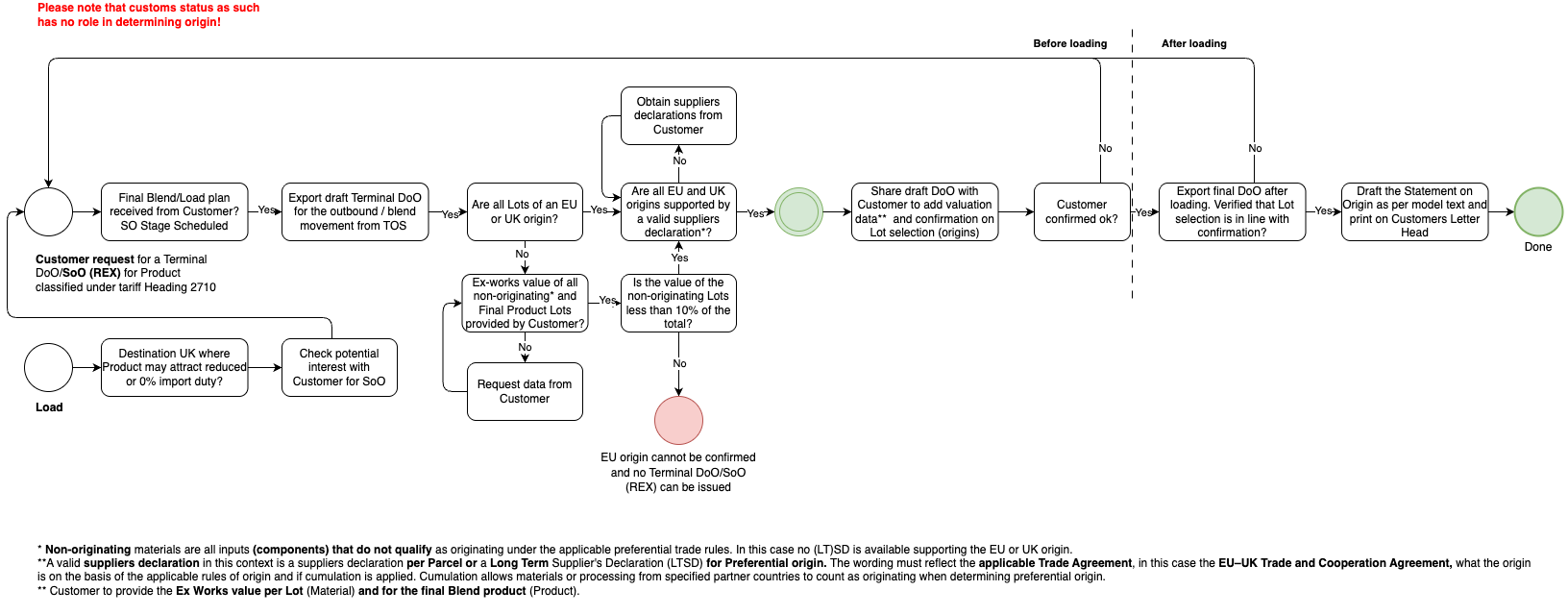
Decision flow Preferential origin EU - UK TCA tariff Heading 2710
Template preferential origin (long term) supplier declaration
[TO BE PRINTED ON COMPANY LETTERHEAD]
SUPPLIER'S DECLARATION
I, the undersigned, declare that the goods listed on this document …………………………….……………….(1), originate in ……………………………….(2) and satisfy the rules of origin governing preferential trade with ……………………………………………(3).
I declare that (4):
 Cumulation applied with
…………………………………(name country/countries)
Cumulation applied with
…………………………………(name country/countries)
 No cumulation applied
I undertake to make available to the customs authorities any further supporting documents they require.
……………………………………………………………………….…. (5)
………………………………………………………………………….. (6)
Footnotes (can be removed after completion)
(1) If only some of the goods listed on the document are concerned, they shall be clearly indicated or marked and this marking entered in the declaration as follows:
“………………..…listed on this document and marked …………………..….originate in ………………….…
(2) The European Union, country, group of countries or territory, from which the goods originate
(3) Country, group of countries or territory concerned
(4) To be completed, where necessary, only for goods having preferential origin status in the context of preferential trade relations with one of the countries with which pan-Euro-Mediterranean cumulation of origin is applicable.
(5) Place and date of issue
(6) Name and position of the undersigned, name and address of company
(7) Signature
LONG-TERM SUPPLIER'S DECLARATION
I, the undersigned, declare that the goods described below:
…………………………………………………………………….(1)
…………………………………………………………………….(2)
Which are regularly supplied to ………………………………….(3), originate in ……………………………….(4) and satisfy the rules of origin governing preferential trade with ……………………………………………(5).
I declare that (6):
 Cumulation applied with
…………………………………(name country/countries)
Cumulation applied with
…………………………………(name country/countries)
 No cumulation applied
This declaration is valid for all shipments of these products dispatched from ......................................... to
...............................(7)
I undertake to inform ............................................(3) immediately if this declaration is no longer valid.
I undertake to make available to the customs authorities any further supporting documents they require.
……………………………………………………………………….…. (8)
………………………………………………………………………….. (9)
Footnotes (can be removed after completion)
Footnotes (can be removed after completion)
(1) Description
(2) Commercial designation as used on the invoices e.g. Model No
(3) Name of the company to which goods are supplied
(4) The European Union, country, group of countries or territory, from which the goods originate
(5) Country, group of countries or territory concerned
(6) To be completed, where necessary, only for goods having preferential origin status in the context of preferential trade relations with one of the countries with which pan-Euro-Mediterranean cumulation of origin is applicable.
(7) Give the start and end dates. The period shall not exceed 24 months.
(8) Place and date of issue
(9) Name and position of the undersigned, name and address of company
Non-Preferential origin
It determines a product's "normal" origin under the World Trade Organization (WTO) framework and the Union Customs Code (UCC).
General principles
Introduction and Context
1. Meaning of non-preferential origin
Non-preferential origin determines the economic nationality of a product for general customs purposes within the EU. It establishes which country a product is considered to originate from when imported or exported, independently of any preferential trade agreements.
Unlike preferential origin, which is used to access reduced or zero tariff rates under free trade or economic partnership agreements, non-preferential origin is used primarily to:
-
Determine applicable customs duties under the EU Common Customs Tariff;
-
Enforce trade remedies (e.g., anti-dumping, countervailing duties, safeguards);
-
Comply with labelling, marking, or origin-statistics requirements;
-
Support customs control and enforcement of EU trade law.
To establish non-preferential origin, a product must either:
-
Be wholly obtained in one country (e.g., minerals, agricultural products, animals raised, or goods extracted/harvested); or
-
Have undergone substantial, economically justified processing or working in a country that results in a change in tariff classification, physical or chemical properties, or composition, thereby constituting a “substantial transformation.”
These rules ensure that origin determinations reflect the true country of production, prevent circumvention of EU trade rules, and provide legal certainty for customs authorities and economic operators.
2. Purpose of Non-Preferential Origin Procedures
The purpose of establishing and verifying non-preferential origin is to:
-
Ensure accurate application of the EU Common Customs Tariff;
-
Prevent circumvention of customs duties through minimal processing, transshipment, or mislabelling;
-
Support fair competition in the EU market;
-
Provide customs authorities with a verifiable and auditable framework for determining origin;
-
Enable importers and exporters to accurately declare the origin of goods for compliance, enforcement, and trade statistics;
-
Facilitate the application of trade defense measures (anti-dumping, countervailing duties, safeguards) when appropriate.
3. Legal Basis
For the European Union, non-preferential origin is governed by:
-
Articles 148–152 of the Union Customs Code (Regulation (EU) No 952/2013);
-
Delegated and Implementing Acts supplementing the UCC, including Annex 22‑01 and related product-specific rules for non-preferential origin;
-
Customs procedures and national regulations implementing the UCC in Member States;
-
CJEU case law interpreting substantial transformation, minimal operations, and primary rules (e.g., C‑86/24 CS STEEL, C-589/17 Prenatal S.A., C-297/23 Harley-Davidson Europe).
General Procedure: Determination of Non-Preferential Origin
Step 1 - Classify the Goods
Determine the correct HS/CN code of the final product.
Check whether the product is listed in Annex 22‑01 (or other EU codified rules).
Step 2 - Check if Goods Are Wholly Obtained
Confirm extraction, production, or manufacture occurred entirely in one country.
If yes → assign origin to that country; no further steps required.
Step 3 - Identify All Countries of Production/Processing
List all countries involved in the supply chain (raw materials, intermediate products, semi-finished goods).
Step 4 - Assess Substantial Transformation
For each processing step, determine:
Nature of operation (chemical change, assembly, finishing)
Economic justification (not solely for tariff avoidance)
Resulting change (new HS heading, change in physical or chemical properties).
Step 5 - Apply Codified List Rules (if applicable)
Check Annex 22‑01 or equivalent for the HS code.
Verify whether the last operation qualifies as “substantial transformation” under the codified rule.
Step 6 - Apply Residual Rule (if no codified rule applies)
Determine the last economically justified processing or use majority material/value rule to assign origin.
Step 7 - Document All Steps
Record:
-
Input materials, their origin, and HS classification
-
Production steps and locations
-
Processing dates and invoices
-
Evidence of substantial transformation (technical specs, change of properties, quality tests).
-
Step 8 - Declare Origin in Customs Procedure
Include origin in import declaration for free circulation.
Attach supporting documents as requested.
Step 9 - Maintain Records for Audit & Post-Clearance
Retain all documentation for the statutory period (usually 3–5 years).
Be prepared for customs inspection or administrative review.
Case law
|
Decision flow non-preferential origin
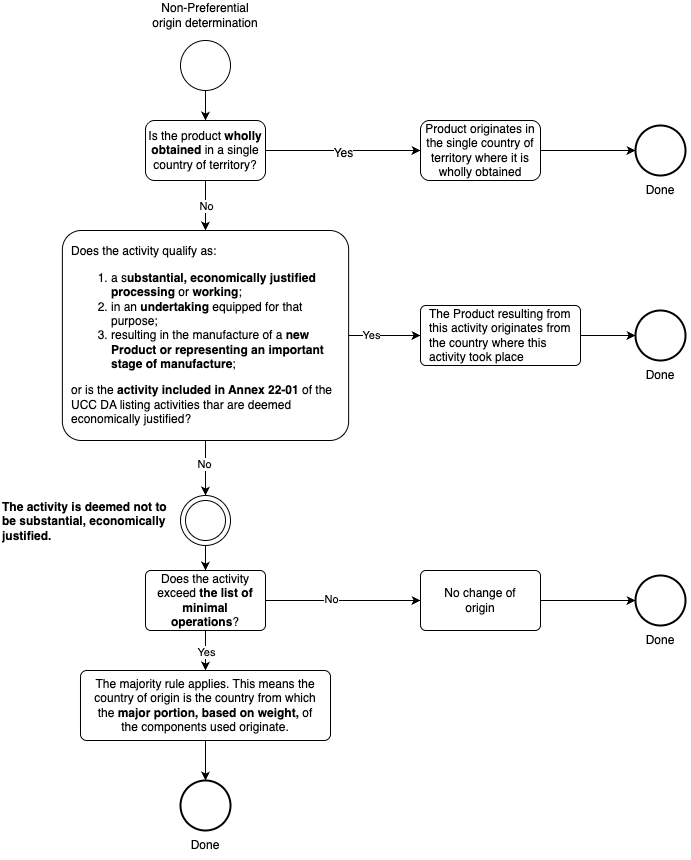
Template non-preferential origin (long term) supplier declaration
Suppliers declaration for products of non-preferential origin - Single use
I, the undersigned, declare that the goods listed on this invoice (1) were produced (2).
I undertake to make available to the Chamber of Commerce any further supporting documents they require.
Place and date:
Name and position:
Signature:
- It should be used within the European Union only.
- This declaration is to be placed on the invoice, packing list or other trade document in which the goods are sufficiently specified. This declaration can also be placed on the supplier’s company letter paper. In that case please refer to the
invoice number.
(1) State the number of the invoice or other document in which the shipment is sufficiently specified. The number needs not to be mentioned if the statement is placed on the invoice.
- When instead of the invoice another document or an annex to the invoice is being used, the kind of document concerned shall be mentioned instead of the word ‘invoice’.
- When the statement concerns only part of the goods listed on the invoice, these should be clearly indicated or marked. Furthermore, this marking should be indicated on the declaration as follows: ‘... listed on this invoice and
marked .................... were produced in .................... and...’
(2) State just the applicable option. If products are delivered of EU origin together with products of non-EU origin, various supplier’s declarations should be issued.
(3) State the country of origin (member state of the European Union); if various goods are of different origins, these origins shall be mentioned to each item.
(4) According to Regulation (EU) 952/2013 art. 61 sub 3. (PB L 269 of 10.10.2013).
(5) State the country of origin; if various goods are of different origins, these origins shall be mentioned to each item.
Verification of this declaration by means of a certificate of origin, issued by the supplier’s regional Chamber of Commerce, may be required by the buyer’s regional Chamber of Commerce.
This declaration is not valid for goods having preferential origin status and which qualify for movement certificates EUR.1, EUR-MED or invoice declaration. For such use the “declaration for products having preferential origin status”according to Regulation (EU) 2015/2447 Annex 22-15 (PB L 343 of 29.12.2015) is applicable.
Suppliers declaration for products of non-preferential origin - Regular use
Long-term suppliers declaration for products of non-preferential origin
I, the undersigned, declare that the goods described below (1)(2)
are produced (4)
⃞ in the European Union, namely in according to the Union Customs Code art. 61 sub 3. (6)
⃞ outside the European Union and originate in (5), and satisfy the rules of origin(7).
This declaration is valid for all shipments of these products dispatched from ______ to ________(8).
I undertake to inform ___________(3) immediately if this declaration is no longer valid.
I undertake to make available to the Chamber of Commerce any further supporting documents they require.
Place and date:
Name and position:
Name and address of the company:
Signature:
- This declaration is to be placed on the supplier’s letter paper.
- The LSO should only be used within the European Union.
Notes for completion of the declaration:
(1) Description of the goods.
(2) Trade description as used on invoices, e.g. model No.
(3) Name of buyer.
(4) State just the applicable option. If products are delivered of EU origin together with products of non-EU origin, various suppliers declarations should be issued.
(5) State the country of origin (member state of the European Union); if various goods are of different origins, these origins shall be mentioned to each item.
(6) According to Regulation (EU) 952/2013 art. 61 sub 3. (PB L 269 of 10.10.2013).
This declaration is not valid for goods having preferential origin status and which qualify for movement certificates EUR.1, EUR-MED or invoice declarations. For such use the “declaration for products having preferential origin status” according to Regulation (EC) 2015/2447, art. 62, annex 22-16 (PB L 343 of 29.12.2015) is applicable.
Verification of Supplier's Declaration - Non-Preferential Origin
Purpose
To ensure that supplier declarations claiming non-preferential origin are accurate, legally compliant, and auditable for EU customs purposes.
Step 1: Collect the Supplier Declaration
-
Obtain a completed supplier declaration for all goods, including:
-
Product description and Commodity code.
-
Country of origin.
-
Basis of origin (wholly obtained or substantially transformed).
-
Signature, company details, and date.
-
-
Ensure the declaration is dated, legible, and signed by an authorized representative.
Step 2: Verify Supplier Credentials
-
Confirm the supplier is legitimate and traceable.
-
Check:
-
Legal registration of the supplier.
-
Manufacturing locations.
-
Historical compliance with customs documentation.
-
Step 3: Check Completeness of the Declaration
-
Ensure all required fields are completed:
-
Product description matches your purchase.
-
Commodity code matches the EU customs classification.
-
Country of origin is stated.
-
Basis of origin (wholly obtained/substantial transformation) is clear.
-
Declaration is signed and dated.
-
Step 4: Validate Basis of Origin
-
For wholly obtained goods:
-
Confirm that all production, extraction, or harvest occurred in the stated country.
-
Request supporting documentation if necessary (e.g., harvest records, production logs).
-
-
For substantially transformed goods:
-
Confirm that processing in the stated country was economically justified and resulted in a substantial transformation:
-
Check change in tariff classification (Commodity code).
-
Check change in physical/chemical properties or composition.
-
Ensure processing was more than minimal operations (not just cleaning, packaging, sorting).
-
-
Step 5: Check Supporting Evidence
-
Review:
-
Invoices for raw materials.
-
Production or processing logs.
-
Bills of lading.
-
Quality certificates or process descriptions.
-
-
Ensure consistency between documentation and the declaration.
Step 6: Cross-Check Against Legal Requirements
-
Verify compliance with:
-
UCC Articles 148-152 (non-preferential origin rules).
-
Delegated / Implementing Acts (Annex 22-01, list of primary rules, minimal operations).
-
-
Ensure the declared origin aligns with EU customs rules and relevant CJEU case law (e.g., C-86/24 CS STEEL).
Step 7: Approve or Request Clarification
-
If all criteria are satisfied:
-
Approve the declaration for use in customs procedures.
-
-
If inconsistencies are found:
-
Contact supplier to provide additional information or correct the declaration.
-
-
Keep all correspondence for audit purposes.
Step 8: Record Retention
-
Retain the supplier declaration and all supporting documents for at least 3-5 years (EU standard for customs audits).
-
Store in a retrievable format (electronic or paper) linked to the relevant shipment.
Step 9: Periodic Review
-
Review supplier declarations periodically (at least annually) to:
-
Confirm consistency with current supply chains.
-
Ensure compliance with updates to UCC or Delegated Regulations.
-
Flag changes in production location or processing steps that may affect origin.
-
This procedure ensures that your non-preferential origin declarations are reliable, auditable, and legally defensible in case of customs verification or post-clearance checks.
Issue ITR Declaration of Origin
The declaration of origin (DoO) report is produced from the terminal operating system and provides an overview of the breakdown of the components and administrative lots that were included in the blending operations. Origin determination is based on the DoO.

Work instruction (commercial incentive)
In practice, there are two types of documents that refer to non-preferential origin:
An official Certificate of Origin (CoO), which exporters can obtain by applying to the competent Chamber of Commerce or the relevant customs authorities; and
A commercial document declaring the non-preferential origin (Terminal Origin Declaration).
Upon request, our terminal can assist with the application for the relevant certificate or document via a broker authorised to apply for an official CoO (digital connection required). When applying with the Chamber of Commerce the burden of proof is greater than when issuing a Terminal Origin Declaration, because the latter is not an official document and it is the discretion of the Terminal to conclude on origin and the proof that is provided. For example, when documentation is provided that the Product comes from a refinery in Italy the Terminal may be inclined to accept this as sufficient proof, where the Chamber of Commerce is likely to require a Suppliers declaration for non-Preferential origin. Apart from whether or not the proof of origin for the components is sufficient or not, the procedure in determining the origin should be the same with the terminal itself and the Chamber.
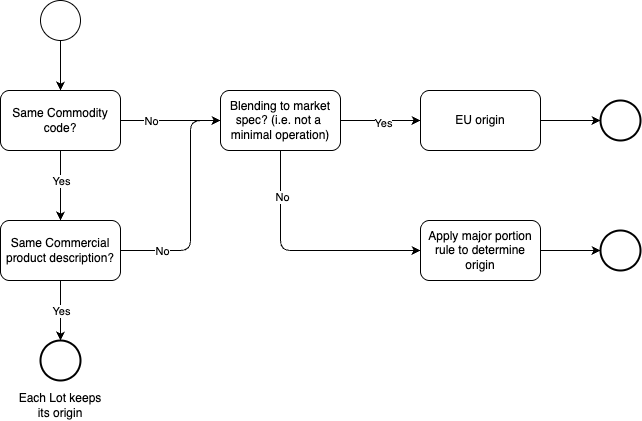
As this involves blending rather than mere storage, the major portion rule applies, provided that customers inform us of the origin and substantiate it with appropriate documentation. This requirement applies at least to the parcel representing the major portion based on weight. The origin of the remaining parcels may be unknown without affecting this assessment.
| Components | ||||||
| Tank | Product | Commodity code | Status | Origin | Kilogram | Liters 15 |
| T x | Gasoline RON 95 | 2710 1245 90 | T2 - Excise controlled | Norway | 35.096.530 | 45.579.910 |
| T x | Additive | 3811 1900 90 | T2 - Excise controlled | Unknown | 244.894 | 349.849 |
| Blended product | ||||||
| T x | Gasoline RON 95 | 2710 1245 90 | T2 - Excise controlled | Norway | 35.341.424 | 45.929.758 |
The processed product results from the combination of several significant components. The fact that one of these components shares the same Commodity code as the final product does not alter this assessment. In quantitative terms, it is not considered a “base” product to which only minimal operations are applied. Accordingly, a new product is deemed to have been created. The majority of the product is not RON 95. The process here is to get the RON 91 to a RON 95 making it a process to obtain a Product by deliberate and proportionate blending.
Components | ||||||
Tank | Product | Commodity code | Status | Origin | Kilogram | Liters 15 |
T x | Gasoline RON 91 | 2710 1241 90 | T1 - Bonded | Norway | 28.077.224 | 36.463.928 |
T x | Naphta | 2710 1225 90 | T1 - Bonded | Unknown | 5.565.992 | 7.951.417 |
T x | Alkylate | 2710 1290 90 | T2 - Excise controlled | Unknown | 4.634.938 | 6.019.400 |
T x | Gasoline RON 95 | 2710 1245 90 | T2 - Excise controlled | Unknown | 17.670.712 | 22.948.977 |
T x | Additive | 3811 1900 90 | T2 - Excise controlled | Unknown | 244.894 | 349.849 |
Blended product | ||||||
T x | Gasoline RON 95 | 2710 1245 90 | T1 - Bonded | EU/Netherlands | 56.193.763 | 73.733.571 |
| Components | ||||||
| Tank | Product | Commodity code | Status | Origin | Kilogram | Liters 15 |
| T x | RMK 500 | 2710196800 | T2 - Excise controlled | Unknown | 427.486 | 429.112 |
| T x | RMK 500 | 2710196800 | T2 - Excise controlled | Unknown | 243.967 | 244.894 |
| T x | HSFO | 2710196800 | T2 - Excise controlled | Unknown | 4.634.938 | 4.617.392 |
| T x | IMFO | 2710196800 | T2 - Excise controlled | Unknown | 5.565.992 | 5.587.141 |
| T x | Cutterstock | 2710196800 | T1 - Bonded | Malaysia | 43.870.663 | 44.037.332 |
| Blended product | ||||||
| T x | HSFO | 2710196800 | T1 - Bonded | EU/Netherlands | 54.743.046 | 54.915.871 |
| Components | ||||||
| Tank | Product | Commodity code | Status | Origin | Kilogram | Liters 15 |
| T x | HSFO | 2710196800 | T2 - Excise controlled | Unknown | 427.486 | 429.112 |
| T x | HSFO | 2710196800 | T2 - Excise controlled | Unknown | 243.967 | 244.894 |
| T x | HSFO | 2710196800 | T2 - Excise controlled | Unknown | 4.634.938 | 4.617.392 |
| T x | HSFO | 2710196800 | T2 - Excise controlled | Unknown | 5.565.992 | 5.587.141 |
| T x | HSFO | 2710196800 | T1 - Bonded | Malaysia | 43.870.663 | 44.037.332 |
| Blended product | ||||||
| T x | HSFO | 2710196800 | T2 - Excise controlled | Unknown | 427.486 | 429.112 |
| T x | HSFO | 2710196800 | T2 - Excise controlled | Unknown | 243.967 | 244.894 |
| T x | HSFO | 2710196800 | T2 - Excise controlled | Unknown | 4.634.938 | 4.617.392 |
| T x | HSFO | 2710196800 | T2 - Excise controlled | Unknown | 4.634.938 | 5.587.141 |
| T x | HSFO | 2710196800 | T1 - Bonded | Malaysia | 43.870.663 | 44.037.332 |
Work instruction (simplified process)
In practice, there are two types of documents that refer to non-preferential origin:
An official Certificate of Origin (CoO), which exporters can obtain by applying to the competent Chamber of Commerce or the relevant customs authorities; and
A commercial document declaring the non-preferential origin (Terminal Origin Declaration).
Upon request, our terminal can assist with the application for the relevant certificate or document via a broker authorised to apply for an official CoO (digital connection required). When applying with the Chamber of Commerce the burden of proof is greater than when issuing a Terminal Origin Declaration, because the latter is not an official document and it is the discretion of the Terminal to conclude on origin and the proof that is provided. For example, when documentation is provided that the Product comes from a refinery in Italy the Terminal may be inclined to accept this as sufficient proof, where the Chamber of Commerce is likely to require a Suppliers declaration for non-Preferential origin. Apart from whether or not the proof of origin for the components is sufficient or not, the procedure in determining the origin should be the same with the terminal itself and the Chamber.
| Components | ||||||
| Tank | Product | Commodity code | Status | Origin | Kilogram | Liters 15 |
| T x | Gasoline RON 95 | 2710 1245 90 | T2 - Excise controlled | Norway | 35.096.530 | 45.579.910 |
| T x | Additive | 3811 1900 90 | T2 - Excise controlled | Unknown | 244.894 | 349.849 |
| Blended product | ||||||
| T x | Gasoline RON 95 | 2710 1245 90 | T2 - Excise controlled | Norway | 35.341.424 | 45.929.758 |
| Components | ||||||
| Tank | Product | Commodity code | Status | Origin | Kilogram | Liters 15 |
| T x | Gasoline RON 91 | 2710 1241 90 | T1 - Bonded | Norway | 28.077.224 | 36.463.928 |
| T x | Naphta | 2710 1225 90 | T1 - Bonded | Unknown | 5.565.992 | 7.951.417 |
| T x | Alkylate | 2710 1290 90 | T2 - Excise controlled | Unknown | 4.634.938 | 6.019.400 |
| T x | Gasoline RON 95 | 2710 1245 90 | T2 - Excise controlled | Unknown | 17.670.712 | 22.948.977 |
| T x | Additive | 3811 1900 90 | T2 - Excise controlled | Unknown | 244.894 | 349.849 |
| Blended product | ||||||
| T x | Gasoline RON 95 | 2710 1245 90 | T1 - Bonded | Unknown | 56.193.763 | 73.733.571 |
| Components | ||||||
| Tank | Product | Commodity code | Status | Origin | Kilogram | Liters 15 |
| T x | RMK 500 | 2710196800 | T2 - Excise controlled | Unknown | 427.486 | 429.112 |
| T x | RMK 500 | 2710196800 | T2 - Excise controlled | Unknown | 243.967 | 244.894 |
| T x | HSFO | 2710196800 | T2 - Excise controlled | Unknown | 4.634.938 | 4.617.392 |
| T x | IMFO | 2710196800 | T2 - Excise controlled | Unknown | 5.565.992 | 5.587.141 |
| T x | Cutterstock | 2710196800 | T1 - Bonded | Malaysia | 43.870.663 | 44.037.332 |
| Blended product | ||||||
| T x | HSFO | 2710196800 | T1 - Bonded | Malaysia | 54.743.046 | 54.915.871 |
| Components | ||||||
| Tank | Product | Commodity code | Status | Origin | Kilogram | Liters 15 |
| T x | HSFO | 2710196800 | T2 - Excise controlled | Unknown | 427.486 | 429.112 |
| T x | HSFO | 2710196800 | T2 - Excise controlled | Unknown | 243.967 | 244.894 |
| T x | HSFO | 2710196800 | T2 - Excise controlled | Unknown | 4.634.938 | 4.617.392 |
| T x | HSFO | 2710196800 | T2 - Excise controlled | Unknown | 5.565.992 | 5.587.141 |
| T x | HSFO | 2710196800 | T1 - Bonded | Malaysia | 43.870.663 | 44.037.332 |
| Blended product | ||||||
| T x | HSFO | 2710196800 | T2 - Excise controlled | Unknown | 427.486 | 429.112 |
| T x | HSFO | 2710196800 | T2 - Excise controlled | Unknown | 243.967 | 244.894 |
| T x | HSFO | 2710196800 | T2 - Excise controlled | Unknown | 4.634.938 | 4.617.392 |
| T x | HSFO | 2710196800 | T2 - Excise controlled | Unknown | 4.634.938 | 5.587.141 |
| T x | HSFO | 2710196800 | T1 - Bonded | Malaysia | 43.870.663 | 44.037.332 |
Proof of Union status
T2L / T2L(F)
T2L / T2L(F) may only be issued after the CSC department has verified that the goods (and the underlying lots) have Union customs status.
- T2L / T2L(F): issued under the company's Self-Issuing Authorization (Vergunning Toegelaten Afgever)
This procedure applies only to goods:
-
Confirmed as Union status, and
-
Not excise goods subject to control measures, because such excise goods are already accompanied by an e-AD which itself serves as accepted proof of Union status.
For excise goods with an e-AD: no T2L or T2L(F) is required.
CSC verifies that the goods qualify for Union status proof via T2L / T2L(F):
-
Validate each lot in internal systems and documentation to confirm Union customs status of the product.
-
For T2L(F) requests, confirm that the goods fall within the scope for which a T2L(F) is required (typically agricultural/fisheries goods where applicable).
-
Confirm the goods are not excise goods under EMCS control.
If discrepancies exist, the request is placed on hold until clarified with the Customer or resolved in the administration.
A.TR Documents
A.TR documents may only be issued after the CSC department has verified that the goods (and the underlying lots) have Union customs status.
Only trained and authorized personnel may issue documents according to the respective authorizations:
-
A.TR: issued under the company’s Approved Exporter Authorization
CSC verifies that:
-
All lots comprising the shipment are in Union free-circulation status.
-
The goods are eligible for A.TR certification under the EU-Turkey Customs Union framework based on the destination being Turkey.
If inconsistencies appear, the request is held until corrected.