Preferential origin - Specific EU - UK TCA Procedures
Here various procedures are listed describing the rules of origin as specified in the specific Preferential trade agreements between the exporting and importing countries, providing the basis for preferential tariff treatment.
- Assessment of Change of Tariff Heading (CTH) Rule for HS Heading 2710
- Statement on Origin
- SOP - Decision flow Preferential origin EU - UK TCA tariff Heading 2710
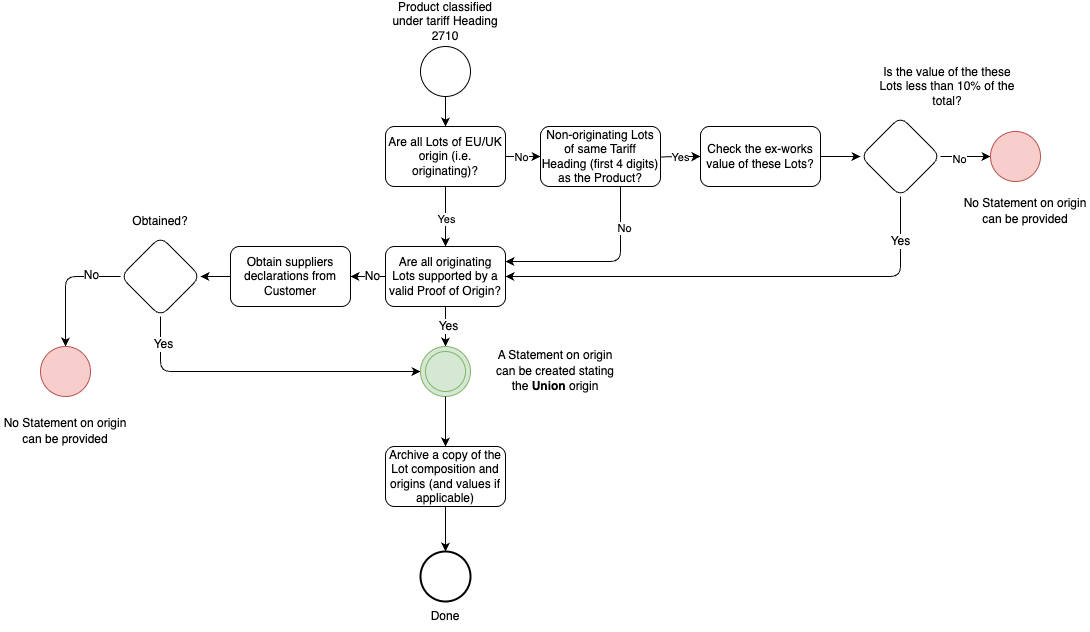
- Decision flow Preferential origin EU - UK TCA tariff Heading 2710
- Template preferential origin (long term) supplier declaration
Assessment of Change of Tariff Heading (CTH) Rule for HS Heading 2710
1. Purpose
The purpose of the Change of Tariff Heading (CTH) rule is to ensure that non-originating materials undergo sufficient processing or transformation before a product obtains preferential origin under the EU–UK Trade and Cooperation Agreement (TCA).
The CTH rule prevents preferential origin from being granted where a product is merely assembled or blended from non-originating materials without a substantial change in tariff classification.
The relevant legal framework is:
EU–UK Trade and Cooperation Agreement (TCA), Chapter 2 – Rules of Origin;
Annex ORIG-1 – Definitions;
Annex ORIG-2 – Product-Specific Rules of Origin.
2. Assessment principle
The CTH assessment is performed only on non-originating materials.
Originating materials are excluded from the CTH assessment because they already have preferential origin status.
The assessment logic is:

3. Practical example – Blended product classified under HS heading 2710
Final product
|
Product |
HS heading |
|
Blended petroleum product |
2710 |
The production process uses ten input components.
Input material assessment
|
Component |
HS heading |
Origin status |
Evidence |
CTH assessment |
|
Component 1 |
2707 |
Non-originating |
No preferential origin evidence |
CTH fulfilled (2707 → 2710) |
|
Component 2 |
2707 |
Non-originating |
No preferential origin evidence |
CTH fulfilled (2707 → 2710) |
|
Component 3 |
2707 |
Non-originating |
No preferential origin evidence |
CTH fulfilled (2707 → 2710) |
|
Component 4 |
2710 |
EU originating |
Supplier declaration |
Excluded from CTH test |
|
Component 5 |
2710 |
EU originating |
Supplier declaration |
Excluded from CTH test |
|
Component 6 |
2710 |
EU originating |
Supplier declaration |
Excluded from CTH test |
|
Component 7 |
2710 |
EU originating |
Supplier declaration |
Excluded from CTH test |
|
Component 8 |
2710 |
EU originating |
Supplier declaration |
Excluded from CTH test |
|
Component 9 |
2710 |
UK originating |
Statement on Origin |
Treated as originating material under EU–UK bilateral cumulation |
|
Component 10 |
2710 |
Non-originating |
No preferential origin evidence |
Assess under applicable tolerance/value rule |
4. Key interpretation points
4.1 Non-originating materials from another HS heading
Example:
Input material:
HS 2707
Final product:
HS 2710
Result:
2707 ≠ 2710
→ CTH requirement fulfilled
The material does not prevent the final product from obtaining preferential origin.
4.2 Originating materials with the same HS heading as the final product
Example:
Input material:
HS 2710
Origin:
UK
Evidence:
Valid Statement on Origin
Result:
Material is originating under EU–UK TCA
→ CTH assessment not required
The fact that the material has the same HS heading as the final product is irrelevant because the CTH rule applies only to non-originating materials.
4.3 Non-originating materials with the same HS heading as the final product
Example:
Input material:
HS 2710
Origin:
Non-originating
Result:
Same heading as final product
→ Additional assessment required
The material must be assessed against any specific tolerance or maximum value rule included in the applicable product-specific rule.
5. Decision tree for HS heading 2710

6. Final conclusion
For a blended product classified under HS heading 2710:
The CTH rule is applied only to non-originating materials.
Materials classified under HS heading 2707 can satisfy the CTH requirement because they undergo a change from heading 2707 to heading 2710.
Materials classified under HS heading 2710 do not automatically prevent preferential origin.
If a 2710 material has EU or UK preferential origin supported by valid documentation, it is treated as originating and is excluded from the CTH assessment.
Only non-originating 2710 materials require further review against the applicable tolerance/value provisions.
This approach ensures that preferential origin is granted where sufficient processing has occurred while allowing originating materials from the EU and UK to be used within the bilateral cumulation framework.
Statement on Origin
To be printed on an invoice or commercial document containing information on the goods concerned
SOP - Decision flow Preferential origin EU - UK TCA tariff Heading 2710
Please note that customs status as such has no role in determining origin!
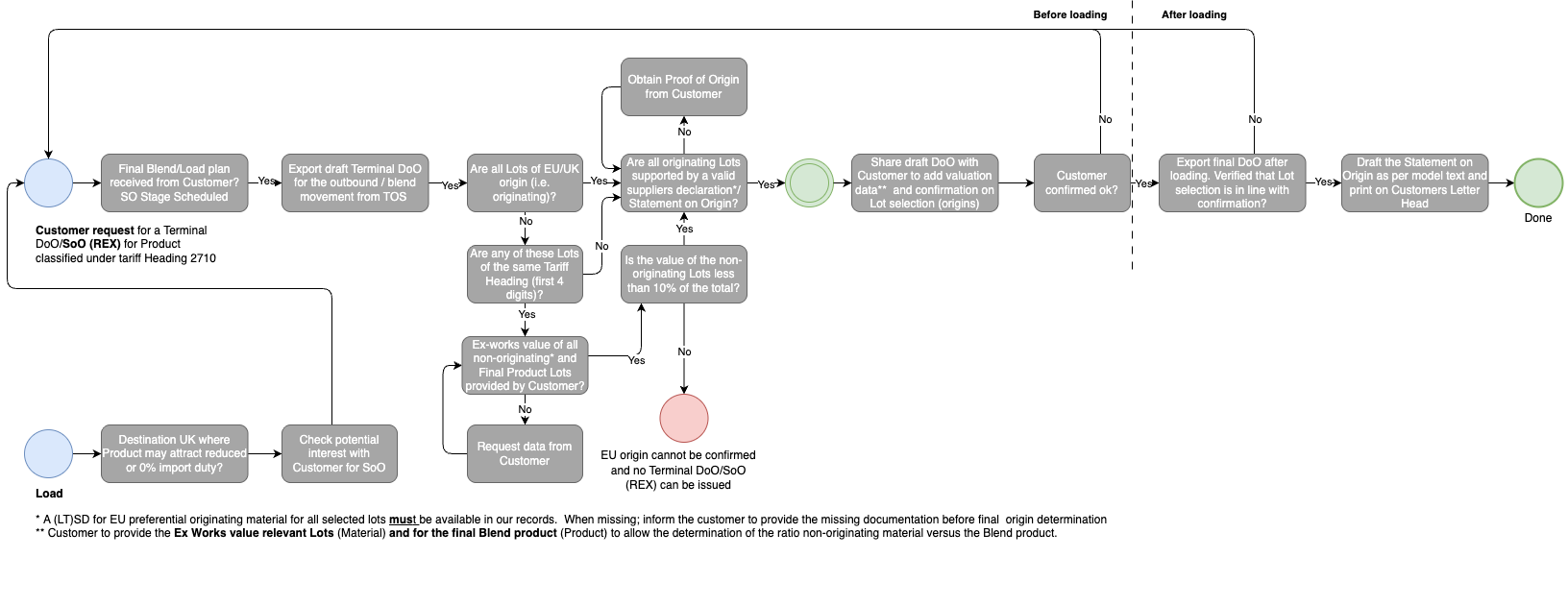
EU originating material: Materials having EU preferential origin under the Trade Agreement rules
- Goodswholly obtained in the EU, or
- Goods sufficiently worked or processed in the EU according to the applicable list rules
Non-originating material: Material that does not qualify as originating under the preferential rules of origin of the Trade Agreement
- Materials imported from third countries that do not qualify as originating, or
- Materials that have not undergone sufficient working or processing to acquire EU origin
T2 product can also be non-originating material. Customs clearance does not change the origin of the material
Change of Tariff Heading "CTH" means production from non-originating materials of any heading, except that of the final product; this means that any non-originating material used in the production of the final product must be classified under a heading (4-digit level of the Harmonised System) other than that of the final product (i.e. a change in heading).
Decision flow Preferential origin EU - UK TCA tariff Heading 2710
Template preferential origin (long term) supplier declaration
[TO BE PRINTED ON COMPANY LETTERHEAD]
SUPPLIER'S DECLARATION
I, the undersigned, declare that the goods listed on this document …………………………….……………….(1), originate in ……………………………….(2) and satisfy the rules of origin governing preferential trade with ……………………………………………(3).
I declare that (4):
 Cumulation applied with
…………………………………(name country/countries)
Cumulation applied with
…………………………………(name country/countries)
 No cumulation applied
I undertake to make available to the customs authorities any further supporting documents they require.
……………………………………………………………………….…. (5)
………………………………………………………………………….. (6)
Footnotes (can be removed after completion)
(1) If only some of the goods listed on the document are concerned, they shall be clearly indicated or marked and this marking entered in the declaration as follows:
“………………..…listed on this document and marked …………………..….originate in ………………….…
(2) The European Union, country, group of countries or territory, from which the goods originate
(3) Country, group of countries or territory concerned
(4) To be completed, where necessary, only for goods having preferential origin status in the context of preferential trade relations with one of the countries with which pan-Euro-Mediterranean cumulation of origin is applicable.
(5) Place and date of issue
(6) Name and position of the undersigned, name and address of company
(7) Signature
LONG-TERM SUPPLIER'S DECLARATION
I, the undersigned, declare that the goods described below:
…………………………………………………………………….(1)
…………………………………………………………………….(2)
Which are regularly supplied to ………………………………….(3), originate in ……………………………….(4) and satisfy the rules of origin governing preferential trade with ……………………………………………(5).
I declare that (6):
 Cumulation applied with
…………………………………(name country/countries)
Cumulation applied with
…………………………………(name country/countries)
 No cumulation applied
This declaration is valid for all shipments of these products dispatched from ......................................... to
...............................(7)
I undertake to inform ............................................(3) immediately if this declaration is no longer valid.
I undertake to make available to the customs authorities any further supporting documents they require.
……………………………………………………………………….…. (8)
………………………………………………………………………….. (9)
Footnotes (can be removed after completion)
Footnotes (can be removed after completion)
(1) Description
(2) Commercial designation as used on the invoices e.g. Model No
(3) Name of the company to which goods are supplied
(4) The European Union, country, group of countries or territory, from which the goods originate
(5) Country, group of countries or territory concerned
(6) To be completed, where necessary, only for goods having preferential origin status in the context of preferential trade relations with one of the countries with which pan-Euro-Mediterranean cumulation of origin is applicable.
(7) Give the start and end dates. The period shall not exceed 24 months.
(8) Place and date of issue
(9) Name and position of the undersigned, name and address of company