AO/IC
- Outline of Business Activities: NL vs. NL/BE Bunkering
- Outline business activities
- Product and it's characteristics from a Customs and excise point of view
- Licenses
- Organisation - People
- Organisation - Control Framework
- Organisation - Third parties
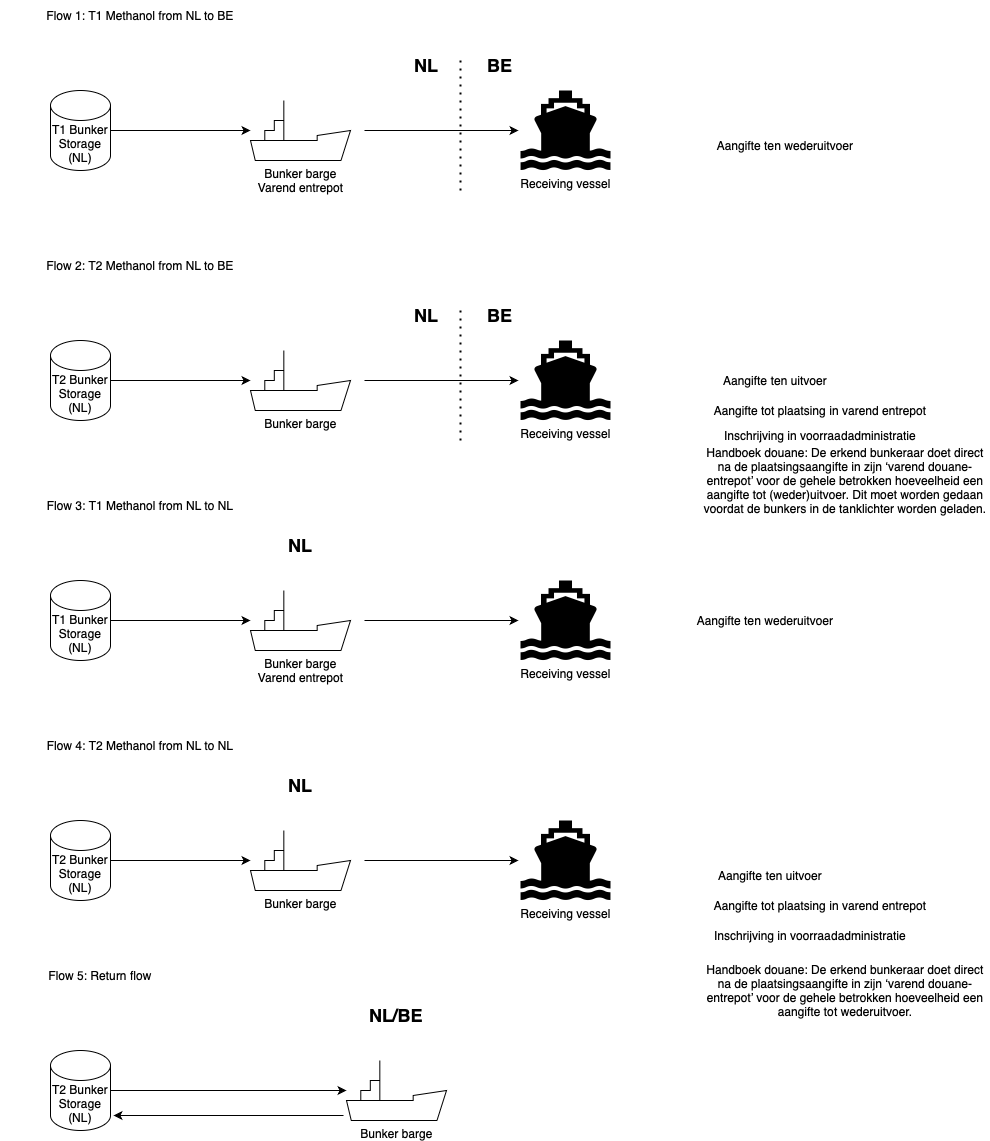
- Details on various flows
Outline of Business Activities: NL vs. NL/BE Bunkering
The application of the “Zeevaartbunkerprocedure 2019” is driven by the objective of enabling bunkering activities in both Belgium and the Netherlands. If bunkering activities were to take place exclusively in the Netherlands, a different procedure would apply.
As this distinction may be relevant from a sustainability perspective—which in the Netherlands is linked to the release for consumption from a tax warehouse—the procedure for bunkering without application of the “Zeevaartbunkerprocedure 2019” is described first below.
1.1 Required Licenses
Fictitious excise warehouse (Fictief AGP):
License required to load T2 (EU) bunker fuel in the Netherlands and supply it as bunker fuel to vessels in the Netherlands.
Uitbunkeren in transito (T1 bunkering):
License required to load T1 (non-EU) bunker fuel in the Netherlands and supply it as bunker fuel to vessels in the Netherlands.To be verified need of additional license? https://www.douane.nl/wp-content/uploads/2025/10/toel_aanvr_toe_proviandering_terr_water_do2441b3fd.pdf
Licenses electronic communications?
1.2 Scope of the Licenses
These licenses only allow loading and supplying bunker fuels in the Netherlands.
Cross-border bunkering is not permitted.
1.3 Transit (T1 Bunkering)
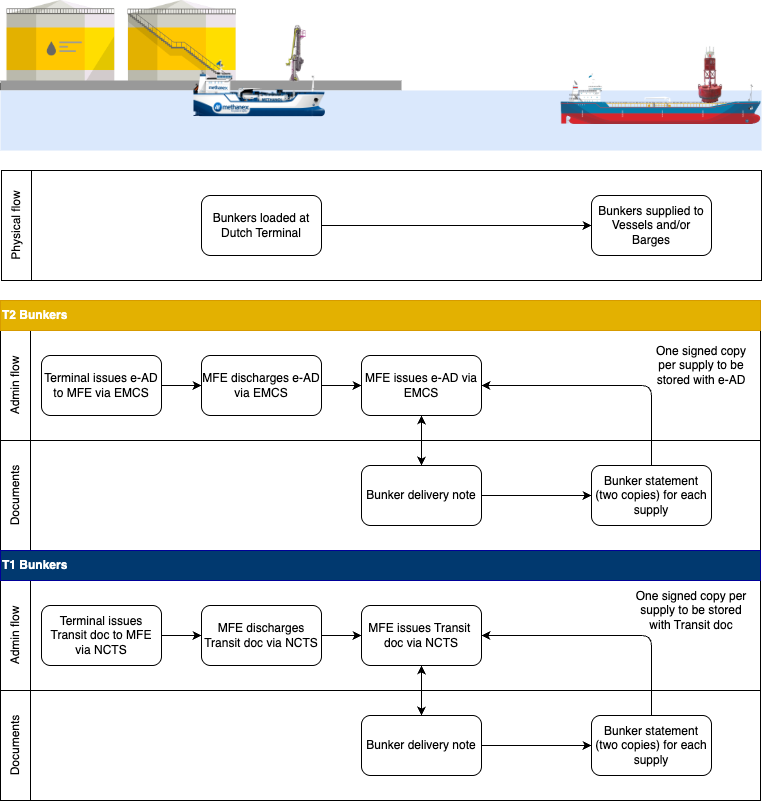
Under the simplified T1 procedure, bunker fuel on the barge is covered by an NCTS Transit document.
The bunker supplier must place the goods under Transit when loading.
This process can be outsourced to a customs broker.
1.4 Supply to Other Bunker Suppliers (T1 Bunkering)
Unlike the cross-border procedure, the domestic T1 procedure allows bunker fuel supply from one bunker trader to another via ship-to-ship operations.
Note: This does not extend the validity of the original Transit document.
1.5 Formalities During Supply (T1 and T2 Bunkering)
Advance notification: Customs must be notified at least 2 hours before the expected supply time.
Document type:
Required information:
EORI number of the bunker supplier
Name and IMO number of the receiving vessel
Expected time of supply
Submission: Advance notification must be submitted as an electronic PRO message via the Single Window Maritime platform.
Attention: Registration of electronic messages (registratie elektronisch berichtenverkeer) is required.
1.6 Clearance of the Procedure (T1 Bunkering)
The procedure is considered cleared when bunker receipts covering the full quantity are attached to the Transit document within its validity period.
Late or incomplete attachment results in non-clearance, which may trigger import and excise duty assessments.
1.7 Bunker Receipt (T1 and T2 Bunkering)
The bunker receipt is critical documentation, serving as:
Evidence that the fuel was supplied to a seagoing vessel. Verify supply to barges covered?
Proof that the goods have left EU customs territory, clearing duty suspension procedures.
Requirements:
Two copies per supply
Languages: Dutch, English, German, or French
Format: No fixed format; customs provides a minimal data content list
Numbering: Unique and sequential
Signature: Authorized crew member of the receiving vessel
Distribution:
One copy stays on the vessel
One copy stays on the bunker barge until the BGD quantity is fully supplied
Replacing the original copy on the barge with a duplicate is allowed
Retention: Keep records for at least 7 years
1.8 E-AD Document (T2 Bunkers)
EU bunker fuel on the barge is covered by an e-AD, equivalent to the T1 Transit document.
Issuance: Loading terminals issue an e-AD via EMCS to the bunker supplier.
The bunker supplier replaces it with its own e-AD for the fuel on the barge.
Clearance: Attaching bunker receipts to the e-AD clears the procedure, similar to Transit document clearance.
2. Bunkering in the Netherlands or Belgium with application of the “Zeevaartbunkerprocedure 2019”
2.1 Required Licenses
- Floating customs warehouse (Varend douane entrepot)
License required to load T1 bunker fuel in the Netherlands and supply it as bunker fuel to vessels in the Netherlands or in Belgium. - Electronic messaging registration (Registratie elektronisch berichtenverkeer):Registration required to communicate with the declaration and notification system of the Dutch Customs Authorities.
Outline business activities