# Common Storage and accounting segregation
Full detailed analysis of the application of article 177 of the Delegated Regulation (EU) 2015/2446 to the UCC 952/2013.
# English
# Executive summary — Common storage and administrative allocation of customs status within an integrated terminal
The common storage arrangement allows equivalent Union and non-Union goods to be stored within an integrated storage facility and their customs status to be accounted for through the records where physical identification is not possible at all times, or would only be possible at disproportionate cost. The relevant storage facility may comprise several tanks and associated product-containing pipelines; it does not necessarily correspond to a single individual tank. This follows from Article 177 of the UCC Delegated Regulation and is expressly supported by the European Commission’s “tank pit” example. European Commission, Special Procedures Guidance, pp. 120 and 122
The basis is the actual storage arrangements and operations, not merely the presence of product in pipelines. The decisive distinction is:
Not: “There is product in the pipelines, so the entire tank farm constitutes common storage.”
Rather: “The actual storage arrangements and movements of goods within the relevant configuration of tanks and product-containing pipelines make physical identification by customs status impossible at all times.”
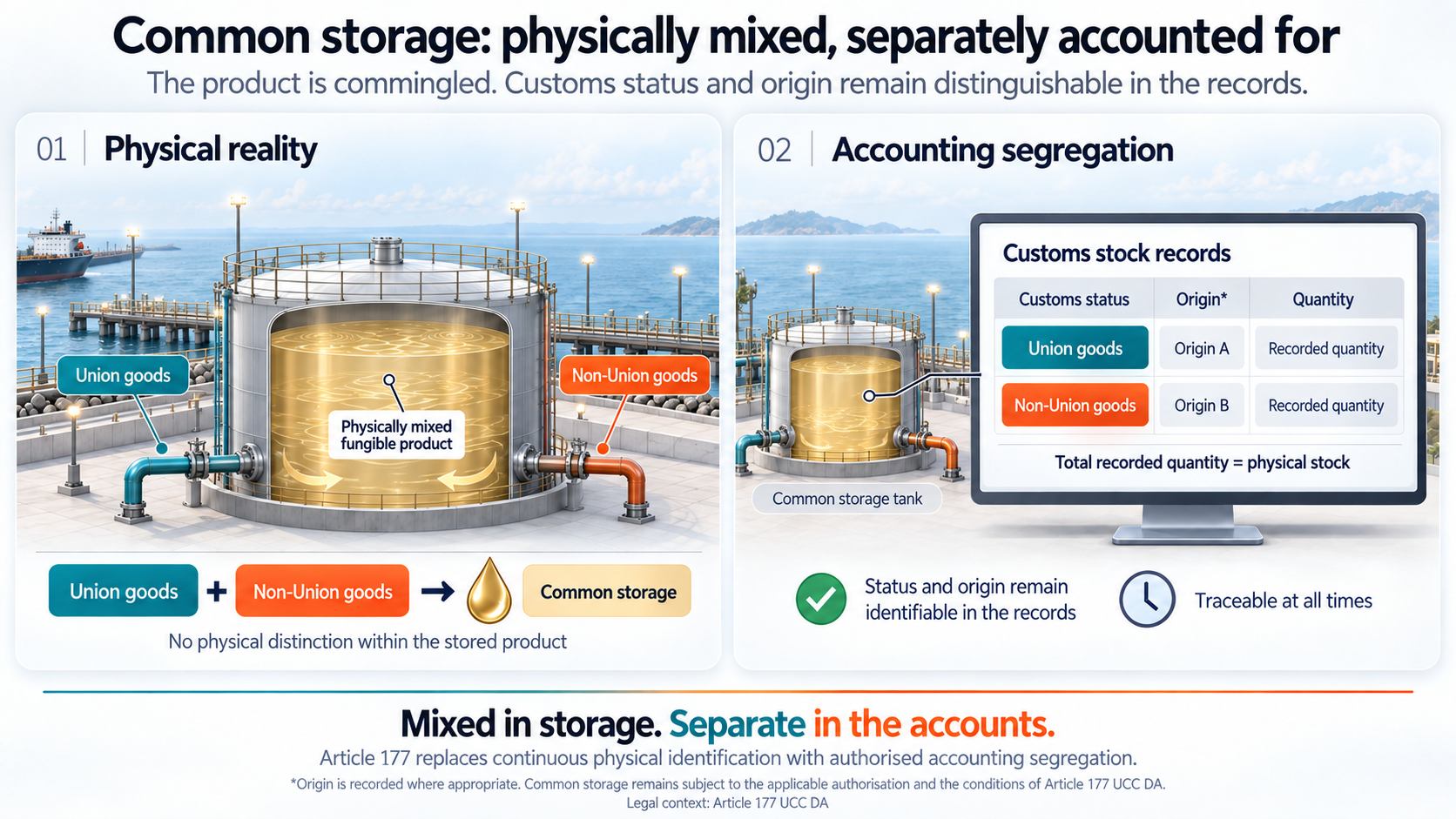
Common storage and accounting segregation are closely connected, but they are not the same. Common storage concerns the actual storage of goods. Accounting segregation subsequently maintains the distinction in the records by type of goods, customs status and, where applicable, origin. It safeguards customs supervision despite the inability to physically distinguish the goods at all times. The records therefore do not independently establish common storage; they make the authorised arrangement auditable. European Commission, guidance, pp. 49–50 and 120
Upon loading, customs status is allocated on the basis of the relevant customs warehouse records. To the extent that the authorised common storage encompasses the integrated configuration, the available stock of qualifying goods within that storage facility forms the basis for allocation. No greater quantity may be allocated than is actually present in the customs warehouse with the relevant status. A separate customs-status balance for each individual tank is therefore not automatically the allocation limit. Dutch Customs Handbook, section 6.4
Historical policy and current European guidance support this approach. For mineral oils, the former Handbook expressly took the boundaries of the tank site as the starting point and permitted, subject to conditions, the substitution of equivalent consignments between tanks. Under the UCC, the European “tank pit” example confirms that common storage may encompass several connected tanks, provided they contain the same product with the same CN code, commercial quality and technical characteristics. The core function—replacing physical differentiation with accountability through the records—has therefore been preserved, without all the former policy conditions necessarily having been carried forward unchanged. Former Dutch Customs Handbook, sections 8.2–8.2.3 European Commission, guidance, p. 122
The biodiesel judgments define the limits of this arrangement, but do not reject it as a general principle. In ECLI:NL:RBNHO:2023:8715, the court found that the consignments concerned were physically separated and individually identifiable. Residues in pipelines and tank heels did not justify treating all tank stocks as commonly stored. In ECLI:NL:GHAMS:2025:990, the Court of Appeal emphasises this physical separation as a particular feature of the case. The judgments therefore concern the administrative substitution of separated consignments, rather than an independent assessment of a terminal duly authorised under the UCC. District Court of Noord-Holland, paragraphs 47–53 Amsterdam Court of Appeal, paragraphs 4.4–4.6
Conclusion
There is a substantiated basis for continuing the arrangement described where the actual storage arrangements and flows of goods prevent physical identification at all times, the relevant common storage and accounting arrangements are covered by the authorisation, and compliance with stock limits can be verified. The biodiesel judgments do not, in themselves, provide grounds for rejecting this practice. Product equivalence and specific statutory restrictions, including those applicable to certain goods subject to anti-dumping or countervailing duties, continue to apply separately. The European guidance supports this interpretation but is not legally binding. European Commission, disclaimer and p. 120
# Context and objective of article 177 DA UCC
#### **Customs status: the starting point**
The starting point is the distinction between Union and non-Union goods under Article 5(22)–(24) of Regulation (EU) No 952/2013 establishing the Union Customs Code (“UCC”). Article 5(23) defines the categories of goods qualifying as Union goods, including imported goods released for free circulation and goods obtained or produced in the Union exclusively from the Union-status goods specified in that provision. Goods falling outside those categories are non-Union goods under Article 5(24). Accordingly, where mixing Union and non-Union goods produces a resulting product incorporating non-Union material that has not been released for free circulation, that product does not qualify as Union goods merely because some of its constituent material had Union status. Subject to any applicable special arrangements, the resulting product is non-Union goods. [UCC, Article 5](https://eur-lex.europa.eu/legal-content/EN/TXT/HTML/?uri=CELEX%3A32013R0952)

#### **Common storage and accounting segregation**
Article 177 of Commission Delegated Regulation (EU) 2015/2446 (“UCC DA”) establishes a specific framework for common storage of Union and non-Union goods in customs warehousing facilities. Where it is impossible, or possible only at disproportionate cost, to identify each type of goods at all times, the customs warehousing authorisation must require accounting segregation by type of goods, customs status and, where appropriate, origin. The provision thus permits accounting segregation to replace individual physical identification, subject to the applicable conditions. [UCC DA, Article 177, as replaced by Regulation (EU) 2020/877](https://eur-lex.europa.eu/legal-content/EN/TXT/?uri=CELEX%3A32020R0877)
The purpose of this arrangement is to facilitate bulk storage without eliminating the legal distinction between Union and non-Union quantities. Article 237(3) UCC expressly provides that Union goods authorised to be stored in a customs warehousing facility are not regarded as being under the customs warehousing procedure. Consistently with that distinction, the Dutch Customs Handbook explains that the records for common storage must establish the quantities having Union and non-Union status. Authorised common storage should therefore not be characterised as an arrangement under which the entire stock necessarily becomes non-Union goods upon commingling. [UCC, Article 237(3)](https://eur-lex.europa.eu/legal-content/EN/TXT/HTML/?uri=CELEX%3A32013R0952) [Dutch Customs Handbook, sections 6.1–6.4](https://kennisbank.douane.nl/handboeken/hdu/douane_entrepots/douane_entrepots-uniegoederen)
#### **The broader wording applicable from 1 May 2016**
Before the UCC framework became applicable on 1 May 2016, Article 534(2) of Regulation (EEC) No 2454/93 expressly required goods placed in common storage to share the same eight-digit Combined Nomenclature (“CN”) code, commercial quality and technical characteristics. Those three express conditions were omitted from the original wording of Article 177 UCC DA. Although the requirement for accounting segregation remained, the new provision was therefore textually broader than its predecessor. The subsequent Commission working paper records this difference, but does not establish that the omission reflected a deliberate policy decision to permit unrestricted mixing of different products. [European Commission working paper, 25 October 2017, pp. 2–4](https://www.clecat.org/media/Common%20storage,%20accounting%20segregation%20and%20usual%20forms%20of%20handling%20(UHF)%20in%20Special%20Procedures.pdf)
The consequences of that omission were expressly addressed in the Commission’s working paper *Common storage, accounting segregation and usual forms of handling (UHF) in Special Procedures*, dated 25 October 2017. The paper noted that several requirements under the former legislation no longer appeared in Article 177, specifically the requirements concerning CN classification, commercial quality and technical characteristics. It identified a potential for misuse where Union goods were stored together with non-Union goods subject, for example, to anti-dumping duties, and proposed restoring the former safeguards. The concern was therefore not simply that goods would physically mix. Physical commingling is an ordinary feature of bulk storage. The concern was that accounting segregation could be applied to goods whose differences mattered for their customs treatment, **potentially producing fraud risks or unjustified import-duty advantages.** [European Commission working paper, pp. 2–4](https://www.clecat.org/media/Common%20storage,%20accounting%20segregation%20and%20usual%20forms%20of%20handling%20(UHF)%20in%20Special%20Procedures.pdf)
#### **Restoration of the safeguards in 2020**
Commission Delegated Regulation (EU) 2020/877 replaced Article 177 with effect from 16 July 2020. The rationale is stated expressly in recital 30:
> “In order to avoid any possible misuse of those rules, the storage of Union and non-Union goods together in a storage facility for customs warehousing (common storage) should only be allowed where the goods have the same CN code, commercial quality and technical characteristics.”
Article 177(2) accordingly restored the requirement that the Union and non-Union goods share the same eight-digit CN code, commercial quality and technical characteristics. The amendment thus reinstated the principal product-identity safeguards that had appeared in the pre-UCC legislation. [Regulation (EU) 2020/877, recital 30 and Articles 1(25) and 4](https://eur-lex.europa.eu/legal-content/EN/TXT/?uri=CELEX%3A32020R0877)
The replacement provision also introduced specific safeguards concerning trade-defence measures. Under Article 177(3), non-Union goods subject to the specified duties or measures at the intended time of common storage are deemed not to have the same commercial quality as the Union goods. Article 177(4) provides an exception where the Union goods to be stored with them were previously released for free circulation and the relevant duties were paid. The provision therefore does not impose an unqualified prohibition on common storage involving goods subject to trade-defence duties; its operation depends on the conditions laid down in those paragraphs. [Regulation (EU) 2020/877, Article 1(25)](https://eur-lex.europa.eu/legal-content/EN/TXT/?uri=CELEX%3A32020R0877)
#### **Interpretative significance**
The legislative history supports reading Article 177 as a controlled facilitation of common storage, rather than a general authorisation to blend different products or interchange their customs status. Its purpose is to accommodate the practical realities of bulk storage while preserving, through accounting segregation, the quantities attributable to each customs status and safeguarding the customs treatment applicable to the goods concerned.
The relevant distinction is therefore between, on the one hand, a resulting product incorporating non-Union material whose status must be assessed under Article 5 UCC and, on the other hand, goods held within a valid common-storage arrangement under Article 177 UCC DA. In the latter case, physical commingling does not, by itself, require the entire stock to be treated as non-Union goods. Whether a particular operation falls within that framework depends on the applicable authorisation, the characteristics of the goods and compliance with the accounting-segregation requirements.
#### **Conclusion: the objective of Article 177 UCC DA**
Article 177 UCC DA should be understood in the context of the UCC’s objectives of facilitating legitimate trade and simplifying customs administration while safeguarding the financial interests of the Union and its Member States. Recital 10 emphasises effective administrative simplification, while recitals 11 and 15 address the protection of financial interests and the fight against fraud. Article 3 gives operative expression to this balance by requiring customs authorities to protect those financial interests while maintaining a proper balance between customs controls and the facilitation of legitimate trade. [UCC, recitals 10, 11 and 15 and Article 3](https://eur-lex.europa.eu/legal-content/EN/TXT/HTML/?uri=CELEX%3A32013R0952)
The wording of Article 177(1) reflects that balance. The reference to **“a disproportionate cost”** expressly recognises that maintaining individual identification may be technically possible but economically unreasonable. The provision is therefore not confined to cases of absolute impossibility. The words **“at all times”** refer to the continuity of identification during storage, rather than merely the ability to identify goods upon receipt or withdrawal. Read together, these expressions support the conclusion that the provision accommodates storage arrangements in which continuous individual identification cannot reasonably be maintained, by requiring accounting segregation as the alternative means of distinguishing the relevant quantities by type of goods, customs status and, where appropriate, origin. [Article 177(1) UCC DA, as replaced by Regulation 2020/877](https://eur-lex.europa.eu/legal-content/EN/TXT/?uri=CELEX%3A32020R0877)
This facilitation does not dispense with customs supervision or the substantive conditions governing common storage. Rather, it changes the means by which the necessary distinctions are maintained: from individual physical identification to an authorised and verifiable accounting system. The product-identity conditions and trade-defence safeguards in Article 177(2)–(4) limit the arrangement to prevent misuse, as expressly stated in recital 30 of Regulation 2020/877. The legitimate cost savings arising from common storage must therefore be distinguished from unjustified customs-duty advantages obtained through misuse of accounting segregation. [Regulation 2020/877, recital 30 and Article 1(25)](https://eur-lex.europa.eu/legal-content/EN/TXT/?uri=CELEX%3A32020R0877)

#### **Continuity of purpose and relevance of the historical policy**
The legislative development discussed above demonstrates that the core function and objective of the common-storage arrangement remained materially the same before and after 1 May 2016. Both former Article 534(2) of the Customs Code Implementing Provisions and current Article 177 UCC DA address situations in which Union and non-Union goods are stored together in a storage facility and it is impossible, or would be possible only at disproportionate cost, to maintain continuous physical identification of the goods concerned. Under both regimes, this practical difficulty is addressed by attributing customs status to quantities recorded in the accounts, subject to the requirement that customs supervision remains fully safeguarded.
The amendments introduced since 2016 did not abandon this fundamental function. After the original wording of Article 177 UCC DA had not expressly reproduced the former product-identity conditions, those conditions were codified again in 2020. Article 177(2) now expressly requires the Union and non-Union goods held in common storage to share the same eight-digit CN code, commercial quality and technical characteristics. According to recital 30 of Commission Delegated Regulation (EU) 2020/877, this amendment was introduced to prevent possible misuse of the arrangement, rather than to abolish the practical facilitation of common storage itself [EUR-Lex](https://eur-lex.europa.eu/legal-content/EN/TXT/?uri=CELEX%3A32020R0877).
The legislature also codified a specific safeguard for goods subject to trade-defence measures. Under Article 177(3), non-Union goods which, at the intended time of common storage, would be subject to, among other measures, anti-dumping duties, countervailing duties, safeguard measures or specified additional duties are deemed **not to have the same commercial quality** as the Union goods concerned. Such goods are therefore excluded by law from the ordinary equivalence assessment, subject to the specific exception in Article 177(4) for Union goods in respect of which the relevant duties were previously paid.
These additional safeguards limit the arrangement where differences between the goods are relevant to their customs treatment or could give rise to unjustified duty advantages. They do not, however, alter the underlying premise that common storage and accounting segregation are intended to accommodate equivalent bulk goods whose physical identity and customs status cannot be tracked separately at all times during ordinary storage operations.
Against this background, the Dutch administrative policy applicable before 1 May 2016 remains relevant to the interpretation and practical application of the current arrangement. That policy cannot constitute an independent legal basis for operations under the present UCC framework, but it demonstrates how the Customs authorities previously gave practical effect to the continuing purpose of common storage in the bulk industry. This is particularly relevant to the assessment of equivalence, the tank location as the relevant operational unit, the administrative allocation of customs status and the treatment of unavoidable tank heels and pipeline residues. The former Customs Handbook expressly explained that common storage was made available for bulk goods because, in the ordinary course of business, it was not always possible to distinguish their status **“at all times”**, also referring to environmental considerations, security of energy supply and energy conservation [former Dutch Customs Handbook, § 8.2](https://kennisbank.douane.nl/handboeken/hd/douane_entrepots/douane_entrepots-gezamenlijke_opslag/).
The historical policy should therefore not be regarded merely as an obsolete departure from a fundamentally different present-day arrangement. Rather, it provides relevant context for determining how the same underlying facilitation can be applied in practice within an integrated and continuously operating bulk terminal, subject to the product-identity and trade-defence safeguards that have since been expressly codified.
The Dutch Customs Handbook applicable before 1 May 2016 contained various facilities tailored to the practical circumstances of the bulk industry. These arrangements recognised that, in the ordinary course of business, mineral oils are stored, moved and mixed within an integrated system of tanks and pipelines. Permanent physical segregation or identification of each original lot was not always possible or practical. Subject to certain conditions, the policy therefore allowed for the administrative allocation of customs status, the interchange of goods between tanks and special treatment of unavoidable residual stocks.
### **Equivalence of mineral oils**
For the common storage of oil and oil products, the former Customs Handbook provided that products classifiable under the same CN code could be regarded as equivalent. The explanatory text referred to the designations, quality standards and technical characteristics customarily used in commercial trade and reflected in the CN classification. Subject to additional conditions for specific products, the same CN code therefore served as the practical starting point for determining equivalence.
These additional conditions were set out in Annex 3. Specific distinctions applied, among other things, to light oils with and without biofuel content, certain gas oils and lubricating oils. The approach therefore did not entail the unconditional equivalence of all goods falling under the same CN code, but neither did it require each lot to be identical in every analytical respect. The Customs Handbook illustrated this by reference to the common storage of Community and non-Community fuel oil with different sulphur contents but falling under the same CN code applicable at the time.
*References: former Customs Handbook, 15.50.00, § 8.2.2; Annex 3 to section 15.50.00; 15.00.00, Annex 7, § 13.2.1.*
### **The tank location as the unit for allocating customs status**
For oil and oil products, the former Customs Handbook expressly identified the tank location, rather than the individual tank, as the relevant boundary for determining customs status:
> “For these types of goods, the boundaries of the tank location are decisive for determining customs status.”
It was expressly permissible to interchange equivalent lots held in different tanks, provided that the goods belonged to the same owner and were located at the same site. Their customs status had to be demonstrable, and goods located elsewhere or still in transit could not be taken into account in anticipation of their arrival. A location could consist of several adjoining cadastral plots within the same operational site; the presence of a public road crossing the site did not necessarily prevent it from being treated as a single location.
This arrangement was consistent with the general explanation that, for certain flows of goods in the ordinary course of business, it was not always possible to distinguish their status **“at all times”**. In addition to practical considerations, the Customs Handbook referred to environmental considerations, security of energy supply and energy conservation. Customs status was therefore linked to the quantity accounted for in the records.
*Reference: former Customs Handbook, 15.50.00, §§ 8.2 and 8.2.2.*
### **Special treatment of tank heels and pipeline residues**
The former policy recognised that storage tanks are not completely empty following ordinary deliveries. A limited residual quantity, referred to as the tank heel or permanent stock, remains in the tank and can generally be removed only when the tank is fully cleaned.
Subject to cumulative conditions, this tank heel could be excluded from the records maintained for the customs facilities concerned. The actual residual stock could not exceed 0.5% of the tank’s total storage capacity, could not result in a change to the CN code of goods subsequently discharged into the tank and could not increase as a result of parts of new receipts being omitted from the records. In principle, the tank heel had non-Community status, unless only Community mineral oils had been stored in the tank since it was last fully cleaned. The 0.5% threshold was not a fixed allowance: only the residual quantity actually present, up to that maximum, could be excluded from the records.
Of particular relevance is that Community goods falling under a different CN code could be stored on top of this residual stock. In such circumstances, the conditions for common storage were deemed to have been met, provided that the tank was otherwise empty and the CN code, commercial quality and technical characteristics of the goods discharged into the tank did not change.
The Customs Handbook also contained a specific exception for the unintended contamination of light oil by residual product containing biofuel, expressly referring to product remaining in a pipeline as an example. This exception was likewise subject to conditions concerning the product and the quantities involved.
These provisions did not constitute a general exemption for residual stocks. They nevertheless demonstrate that unavoidable physical mixing with residual product did not necessarily result in the entire subsequent lot losing its customs status.
*References: former Customs Handbook, 15.00.00, Annex 7, § 13.5; 15.50.00, Annex 3, section on light oils.*
### **Common storage and usual forms of handling**
The former Customs Handbook distinguished between common storage and mixing as a usual form of handling.
Common storage was also permitted where its purpose was to bring the product within specification. The Customs Handbook stated that no single new lot arose in such circumstances, even where the product was brought within specification. The original quantities continued to exist administratively with their respective customs statuses. A worked example permitted the available quantity of Community goods to be written off first upon removal, with import formalities being completed only for the excess quantity.
A different approach applied, in the version of the Customs Handbook identified, to mixing as a usual form of handling. A mixture obtained from Community and non-Community components was treated as entirely non-Community; the customs status could not be allocated proportionately to the constituent components. However, for the purpose of calculating import duties, it was possible, upon request, to determine the nature, customs value and quantity of the goods as though the usual form of handling had not taken place. This made it possible to avoid the imposition of duties on the Community component.
This adjustment to the calculation of duties must be distinguished from the preservation of the Community status of the component itself. A potentially earlier policy under which the status of individual components could also be preserved following a usual form of handling has not yet been substantiated by an original dated source and is therefore not presented as an established part of this analysis.
*References: former Customs Handbook, 15.00.00, Annex 7, §§ 13.2.1, 13.3.1, 13.3.2 and 13.4.1; 15.50.00, §§ 7.3–7.4.*
### **Relevance to the current assessment**
The common thread running through these historical arrangements is that physical mixing was not automatically equated with the loss of customs status. The policy allowed the necessary distinctions to be maintained administratively, taking account of product equivalence, the boundaries of the storage location, unavoidable residual stocks and accurate quantitative stock records.
This development in policy is relevant to the interpretation of Article 177 UCC DA, in particular the terms **“storage facility”**, **“at all times”** and **“disproportionate cost”**. It supports an assessment that considers the full operational cycle of a bulk terminal rather than focusing exclusively on the temporary physical distribution of goods among individual tanks.
The historical policy does not, however, constitute an independent legal basis for continuing every facility that existed under the former arrangements. Whether a particular arrangement is permissible today must be assessed by reference to the applicable EU customs legislation, the relevant authorisation and the specific facts. The historical provisions primarily demonstrate that location-based allocation of customs status and solutions for residual mixing were explicit and controlled elements of Dutch customs policy, rather than merely practices developed by the industry.
The cited sources form part of the official collection entitled **“Customs Handbook (HD), valid until 30 April 2016.”**
"Physical identification is not possible at all times, (...).”

1. Starting position: Tank 1 contains Union goods (T2), Tank 2 contains the same product as non-Union goods (T1), and the shared pipeline contains a known T1 linefill.
2. Allocation restricted to a single tank: The T1 linefill reaches the barge before the T2 product from Tank 1. Consequently, loading cannot proceed as the nominated T2 loading without additional measures.
3. Accounting segregation at storage-site level: Before loading, the quantity in the pipeline is administratively reallocated from T1 to T2, and an identical quantity in Tank 1 is reallocated from T2 to T1. The total T1 and T2 quantities remain unchanged before loading, and all T1 goods remain under customs supervision.
#### Tank heel resulting in a loss of customs status
“Physical identification (...) would only be possible at disproportionate cost.”
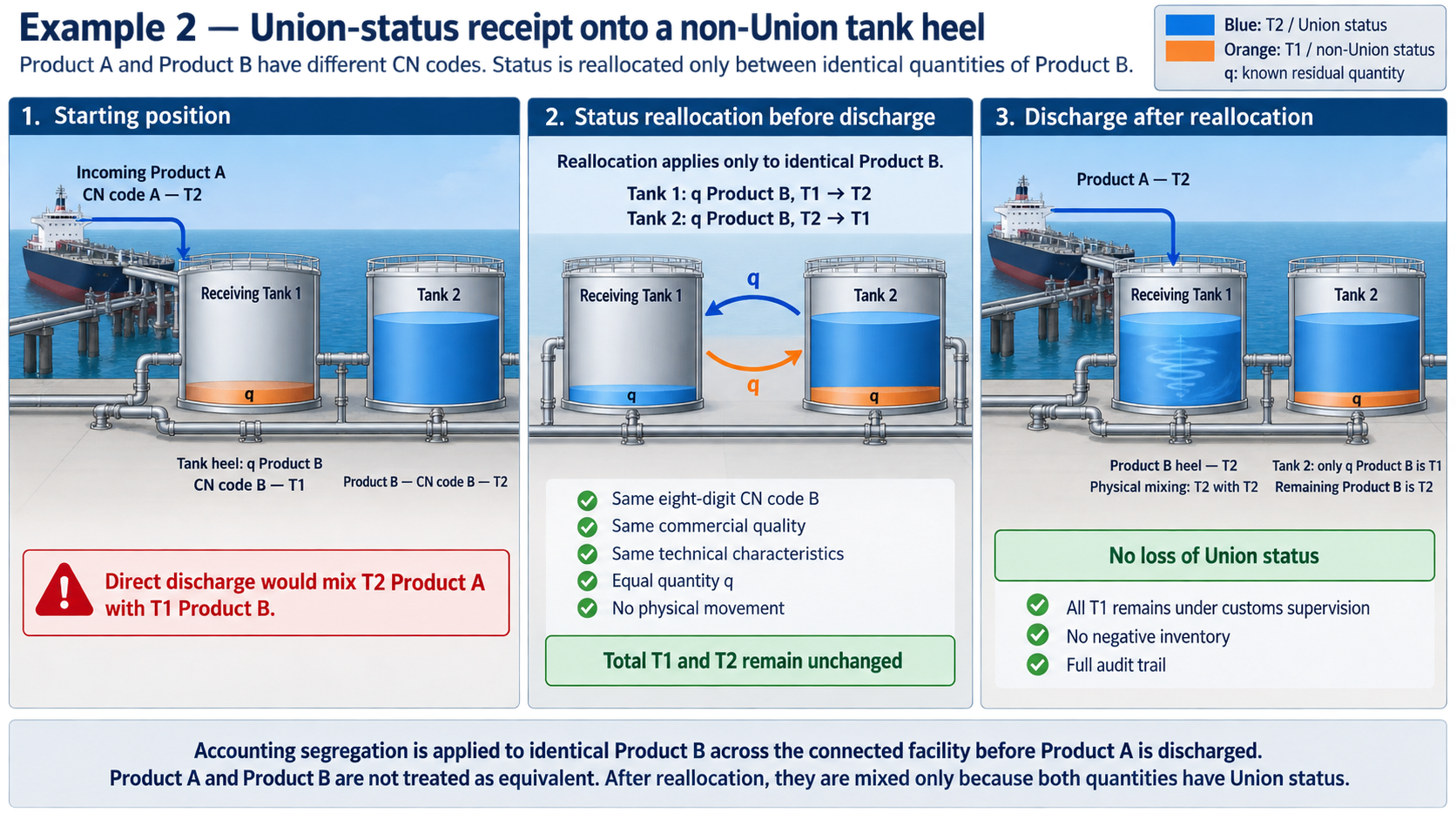
1. Starting position: T2 product A, classified under CN code A, is to be received into Tank 1, which still contains a heel of T1 product B, classified under CN code B.
2. Reallocation: This takes place exclusively between identical quantities of product B:
- Tank 1: A quantity of product B is reallocated from T1 to T2.
- Tank 2: The same quantity of product B is reallocated from T2 to T1.
3. Discharge: Product A is subsequently discharged as T2 onto the heel of product B, which has by then also been recorded as T2. In Tank 2, only the corresponding quantity is recorded as T1; the remaining stock remains T2.
The illustration emphasises that products A and B are not treated as equivalent. Reallocation takes place exclusively between the two identical quantities of product B. As a result, the subsequent physical mixing is between T2 goods and T2 goods, and all T1 goods remain under customs supervision. The alternative would require the goods to remain physically separated, meaning that physical identification would only be possible at disproportionate cost.
#### No unnecessary physical operations solely for administrative purposes
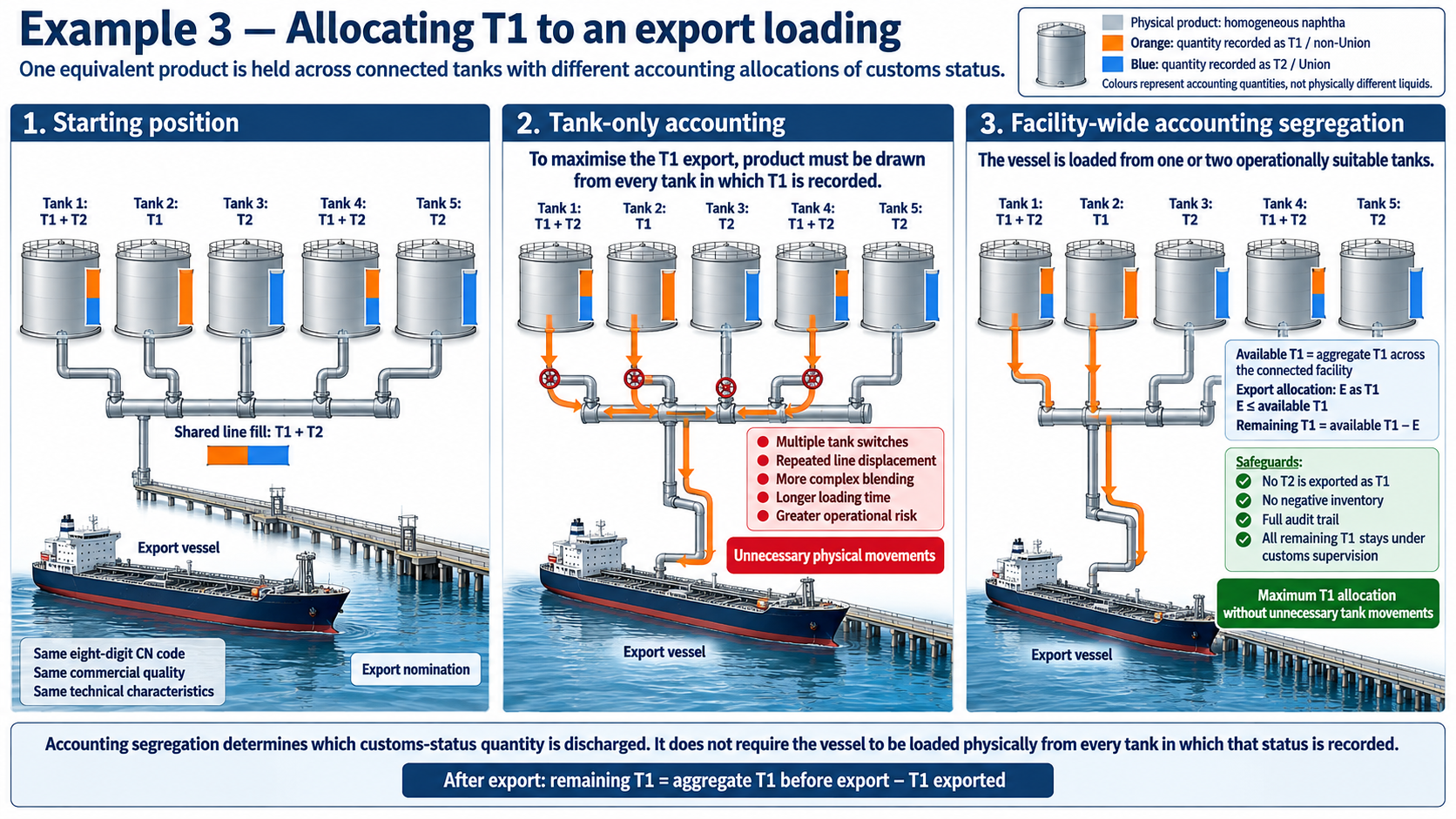
1. Starting position: The same equivalent product is distributed across five connected tanks. Some tanks contain quantities administratively recorded as both T1 and T2, while others contain only T1 or T2. The known linefill also comprises quantities administratively recorded as T1 and T2.
2. Tank-specific accounting: To export as much T1 as possible, product must physically be loaded from several tanks. This requires switching between tanks, displacing line contents and a more complex loading operation.
3. Facility-wide accounting segregation: The vessel is physically loaded from one or two operationally suitable tanks. The export is administratively allocated to the total available T1 stock within the connected facility.
# Evaluation of the biodiesel judgments
The judgments of the District Court of Noord-Holland of 1 September 2023, ECLI:NL:RBNHO:2023:8715, and the Amsterdam Court of Appeal of 25 February 2025, ECLI:NL:GHAMS:2025:990, provide no basis for a general prohibition on common storage and the administrative allocation of customs status across multiple tanks. A reasoned argument can be made that they do not undermine the current terminal practice described, where that practice is based on authorised common storage of equivalent goods that cannot, within the relevant storage facility, be physically distinguished by customs status at all times.
#### 1. The judgments concern physically separated and identifiable consignments of biodiesel
In ECLI:NL:RBNHO:2023:8715, the District Court finds that the biodiesel concerned had remained physically separated in different tanks and individually identifiable. Treating all the biodiesel as a single common stock in the records did not change that factual situation.
In ECLI:NL:GHAMS:2025:990, the Court of Appeal confirms that the common storage arrangement could not justify the specific practice whereby physically separated biodiesel from third countries was administratively substituted for EU biodiesel. In paragraph 4.5, the Court expressly links its conclusion to the “particular characteristics of this case”, especially the physical separation. The substantive assessment concerns transactions under the Community Customs Code and its Implementing Provisions (CCC/CCIP), not an authorisation for an integrated tank pit under the current Union Customs Code (UCC). Amsterdam Court of Appeal, paragraphs 2.9 and 4.4–4.6
#### 2. The District Court recognises the separate policy for mineral oils
In ECLI:NL:RBNHO:2023:8715, the District Court expressly describes the exception in the former Handbook for petroleum and petroleum products: equivalent goods from different tanks could be substituted subject to certain conditions. It rejects reliance on that exception because biodiesel is not a mineral oil, rather than because every allocation across tank boundaries would, as such, be impermissible. The Court also leaves the alleged new policy for mineral oils outside its assessment because the case concerns biodiesel. District Court of Noord-Holland, paragraphs 75–78 and 88
The former Handbook therefore provides a relevant interpretative reference point. It reflected normal bulk-storage operations, in which customs status cannot always be physically distinguished. For petroleum and petroleum products, the boundaries of the tank site were decisive. Substitution between tanks was possible for equivalent goods belonging to the same owner at the same location, without anticipating future arrivals. Former Dutch Customs Handbook, sections 8.2–8.2.3
#### 3. Current European guidance supports common storage across multiple tanks
Under the UCC, this site-based approach receives specific support from the example “Common storage in different tanks connected with each other” in the European Commission’s guidance.
The example describes a group of interconnected tanks—a “tank pit”—in which products with different customs statuses are stored. The Commission confirms that common storage may be authorised under Article 177 of the UCC Delegated Regulation where all tanks contain the same Union and non-Union product, with the same CN code, technical characteristics and commercial quality. An individual tank therefore does not necessarily define the boundary of common storage. European Commission, Special Procedures Guidance, revision 26, p. 122
The arrangement’s core function has therefore been preserved: where identification at all times is impossible, or would only be possible at disproportionate cost, accounting segregation enables customs supervision.
#### 4. Common storage and accounting segregation are closely connected, but they are not the same
Common storage concerns the actual storage of qualifying goods. Accounting segregation concerns the recording and accounting of quantities by type of goods, customs status and, where applicable, origin.
The records therefore preserve the legal distinction where that distinction cannot be made physically at all times. They do not necessarily require separate physical stocks or independent customs-status balances for each tank. Conversely, a fully reconciled set of records does not, by itself, establish authorisation for common storage. European Commission, guidance, pp. 49–50 and 120
#### 5. Customs status is allocated on the basis of the relevant customs warehouse records
The current Handbook provides that, in authorised common storage, the authorisation holder is free to choose the customs status allocated. However, the quantity allocated may not exceed the quantity present in the customs warehouse with that status. The quantitative limit is therefore not automatically applied to each individual tank. Current Dutch Customs Handbook, section 6.4
Where the authorised common storage encompasses the integrated tank site, the relevant stock records for that site form the basis for allocation. Upon loading, the quantity allocated to a particular status cannot exceed the quantity of qualifying goods actually available with that status.
#### Conclusion
The biodiesel judgments do not generally call into question a duly authorised practice of common storage and accounting segregation. The former policy for mineral oils and the current European tank-pit example support the proposition that common storage may encompass several connected tanks and that customs status is subsequently allocated on the basis of the relevant customs warehouse stock.
This conclusion nevertheless depends on a demonstrable difference from the circumstances adjudicated: the decisive factors are actual common storage and the inability to physically distinguish the goods at all times, not merely connected pipelines or a single authorisation. The tanks in the biodiesel case were also connected by pipelines; this was insufficient because the consignments concerned remained physically separated.
Subject to those factual and authorisation-related conditions, there is a substantiated basis for continuing the practice described. Specific statutory restrictions, including Article 177(3) of the UCC Delegated Regulation for certain goods subject to anti-dumping or countervailing duties, continue to apply separately. European Commission, disclaimer and p. 120
# The same commercial quality and technical characteristics: assessment in the biodiesel judgments
The District Court accepts that different types of biodiesel may be treated as equivalent for common storage, despite differences in feedstock and certain product specifications. The Court of Appeal subsequently expressly leaves this question open. The judgments therefore do not establish a general, definitive test under which every technical deviation is automatically either permissible or impermissible.
#### 1. District Court: comparable basic properties and the same use are key considerations
In ECLI:NL:RBNHO:2023:8715, paragraphs 40–42, the District Court endorses the parties’ common position that the different biodiesels satisfied the conditions for common storage under Article 534(2) of the Community Customs Code Implementing Provisions (CCIP).
It identifies the following supporting considerations:
- Comparable basic physical, chemical and technical properties.
- Use for the same purposes.
- Differences in feedstock and production processes do not necessarily alter the product’s basic definition and properties.
- The way market participants regard the product also supports its comparability.
The District Court draws support from the European anti-dumping regulations concerning US biodiesel. These describe the different types of biodiesel as products with “the same or very similar” basic properties and the same uses. District Court of Noord-Holland, paragraphs 41–42
#### 2. Differences in individual specifications do not automatically preclude equivalence
The company argued that differences in:
- CFPP — cold filter plugging point;
- oxidation stability;
- relative density;
- did not necessarily result in different commercial quality or technical characteristics.
This was the company’s position, which the District Court reproduces in its reasoning. The Court does not conduct a separate technical assessment of each parameter, but follows the parties’ common position on the permissibility of the storage. District Court of Noord-Holland, paragraphs 41–42
For CFPP, the District Court also refers to the Commission: the difference between US and European biodiesel identified in the anti-dumping investigation was minimal, could be compensated for by blending or additives, and was of little relevance to most blends sold on the EU market. This is not a general finding that every CFPP difference is insignificant, but support for the comparability of the products examined. District Court of Noord-Holland, paragraph 41
#### 3. The same CN code is a separate requirement, not a complete quality assessment
According to the District Court, all the biodiesels concerned were classified under CN code 3826 00 10, irrespective of their CFPP. The same classification supports their similarity for tariff purposes, but the judgment does not establish that the same CN code, by itself, proves that commercial quality and technical characteristics are identical. The reasoning also considers the basic properties and uses. District Court of Noord-Holland, paragraphs 5 and 41–42
#### 4. Court of Appeal: no definitive ruling on equivalence
In ECLI:NL:GHAMS:2025:990, the Court of Appeal identifies differences between palm, soybean and rapeseed biodiesel, including CFPP values of approximately +12 °C, −4 °C and −13 °C, respectively.
However, in paragraph 4.6, the Court expressly leaves unanswered whether these products have the same commercial quality and technical characteristics, and whether it is bound by the parties’ unanimous position on that issue. According to the Court, the specific practice was already impermissible because of the physical separation and subsequent removal of the goods. The Court therefore neither independently confirms equivalence nor definitively rules that equivalence is absent. Amsterdam Court of Appeal, paragraphs 2.4 and 4.4–4.6
#### Summary
The District Court’s judgment indicates that differences in feedstock or individual product specifications do not automatically mean that products have different commercial quality or technical characteristics. The accepted comparability was based primarily on their corresponding basic properties, the same intended uses, and the significance of the differences in commercial practice.
# Nederlands
# Executive summary — Gezamenlijke opslag en administratieve statustoerekening binnen een geïntegreerde terminal
De faciliteit van gezamenlijke opslag maakt het mogelijk om gelijkwaardige Unie- en niet-Uniegoederen binnen een geïntegreerde opslaginrichting op te slaan en hun douanestatus administratief te verantwoorden wanneer fysieke identificatie niet te allen tijde mogelijk is, of uitsluitend tegen buitensporige kosten mogelijk zou zijn. De relevante opslaginrichting kan meerdere tanks en bijbehorende producthoudende leidingen omvatten; zij valt niet noodzakelijk samen met één individuele tank. Dit volgt uit artikel 177 GVo.DWU en wordt expliciet ondersteund door het Europese tank pit-voorbeeld. Europese Commissie, Special Procedures Guidance, pp. 120 en 122
De grondslag is de werkelijke opslag en bedrijfsvoering, niet het enkele bestaan van leidinginhoud. Het beslissende onderscheid luidt:
> **Niet:** “Er zit product in de leidingen, dus het gehele tankpark is gezamenlijk opgeslagen.”
>
>
**Wel:** “De daadwerkelijke opslag en goederenbewegingen binnen het relevante samenstel van tanks en producthoudende leidingen maken fysieke identificatie naar douanestatus niet te allen tijde mogelijk.”
Gezamenlijke opslag en gescheiden boekhouding liggen in elkaars verlengde, maar zijn niet hetzelfde. Gezamenlijke opslag betreft de feitelijke opslag van goederen. De gescheiden boekhouding bewaart vervolgens het administratieve onderscheid naar goederensoort, douanestatus en, waar van toepassing, oorsprong. Zij waarborgt het douanetoezicht ondanks het ontbreken van voortdurende fysieke onderscheidbaarheid. De administratie creëert dus niet zelfstandig de gezamenlijke opslag, maar maakt de toegestane faciliteit controleerbaar. Europese Commissie, guidance, pp. 49–50 en 120
Bij laden vindt statustoerekening plaats vanuit de relevante entrepotadministratie. Voor zover de toegestane gezamenlijke opslag het geïntegreerde samenstel omvat, vormt de beschikbare voorraad van kwalificerende goederen binnen die opslaginrichting de allocatiebasis. Er mag niet meer worden toegerekend dan daadwerkelijk met de betreffende status in het douane-entrepot aanwezig is. Een zelfstandig statussaldo per individuele tank is dan niet automatisch de allocatiegrens. Handboek Douane, § 6.4
Het historische beleid en de huidige Europese guidance ondersteunen deze benadering. Het oude Handboek nam voor minerale oliën expliciet de begrenzing van de tanklocatie als uitgangspunt en stond onder voorwaarden verwisseling van gelijkwaardige partijen tussen tanks toe. Onder het DWU bevestigt het Europese tank pit-voorbeeld dat gezamenlijke opslag meerdere verbonden tanks kan omvatten, mits het hetzelfde product betreft met dezelfde GN-code, handelskwaliteit en technische kenmerken. De kernfunctie — fysieke onderscheiding vervangen door administratieve verantwoording — is daarmee behouden, zonder dat alle oude beleidsvoorwaarden ongewijzigd zijn voortgezet. Oud Handboek Douane, §§ 8.2–8.2.3 Europese Commissie, guidance, p. 122
De biodieseluitspraken begrenzen deze faciliteit, maar verwerpen haar niet in algemene zin. In ECLI:NL:RBNHO:2023:8715 waren de betrokken partijen volgens de rechtbank fysiek gescheiden en afzonderlijk identificeerbaar. Resten in leidingen en tankhielen rechtvaardigden niet dat alle tankvoorraden als gezamenlijk opgeslagen werden behandeld. In ECLI:NL:GHAMS:2025:990 benadrukt het hof deze fysieke scheiding als bijzonder kenmerk van het geval. De uitspraken betreffen daarmee administratieve verwisseling van gescheiden partijen, niet een zelfstandige beoordeling van een rechtsgeldig vergunde terminal onder het DWU. Rechtbank Noord-Holland, r.o. 47–53 Gerechtshof Amsterdam, r.o. 4.4–4.6
#### Conclusie
Er bestaat een onderbouwde grond voor voortzetting van de beschreven faciliteit wanneer de daadwerkelijke opslag en goederenstromen de voortdurende fysieke identificatie verhinderen, de relevante gezamenlijke opslag en boekhouding door de vergunning worden gedekt en de voorraadgrenzen controleerbaar worden nageleefd. De biodieseluitspraken vormen op zichzelf geen reden om die werkwijze te verwerpen. Productgelijkwaardigheid en bijzondere wettelijke beperkingen, waaronder die voor bepaalde aan antidumping- of compenserende rechten onderworpen goederen, blijven afzonderlijk gelden. De Europese guidance ondersteunt deze interpretatie, maar is niet juridisch bindend. Europese Commissie, disclaimer en p. 120
# De context en het doel van artikel 177 GVo DWU
### **Douanestatus: het uitgangspunt**
Het uitgangspunt is het onderscheid tussen Unie- en niet-Uniegoederen op grond van artikel 5, punten 22 tot en met 24, van Verordening (EU) nr. 952/2013 tot vaststelling van het douanewetboek van de Unie (“DWU”). Artikel 5, punt 23, omschrijft de categorieën goederen die als Uniegoederen worden aangemerkt, waaronder ingevoerde goederen die in het vrije verkeer zijn gebracht en goederen die in de Unie uitsluitend zijn verkregen of vervaardigd uit de in die bepaling genoemde goederen met Uniestatus. Goederen die niet tot die categorieën behoren, zijn op grond van artikel 5, punt 24, niet-Uniegoederen. Wanneer de vermenging van Unie- en niet-Uniegoederen leidt tot een product waarin niet-Uniemateriaal is verwerkt dat niet in het vrije verkeer is gebracht, kwalificeert dat product derhalve niet als Uniegoed uitsluitend omdat een deel van de bestanddelen Uniestatus had. Behoudens eventueel toepasselijke bijzondere regelingen is het resulterende product een niet-Uniegoed.
*Bron: DWU, artikel 5.*

###
### **Gezamenlijke opslag en gescheiden boekhouding**
Artikel 177 van Gedelegeerde Verordening (EU) 2015/2446 van de Commissie (“GVo DWU”) bevat een specifiek kader voor de gezamenlijke opslag van Unie- en niet-Uniegoederen in opslagruimten voor douane-entrepots. Wanneer het onmogelijk is, of uitsluitend tegen onevenredige kosten mogelijk is, om iedere soort goederen te allen tijde te identificeren, moet de vergunning voor het douane-entrepot voorzien in een gescheiden boekhouding naar goederensoort, douanestatus en, waar passend, oorsprong. De bepaling staat daarmee toe dat individuele fysieke identificatie wordt vervangen door een gescheiden boekhouding, met inachtneming van de toepasselijke voorwaarden.
*Bron: GVo DWU, artikel 177, zoals vervangen bij Verordening (EU) 2020/877.*
Deze regeling beoogt bulkopslag te faciliteren zonder het juridische onderscheid tussen hoeveelheden Unie- en niet-Uniegoederen op te heffen. Artikel 237, lid 3, DWU bepaalt uitdrukkelijk dat Uniegoederen die met toestemming in een opslagruimte voor douane-entrepots worden opgeslagen, niet worden geacht onder de regeling douane-entrepot te zijn geplaatst. In overeenstemming met dat onderscheid licht het Nederlandse Handboek Douane toe dat uit de administratie voor gezamenlijke opslag moet blijken welke hoeveelheden de status van Uniegoederen en welke de status van niet-Uniegoederen hebben. Vergunde gezamenlijke opslag mag daarom niet worden gekwalificeerd als een regeling waarbij de volledige voorraad bij vermenging noodzakelijkerwijs de status van niet-Uniegoederen verkrijgt.
*Bronnen: DWU, artikel 237, lid 3; Handboek Douane, paragrafen 6.1–6.4.*
### **De ruimere formulering vanaf 1 mei 2016**
Voordat het DWU-kader op 1 mei 2016 van toepassing werd, vereiste artikel 534, lid 2, van Verordening (EEG) nr. 2454/93 uitdrukkelijk dat gezamenlijk opgeslagen goederen dezelfde achtcijferige code van de gecombineerde nomenclatuur (“GN-code”), handelskwaliteit en technische kenmerken hadden. Deze drie uitdrukkelijke voorwaarden ontbraken in de oorspronkelijke tekst van artikel 177 GVo DWU. Hoewel de verplichting tot het voeren van een gescheiden boekhouding bleef bestaan, was de nieuwe bepaling tekstueel dus ruimer dan haar voorganger. Het latere werkdocument van de Commissie benoemt dit verschil, maar stelt niet vast dat het weglaten van deze voorwaarden voortkwam uit een bewuste beleidskeuze om onbeperkte vermenging van verschillende producten toe te staan.
*Bron: werkdocument van de Europese Commissie van 25 oktober 2017, blz. 2–4.*
De gevolgen van het ontbreken van deze voorwaarden zijn uitdrukkelijk besproken in het werkdocument van de Commissie *Common storage, accounting segregation and usual forms of handling (UHF) in Special Procedures* van 25 oktober 2017. Daarin werd opgemerkt dat verschillende vereisten uit de voormalige wetgeving niet langer in artikel 177 waren opgenomen, in het bijzonder de vereisten inzake GN-indeling, handelskwaliteit en technische kenmerken. Het document signaleerde mogelijkheden tot misbruik wanneer Uniegoederen gezamenlijk werden opgeslagen met niet-Uniegoederen waarop bijvoorbeeld antidumpingrechten van toepassing waren, en stelde voor de eerdere waarborgen te herstellen. De zorg betrof dus niet uitsluitend het feit dat goederen fysiek zouden vermengen. Fysieke vermenging is een gebruikelijk kenmerk van bulkopslag. De zorg was dat gescheiden boekhouding zou kunnen worden toegepast op goederen waarvan de onderlinge verschillen relevant waren voor hun douanebehandeling, met mogelijke frauderisico’s of ongerechtvaardigde voordelen op het gebied van invoerrechten tot gevolg.
*Bron: werkdocument van de Europese Commissie, blz. 2–4.*
### **Herstel van de waarborgen in 2020**
Gedelegeerde Verordening (EU) 2020/877 van de Commissie heeft artikel 177 met ingang van 16 juli 2020 vervangen. De reden daarvoor is uitdrukkelijk vermeld in overweging 30:
> “Om mogelijk misbruik van die regels te voorkomen, mag de gezamenlijke opslag van Unie- en niet-Uniegoederen in een opslagruimte voor douane-entrepots alleen worden toegestaan wanneer de goederen dezelfde GN-code, handelskwaliteit en technische kenmerken hebben.”
Artikel 177, lid 2, heeft dienovereenkomstig de voorwaarde hersteld dat de Unie- en niet-Uniegoederen dezelfde achtcijferige GN-code, handelskwaliteit en technische kenmerken moeten hebben. Daarmee zijn de belangrijkste waarborgen inzake productidentiteit uit de wetgeving van vóór het DWU opnieuw ingevoerd.
*Bron: Verordening (EU) 2020/877, overweging 30 en artikelen 1, punt 25, en 4.*
De vervangende bepaling heeft tevens specifieke waarborgen ingevoerd met betrekking tot handelsbeschermingsmaatregelen. Op grond van artikel 177, lid 3, worden niet-Uniegoederen waarop op het voorgenomen tijdstip van gezamenlijke opslag de daarin genoemde rechten of maatregelen van toepassing zijn, geacht niet dezelfde handelskwaliteit te hebben als de Uniegoederen. Artikel 177, lid 4, voorziet in een uitzondering wanneer de Uniegoederen die daarmee gezamenlijk zullen worden opgeslagen eerder in het vrije verkeer zijn gebracht en de betreffende rechten zijn betaald. De bepaling bevat dus geen onvoorwaardelijk verbod op gezamenlijke opslag van goederen waarop handelsbeschermingsrechten van toepassing zijn; de werking ervan hangt af van de voorwaarden in die leden.
*Bron: Verordening (EU) 2020/877, artikel 1, punt 25.*
### **Betekenis voor de interpretatie**
De ontstaansgeschiedenis ondersteunt een uitleg van artikel 177 als een faciliteit voor gezamenlijke opslag onder gecontroleerde voorwaarden, en niet als een algemene toestemming om verschillende producten te mengen of hun douanestatus onderling uit te wisselen. De bepaling beoogt tegemoet te komen aan de praktische realiteit van bulkopslag, waarbij door middel van een gescheiden boekhouding de aan iedere douanestatus toe te rekenen hoeveelheden worden behouden en de op de betrokken goederen toepasselijke douanebehandeling wordt gewaarborgd.
Het relevante onderscheid is daarom dat tussen enerzijds een resulterend product waarin niet-Uniemateriaal is verwerkt en waarvan de status op grond van artikel 5 DWU moet worden beoordeeld, en anderzijds goederen die binnen een rechtsgeldige regeling voor gezamenlijke opslag op grond van artikel 177 GVo DWU worden gehouden. In het laatste geval brengt fysieke vermenging op zichzelf niet mee dat de volledige voorraad als niet-Uniegoederen moet worden behandeld. Of een bepaalde handeling binnen dat kader valt, hangt af van de toepasselijke vergunning, de kenmerken van de goederen en de naleving van de vereisten voor gescheiden boekhouding.
### **Conclusie: de doelstelling van artikel 177 GVo DWU**
Artikel 177 GVo DWU moet worden begrepen in de context van de doelstellingen van het DWU: het faciliteren van legitieme handel en het vereenvoudigen van de douaneadministratie, met behoud van de bescherming van de financiële belangen van de Unie en haar lidstaten. Overweging 10 benadrukt doeltreffende administratieve vereenvoudiging, terwijl de overwegingen 11 en 15 betrekking hebben op de bescherming van financiële belangen en de bestrijding van fraude. Artikel 3 geeft aan dit evenwicht concrete uitwerking door de douaneautoriteiten op te dragen die financiële belangen te beschermen en tegelijkertijd een passend evenwicht te bewaren tussen douanecontroles en het faciliteren van legitieme handel.
*Bron: DWU, overwegingen 10, 11 en 15 en artikel 3.*
De formulering van artikel 177, lid 1, weerspiegelt dat evenwicht. De verwijzing naar **“onevenredige kosten”** erkent uitdrukkelijk dat het handhaven van individuele identificatie technisch mogelijk kan zijn, maar economisch onredelijk. De bepaling is dus niet beperkt tot gevallen van absolute onmogelijkheid. De woorden **“te allen tijde”** hebben betrekking op de continuïteit van de identificatie tijdens de opslag, en niet uitsluitend op de mogelijkheid goederen bij ontvangst of uitslag te identificeren. In onderlinge samenhang ondersteunen deze formuleringen de conclusie dat de bepaling ruimte biedt voor opslagarrangementen waarin voortdurende individuele identificatie redelijkerwijs niet kan worden gehandhaafd. De gescheiden boekhouding wordt daarbij voorgeschreven als alternatief middel om de relevante hoeveelheden te onderscheiden naar goederensoort, douanestatus en, waar passend, oorsprong.
*Bron: artikel 177, lid 1, GVo DWU, zoals vervangen bij Verordening (EU) 2020/877.*
Deze faciliteit laat het douanetoezicht en de materiële voorwaarden voor gezamenlijke opslag onverlet. Zij verandert veeleer de wijze waarop de noodzakelijke onderscheidingen worden gehandhaafd: van individuele fysieke identificatie naar een vergund en controleerbaar administratief systeem. De voorwaarden inzake productidentiteit en de waarborgen inzake handelsbeschermingsmaatregelen in artikel 177, leden 2 tot en met 4, begrenzen de regeling om misbruik te voorkomen, zoals uitdrukkelijk vermeld in overweging 30 van Verordening (EU) 2020/877. De legitieme kostenbesparingen die voortvloeien uit gezamenlijke opslag moeten daarom worden onderscheiden van ongerechtvaardigde douanerechtenvoordelen die worden verkregen door misbruik van gescheiden boekhouding.
*Bron: Verordening (EU) 2020/877, overweging 30 en artikel 1, punt 25.*


#### **Continuïteit van doelstelling en relevantie van het historische beleid**
Uit de hiervoor besproken wettelijke ontwikkeling volgt dat de kernfunctie en doelstelling van de regeling voor gezamenlijke opslag vóór en na 1 mei 2016 materieel dezelfde zijn gebleven. Zowel het voormalige artikel 534, lid 2, TVo. CDW als het huidige artikel 177 GVo DWU beogen tegemoet te komen aan situaties waarin Unie- en niet-Uniegoederen in een opslagfaciliteit gezamenlijk worden opgeslagen en het niet mogelijk is, of slechts tegen onevenredige kosten mogelijk zou zijn, om de betrokken goederen voortdurend fysiek van elkaar te onderscheiden. In beide regimes wordt dit ondervangen door de douanestatus aan administratief verantwoorde hoeveelheden te verbinden, onder de voorwaarde dat het douanetoezicht gewaarborgd blijft.
De sinds 2016 doorgevoerde wijzigingen hebben deze fundamentele functie van de regeling niet verlaten. Nadat de oorspronkelijke tekst van artikel 177 GVo DWU de voormalige productidentiteitsvoorwaarden niet uitdrukkelijk had overgenomen, zijn deze voorwaarden in 2020 opnieuw gecodificeerd. Artikel 177, lid 2, vereist sindsdien uitdrukkelijk dat de gezamenlijk opgeslagen Unie- en niet-Uniegoederen dezelfde achtcijferige GN-code, handelskwaliteit en technische kenmerken hebben. Volgens overweging 30 van Gedelegeerde Verordening (EU) 2020/877 is deze wijziging ingevoerd om mogelijk misbruik van de regeling te voorkomen, en niet om de praktische faciliteit voor gezamenlijke opslag als zodanig af te schaffen [EUR-Lex](https://eur-lex.europa.eu/legal-content/NL/TXT/?uri=CELEX%3A32020R0877).
De wetgever heeft daarnaast een specifieke waarborg gecodificeerd voor goederen waarop handelsbeschermingsmaatregelen van toepassing zijn. Op grond van artikel 177, lid 3, worden niet-Uniegoederen die bij het begin van de gezamenlijke opslag onder meer aan antidumpingrechten, compenserende rechten, vrijwaringsmaatregelen of bepaalde aanvullende rechten zouden zijn onderworpen, geacht **niet dezelfde handelskwaliteit** te hebben als de betrokken Uniegoederen. Daarmee worden dergelijke goederen wettelijk buiten de reguliere gelijkwaardigheidsbeoordeling geplaatst, behoudens de specifieke uitzondering van artikel 177, lid 4 voor Uniegoederen waarvoor de desbetreffende rechten eerder zijn betaald.
Deze aanvullende waarborgen begrenzen de regeling waar productverschillen relevant zijn voor de douanebehandeling of tot ongerechtvaardigde rechtenvoordelen zouden kunnen leiden. Zij veranderen echter niet het uitgangspunt dat gezamenlijke opslag en gescheiden boekhouding juist zijn bedoeld voor gelijkwaardige bulkgoederen waarvan de fysieke identiteit en douanestatus tijdens de normale opslagactiviteiten niet te allen tijde afzonderlijk kunnen worden gevolgd.
Tegen deze achtergrond blijft het vóór 1 mei 2016 geldende Nederlandse uitvoeringsbeleid relevant voor de uitleg en praktische toepassing van de huidige regeling. Dat beleid kan niet als zelfstandige rechtsgrond dienen voor handelingen onder het huidige DWU, maar illustreert wel hoe de Douane de blijvende doelstelling van gezamenlijke opslag in de bulksector destijds operationaliseerde. Dit geldt in het bijzonder voor de beoordeling van gelijkwaardigheid, de tanklocatie als relevante operationele eenheid, de administratieve toerekening van douanestatus en de behandeling van onvermijdelijke tankhielen en leidingrestanten. Het oude Handboek verklaarde uitdrukkelijk dat gezamenlijke opslag voor bulkgoederen mogelijk was omdat het tijdens de normale bedrijfsvoering niet altijd mogelijk is de status **“te allen tijde”** te onderscheiden en verwees daarbij tevens naar milieu, energievoorziening en energiebesparing [oud Handboek Douane, § 8.2](https://kennisbank.douane.nl/handboeken/hd/douane_entrepots/douane_entrepots-gezamenlijke_opslag/).
Het historische beleid moet daarom niet worden beschouwd als een achterhaalde afwijking van een fundamenteel andere huidige regeling. Het vormt relevante context voor de vraag hoe dezelfde onderliggende faciliteit binnen een geïntegreerde en continu opererende bulkterminal praktisch kan worden toegepast, met inachtneming van de inmiddels uitdrukkelijk gecodificeerde productidentiteits- en handelsbeschermingswaarborgen.
Het vóór 1 mei 2016 geldende Handboek Douane bevatte verschillende faciliteiten die waren toegesneden op de praktische omstandigheden van de bulksector. Deze regelingen erkenden dat minerale oliën tijdens de normale bedrijfsvoering worden opgeslagen, verplaatst en vermengd binnen een samenhangend systeem van tanks en leidingen. Permanente fysieke scheiding of identificatie van iedere oorspronkelijke partij was daarbij niet steeds mogelijk of doelmatig. Het beleid bood daarom, onder voorwaarden, ruimte voor administratieve statustoerekening, verwisseling tussen tanks en een bijzondere behandeling van onvermijdelijke restvoorraden.
#### **Gelijkwaardigheid van minerale oliën**
Voor gezamenlijke opslag van olie en olieproducten bepaalde het oude Handboek Douane dat producten die onder dezelfde GN-code waren in te delen als gelijkwaardig konden worden beschouwd. De toelichting verwees naar de in het handelsverkeer gebruikelijke benamingen, kwaliteitsnormen en technische kenmerken die in de GN-indeling waren verwerkt. Dezelfde GN-code vormde daarmee het praktische uitgangspunt voor de beoordeling van gelijkwaardigheid, behoudens aanvullende voorwaarden voor specifieke producten.
Deze aanvullende voorwaarden waren opgenomen in bijlage 3. Zo golden bijzondere onderscheidingen voor onder meer lichte oliën met en zonder biobrandstof, bepaalde gasoliën en smeeroliën. De benadering hield dus geen onvoorwaardelijke gelijkstelling van alle goederen onder dezelfde GN-code in, maar evenmin een eis dat iedere partij op alle analytische eigenschappen identiek moest zijn. Het Handboek illustreerde dit met gezamenlijke opslag van communautaire en niet-communautaire stookolie met verschillende zwavelgehalten, maar dezelfde toenmalige GN-code.
*Vindplaatsen: [oud Handboek Douane, 15.50.00, § 8.2.2](https://kennisbank.douane.nl/handboeken/hd/douane_entrepots/douane_entrepots-gezamenlijke_opslag/); [bijlage 3 bij onderdeel 15.50.00](https://kennisbank.douane.nl/handboeken/hd/douane_entrepots/douane_entrepots-bijlage_3_lijst_van_soortgelijkheid/); [15.00.00, bijlage 7, § 13.2.1](https://kennisbank.douane.nl/handboeken/hd/basisbepalingen_die_de_verschillende/basisbepalingen_die_de_verschillende-bijlage_7_mengen_minerale_olien).*
#### **De tanklocatie als eenheid voor statustoerekening**
Voor olie en olieproducten wees het oude Handboek uitdrukkelijk de **tanklocatie**, en niet de individuele tank, aan als relevante begrenzing voor de vaststelling van de douanestatus:
> “Bij deze goederensoorten is voor de vaststelling van de douanestatus de begrenzing van de tanklocatie bepalend.”
Daarbij was expliciet toegestaan om gelijkwaardige partijen uit verschillende tanks met elkaar te verwisselen, mits de goederen van dezelfde eigenaar waren en zich op dezelfde locatie bevonden. De douanestatus moest aantoonbaar zijn en er mocht niet worden vooruitgelopen op goederen die elders lagen of nog onderweg waren. Een locatie kon bestaan uit meerdere aaneengesloten kadastrale percelen binnen hetzelfde werkgebied; een openbare weg door dat gebied stond daaraan niet noodzakelijk in de weg.
Deze regeling sloot aan bij de algemene toelichting dat het bij bepaalde goederenstromen tijdens de normale bedrijfsvoering niet steeds mogelijk was om **“te allen tijde”** de status te onderscheiden. Naast praktische redenen noemde het Handboek milieu, energievoorziening en energiebesparing. De douanestatus werd daarom gekoppeld aan de administratief verantwoorde hoeveelheid.
*Vindplaats: [oud Handboek Douane, 15.50.00, §§ 8.2 en 8.2.2](https://kennisbank.douane.nl/handboeken/hd/douane_entrepots/douane_entrepots-gezamenlijke_opslag/).*
#### **Bijzondere behandeling van tankhielen en leidingrestanten**
Het oude beleid erkende dat opslagtanks na normale leveringen niet volledig leeg zijn. Een beperkte restantvoorraad, de zogenoemde hiel of ijzeren voorraad, blijft achter en kan doorgaans pas bij volledige reiniging worden verwijderd.
Deze hiel mocht onder cumulatieve voorwaarden buiten de verantwoording van de betrokken douanefaciliteiten blijven. De werkelijke restantvoorraad mocht maximaal **0,5% van de totale opslagcapaciteit** bedragen, mocht niet leiden tot wijziging van de GN-code van de daarop geloste partijen en mocht niet aangroeien doordat delen van nieuwe ontvangsten buiten de administratie bleven. De hiel had in beginsel niet-communautaire status, tenzij sinds de laatste volledige reiniging uitsluitend communautaire minerale oliën waren opgeslagen. De grens van 0,5% was geen forfait: uitsluitend de daadwerkelijk aanwezige restantvoorraad kon buiten beschouwing blijven.
Van bijzonder belang is dat communautaire goederen met een afwijkende GN-code op deze restantpartij mochten worden opgeslagen. Daarbij werd geacht aan de voorwaarden voor gezamenlijke opslag te zijn voldaan, mits de tank verder leeg was en de GN-code, handelskwaliteit en technische kenmerken van de geloste partij niet veranderden.
Daarnaast bevatte het Handboek een specifieke uitzondering voor onbedoelde contaminatie van lichte olie door biobrandstofhoudend restproduct, waarbij achtergebleven product in een leiding uitdrukkelijk als voorbeeld werd genoemd. Ook deze uitzondering was aan product- en hoeveelheidsvoorwaarden gebonden.
Deze bepalingen vormden geen algemene vrijstelling voor restvoorraden, maar laten wel zien dat onvermijdelijke fysieke restvermenging niet zonder meer hoefde te leiden tot statusverlies van de volledige daaropvolgende partij.
*Vindplaatsen: [oud Handboek Douane, 15.00.00, bijlage 7, § 13.5](https://kennisbank.douane.nl/handboeken/hd/basisbepalingen_die_de_verschillende/basisbepalingen_die_de_verschillende-bijlage_7_mengen_minerale_olien); [15.50.00, bijlage 3, onderdeel lichte oliën](https://kennisbank.douane.nl/handboeken/hd/douane_entrepots/douane_entrepots-bijlage_3_lijst_van_soortgelijkheid/).*
#### **Gezamenlijke opslag en gebruikelijke behandelingen**
Het oude Handboek maakte onderscheid tussen gezamenlijke opslag en mengen als gebruikelijke behandeling.
Gezamenlijke opslag was ook mogelijk wanneer deze tot doel had het product op specificatie te brengen. Het Handboek bepaalde daarbij dat niet één nieuwe partij ontstond, zelfs niet bij het op specificatie brengen. De oorspronkelijke hoeveelheden bleven administratief met hun eigen douanestatus bestaan. Een uitgewerkt voorbeeld liet toe dat bij uitslag eerst de beschikbare communautaire hoeveelheid werd afgeboekt en uitsluitend voor het meerdere invoerformaliteiten werden vervuld.
Voor mengen als gebruikelijke behandeling gold in de teruggevonden handboekversie een andere benadering. Het uit communautaire en niet-communautaire componenten verkregen mengsel werd als niet-communautair aangemerkt; evenredige statustoedeling aan de samenstellende delen was niet toegestaan. Wel kon bij de berekening van invoerrechten op verzoek worden uitgegaan van de soort, douanewaarde en hoeveelheid alsof de gebruikelijke behandeling niet had plaatsgevonden. Daarmee kon heffing over de communautaire component worden voorkomen.
**Deze heffingscorrectie moet worden onderscheiden van behoud van de communautaire status van de component zelf.** Een mogelijk daaraan voorafgaand beleid dat ook bij gebruikelijke behandelingen het statusbehoud van afzonderlijke componenten toestond, is vooralsnog niet met een gedateerde oorspronkelijke bron vastgesteld en wordt daarom niet als vaststaand onderdeel van deze analyse aangevoerd.
*Vindplaatsen: [oud Handboek Douane, 15.00.00, bijlage 7, §§ 13.2.1, 13.3.1, 13.3.2 en 13.4.1](https://kennisbank.douane.nl/handboeken/hd/basisbepalingen_die_de_verschillende/basisbepalingen_die_de_verschillende-bijlage_7_mengen_minerale_olien); [15.50.00, §§ 7.3–7.4](https://kennisbank.douane.nl/handboeken/hd/douane_entrepots/douane_entrepots-gebruikelijke_behandelingen/).*
#### **Betekenis voor de huidige beoordeling**
De gemeenschappelijke lijn in deze historische regelingen is dat **fysieke vermenging niet automatisch werd gelijkgesteld aan douanerechtelijk statusverlies**. Het beleid bood ruimte om de noodzakelijke onderscheidingen administratief te handhaven, rekening houdend met productgelijkwaardigheid, de afbakening van de opslaglocatie, onvermijdelijke restvoorraden en een sluitende hoeveelhedenadministratie.
Deze beleidsontwikkeling is relevant voor de uitleg van artikel 177 GVo DWU, in het bijzonder de begrippen *opslagruimte*, *te allen tijde* en *onevenredige kosten*. Zij ondersteunt een beoordeling die rekening houdt met de volledige operationele cyclus van een bulkterminal, in plaats van uitsluitend met de tijdelijke fysieke verdeling van goederen over individuele tanks.
Het historische beleid vormt echter **geen zelfstandige rechtsgrond voor voortzetting van iedere vroegere faciliteit**. De huidige toelaatbaarheid moet worden beoordeeld aan de hand van het geldende Unierecht, de toepasselijke vergunning en de relevante feiten. De historische bepalingen tonen vooral aan dat locatiegebonden statustoerekening en oplossingen voor restvermenging expliciete, gecontroleerde onderdelen van het Nederlandse uitvoeringsbeleid waren, en niet uitsluitend op een door de sector ontwikkelde praktijk berustten.
*De aangehaalde bronnen behoren tot de officiële collectie “Handboek Douane (HD), geldig tot 30 april 2016”.
*
"Fysieke identificatie niet te allen tijde mogelijk is, (...)."
1. **Start positie:** Tank 1 bevat Uniegoederen (T2), Tank 2 dezelfde niet-Uniegoederen (T1) en de gezamenlijke leiding bevat een bekende T1-leidingvulling.
2. **Beperking tot een tank:** de T1-leidingvulling bereikt de barge vóór het T2-product uit Tank 1. De belading kan daardoor niet als genomineerde T2-belading doorgaan zonder aanvullende behandeling.
3. **Gescheiden boekhouding ten aanzien van de opslaglocatie:** vóór belading wordt hoeveelheid
in de leiding administratief van T1 naar T2 gealloceerd en een identieke hoeveelheid in Tank 1 van T2 naar T1. De totale T1- en T2-hoeveelheden blijven vóór belading ongewijzigd en alle T1 blijft onder douanetoezicht.
#### Tank hiel met verlies douanestatus als gevolg
"Fysieke identificatie (...) uitsluitend tegen buitensporige kosten mogelijk zou zijn."

1. **Uitgangssituatie:** T2-product met GN-code A wordt ontvangen in Tank 1, waarin nog een hiel T1-product B met GN-code B aanwezig is.
2. **Herallocatie:** uitsluitend tussen identieke hoeveelheden product B:
- Tank 1: hoeveelheid
product B van T1 naar T2;
- Tank 2: dezelfde hoeveelheid product B van T2 naar T1.
3. **Lossing:** product A wordt vervolgens als T2 gelost op de hiel product B, die inmiddels eveneens als T2 is geadministreerd. In Tank 2 blijft alleen hoeveelheid als T1 geadministreerd; de overige voorraad blijft T2.
De visual benadrukt dat product A en B **niet als gelijkwaardig worden behandeld**. De herallocatie vindt uitsluitend plaats tussen de twee dezelfde hoeveelheden product B. Hierdoor vindt uiteindelijk een fysieke vermenging van **T2 met T2** plaats en blijft alle T1 onder douanetoezicht. Het alternatief zou zijn dat goederen fysiek gescheiden moeten blijven en fysieke identificatie daarmee
uitsluitend tegen buitensporige kosten mogelijk zou zijn.
### Geen onnodige fysieke operaties omwille van administratieve elementen

1. **Uitgangssituatie:** hetzelfde equivalente product ligt verspreid over vijf verbonden tanks. Sommige tanks bevatten administratief T1 en T2, andere uitsluitend T1 of T2. Ook de bekende leidingvulling bestaat administratief uit T1 en T2.
2. **Tankgebonden administratie:** om zoveel mogelijk T1 te exporteren, moet fysiek uit meerdere tanks worden geladen. Dit vereist tankwisselingen, leidingverdringing en een complexere belading.
3. **Faciliteitsbrede gescheiden boekhouding:** het schip wordt fysiek uit één of twee operationeel geschikte tanks geladen. De export wordt administratief toegerekend aan de totale beschikbare T1-voorraad binnen de verbonden faciliteit.
# Evaluatie van de biodieseluitspraken
De uitspraken van de Rechtbank Noord-Holland van 1 september 2023, ECLI:NL:RBNHO:2023:8715, en het Gerechtshof Amsterdam van 25 februari 2025, ECLI:NL:GHAMS:2025:990, geven geen grond voor een algemeen verbod op gezamenlijke opslag en administratieve statustoerekening over meerdere tanks. Er kan gemotiveerd worden verdedigd dat zij de beschreven huidige terminalwerkwijze niet aantasten, wanneer deze berust op toegestane gezamenlijke opslag van gelijkwaardige goederen die binnen de relevante opslaginrichting niet te allen tijde fysiek naar douanestatus kunnen worden onderscheiden.
####
1. De uitspraken betreffen fysiek gescheiden en identificeerbare partijen biodiesel
In ECLI:NL:RBNHO:2023:8715 oordeelt de rechtbank dat de betrokken biodiesel in verschillende tanks fysiek gescheiden en afzonderlijk identificeerbaar was gebleven. Het administratief behandelen van alle biodiesel als één gezamenlijke voorraad veranderde deze feitelijke situatie niet.
Het hof bevestigt in ECLI:NL:GHAMS:2025:990 dat de faciliteit van gezamenlijke opslag niet de concrete werkwijze kon rechtvaardigen waarbij fysiek gescheiden biodiesel uit derde landen administratief werd verwisseld met EU-biodiesel. In r.o. 4.5 verbindt het hof zijn oordeel uitdrukkelijk aan de “bijzondere kenmerken van dit geval”, vooral de fysieke scheiding. De materiële beoordeling betreft transacties onder het CDW/TCDW, niet een vergunning voor een geïntegreerde tank pit onder het huidige DWU. Gerechtshof Amsterdam, r.o. 2.9 en 4.4–4.6
####
2. De rechtbank erkent het afzonderlijke beleid voor minerale oliën
De rechtbank beschrijft in ECLI:NL:RBNHO:2023:8715 expliciet dat het oude Handboek voor aardolie en aardolieproducten een uitzondering kende: gelijkwaardige goederen uit verschillende tanks mochten onder voorwaarden worden verwisseld. Zij wijst het beroep daarop af omdat biodiesel geen minerale olie is, niet omdat iedere tankoverschrijdende allocatie als zodanig ontoelaatbaar zou zijn. Ook de beoordeling van het gestelde nieuwe beleid voor minerale oliën blijft buiten beschouwing, omdat de zaak biodiesel betreft. Rechtbank Noord-Holland, r.o. 75–78 en 88
Het oude Handboek biedt daarmee een relevant interpretatief aanknopingspunt. Het sloot aan bij de normale bedrijfsvoering van bulkopslag, waarbij de status niet steeds fysiek kan worden onderscheiden. Voor olie en olieproducten was de begrenzing van de tanklocatie bepalend. Verwisseling tussen tanks was mogelijk voor gelijkwaardige goederen van dezelfde eigenaar op dezelfde locatie, zonder vooruit te lopen op toekomstige aanvoer. Oud Handboek Douane, §§ 8.2–8.2.3
####
3. De huidige Europese guidance ondersteunt gezamenlijke opslag over meerdere tanks
Deze locatiegerichte benadering vindt onder het DWU concrete ondersteuning in het voorbeeld “Common storage in different tanks connected with each other” in de guidance van de Europese Commissie.
Daarin wordt een groep onderling verbonden tanks — een ‘tank pit’ — beschreven waarin producten met verschillende douanestatussen worden opgeslagen. De Commissie bevestigt dat gezamenlijke opslag op grond van artikel 177 GVo.DWU kan worden vergund wanneer alle tanks hetzelfde Unie- en niet-Unieproduct bevatten, met dezelfde GN-code, technische kenmerken en handelskwaliteit. De individuele tank vormt dus niet noodzakelijk de grens van gezamenlijke opslag. Europese Commissie, Special Procedures Guidance, revisie 26, p. 122
De kernfunctie van de regeling is daarmee behouden: wanneer identificatie te allen tijde onmogelijk is of slechts tegen buitensporige kosten mogelijk zou zijn, maakt administratieve scheiding het douanetoezicht mogelijk.
####
4. Gezamenlijke opslag en gescheiden boekhouding liggen in elkaars verlengde, maar zijn niet hetzelfde
Gezamenlijke opslag betreft de feitelijke opslag van de kwalificerende goederen. Gescheiden boekhouding betreft de administratieve verantwoording van hoeveelheden naar goederensoort, douanestatus en, waar van toepassing, oorsprong.
De boekhouding bewaart dus het juridische onderscheid wanneer dit fysiek niet te allen tijde kan worden gemaakt. Zij vereist niet noodzakelijk afzonderlijke fysieke voorraden of zelfstandige statussaldi per tank. Omgekeerd creëert een sluitende boekhouding niet zelfstandig toestemming voor gezamenlijke opslag. Europese Commissie, guidance, pp. 49–50 en 120
####
5. Statustoerekening vindt plaats vanuit de relevante entrepotadministratie
Het huidige Handboek bepaalt dat de vergunninghouder bij toegestane gezamenlijke opslag vrij is in de keuze van de toegerekende douanestatus. De hoeveelheid mag echter niet groter zijn dan de hoeveelheid die zich met die status in het douane-entrepot bevindt. De kwantitatieve grens wordt daarmee niet automatisch per individuele tank gesteld. Huidig Handboek Douane, § 6.4
Wanneer de toegestane gezamenlijke opslag de geïntegreerde tanklocatie omvat, vormt de relevante voorraadadministratie van die opslaglocatie de allocatiebasis. Bij laden kan niet meer status worden toegerekend dan voor de kwalificerende goederen daadwerkelijk beschikbaar is.
####
Conclusie
De biodieseluitspraken stellen een rechtsgeldig toegestane gezamenlijke opslag en het voeren van gescheiden boekhouding werkwijze niet in algemene zin ter discussie. Het oude beleid voor minerale oliën en het huidige Europese tank-pitvoorbeeld ondersteunen dat gezamenlijke opslag meerdere verbonden tanks kan omvatten en dat statustoerekening vervolgens vanuit de relevante entrepotvoorraad plaatsvindt.
Deze conclusie berust wel op een aantoonbaar verschil met de berechte situatie: niet uitsluitend verbonden leidingen of één vergunning, maar de werkelijke gezamenlijke opslag en het ontbreken van voortdurende fysieke onderscheidbaarheid zijn beslissend. Ook in de biodieselzaak waren tanks met leidingen verbonden; dat was onvoldoende omdat de betrokken partijen feitelijk gescheiden bleven.
Onder die feitelijke en vergunningstechnische uitgangspunten bestaat een onderbouwde grond voor voortzetting van de beschreven werkwijze. Bijzondere wettelijke beperkingen, waaronder artikel 177, lid 3, GVo.DWU voor bepaalde aan antidumping- of compenserende rechten onderworpen goederen, blijven afzonderlijk van toepassing. Europese Commissie, disclaimer en p. 120
# Gelijke handelskwaliteit en technische kenmerken: beoordeling in de biodieseluitspraken
De rechtbank aanvaardt dat verschillende biodieselsoorten voor gezamenlijke opslag als gelijkwaardig kunnen worden behandeld, ondanks verschillen in grondstof en bepaalde productspecificaties. Het hof laat deze vraag vervolgens uitdrukkelijk open. De uitspraken geven daardoor geen algemene, definitieve toets waarbij iedere technische afwijking automatisch wel of niet is toegestaan.
####
1. Rechtbank: vergelijkbare basiseigenschappen en hetzelfde gebruik zijn bepalende aanknopingspunten
In ECLI:NL:RBNHO:2023:8715, r.o. 40–42, sluit de rechtbank zich aan bij het gezamenlijke standpunt van partijen dat de verschillende biodiesels voldeden aan de voorwaarden voor gezamenlijke opslag van artikel 534, lid 2, TCDW.
Daarbij noemt zij de volgende onderbouwing:
- Vergelijkbare fysische, chemische en technische basiseigenschappen.
- Gebruik voor dezelfde doeleinden.
- Verschillen in grondstof en productieproces veranderen niet noodzakelijk de basisdefinitie en eigenschappen van het product.
- Ook de wijze waarop marktpartijen het product beschouwen, ondersteunt de vergelijkbaarheid.
De rechtbank ontleent hiervoor steun aan de Europese antidumpingverordeningen voor Amerikaanse biodiesel. Daarin worden de verschillende soorten biodiesel beschreven als producten met “dezelfde of sterk gelijkende” basiseigenschappen en hetzelfde gebruik. Rechtbank Noord-Holland, r.o. 41–42
####
2. Verschillen in afzonderlijke specificaties sluiten gelijkwaardigheid niet automatisch uit
De onderneming voerde aan dat verschillen in:
- CFPP — koudefiltreerbaarheid;
- oxidation stability — oxidatiestabiliteit;
- relative density — relatieve dichtheid;
niet noodzakelijk tot een andere handelskwaliteit of andere technische kenmerken leidden.
Dit was het standpunt van de onderneming, dat de rechtbank in haar motivering weergeeft. De rechtbank verricht geen afzonderlijke technische beoordeling van iedere parameter, maar volgt het gezamenlijke standpunt over de toelaatbaarheid van de opslag. Rechtbank Noord-Holland, r.o. 41–42
Voor CFPP verwijst de rechtbank bovendien naar de Commissie: het in het antidumpingonderzoek vastgestelde verschil tussen Amerikaanse en Europese biodiesel was minimaal, kon door mengen of additieven worden gecompenseerd en speelde bij de meeste op de EU-markt verkochte mengsels nauwelijks een rol. Dat is geen algemene vaststelling dat ieder CFPP-verschil onbelangrijk is, maar ondersteuning voor de vergelijkbaarheid van de onderzochte producten. Rechtbank Noord-Holland, r.o. 41
####
3. Dezelfde GN-code is een afzonderlijke voorwaarde, geen volledige kwaliteitstoets
De betrokken biodiesels waren volgens de rechtbank allemaal ingedeeld onder GN-code 3826 00 10, ongeacht hun CFPP. Dezelfde indeling ondersteunt de tariefmatige gelijksoortigheid, maar uit de uitspraak volgt niet dat dezelfde GN-code op zichzelf bewijst dat de handelskwaliteit en technische kenmerken gelijk zijn. De motivering betrekt ook de basiseigenschappen en het gebruik. Rechtbank Noord-Holland, r.o. 5 en 41–42
####
4. Hof: geen definitief oordeel over de gelijkwaardigheid
In ECLI:NL:GHAMS:2025:990 noemt het hof de verschillen tussen palm-, soja- en raapzaadbiodiesel, waaronder CFPP-waarden van ongeveer +12 °C, −4 °C en −13 °C.
Maar in r.o. 4.6 laat het hof expliciet onbeantwoord of deze producten dezelfde handelskwaliteit en technische kenmerken hebben en of het gebonden is aan het eenparige standpunt van partijen daarover. De concrete werkwijze faalde volgens het hof al vanwege de fysieke scheiding en de daaropvolgende uitslag. Het hof bevestigt dus niet zelfstandig de gelijkwaardigheid, maar oordeelt evenmin definitief dat deze ontbreekt. Gerechtshof Amsterdam, r.o. 2.4 en 4.4–4.6
####
Samengevat
Uit de rechtbankuitspraak volgt dat verschillen in grondstof of afzonderlijke productspecificaties niet automatisch betekenen dat producten een andere handelskwaliteit of andere technische kenmerken hebben. Voor de aanvaarde vergelijkbaarheid waren vooral de overeenkomstige basiseigenschappen, dezelfde gebruiksdoeleinden en de betekenis van de verschillen in de handelspraktijk relevant.