English
- Executive summary — Common storage and administrative allocation of customs status within an integrated terminal
- Context and objective of article 177 DA UCC
- Historical Dutch customs policy for bulk storage
- Pratical examples
- Evaluation of the biodiesel judgments
- The same commercial quality and technical characteristics: assessment in the biodiesel judgments
Executive summary — Common storage and administrative allocation of customs status within an integrated terminal
The basis is the actual storage arrangements and operations, not merely the presence of product in pipelines. The decisive distinction is:
Not: “There is product in the pipelines, so the entire tank farm constitutes common storage.”
Rather: “The actual storage arrangements and movements of goods within the relevant configuration of tanks and product-containing pipelines make physical identification by customs status impossible at all times.”
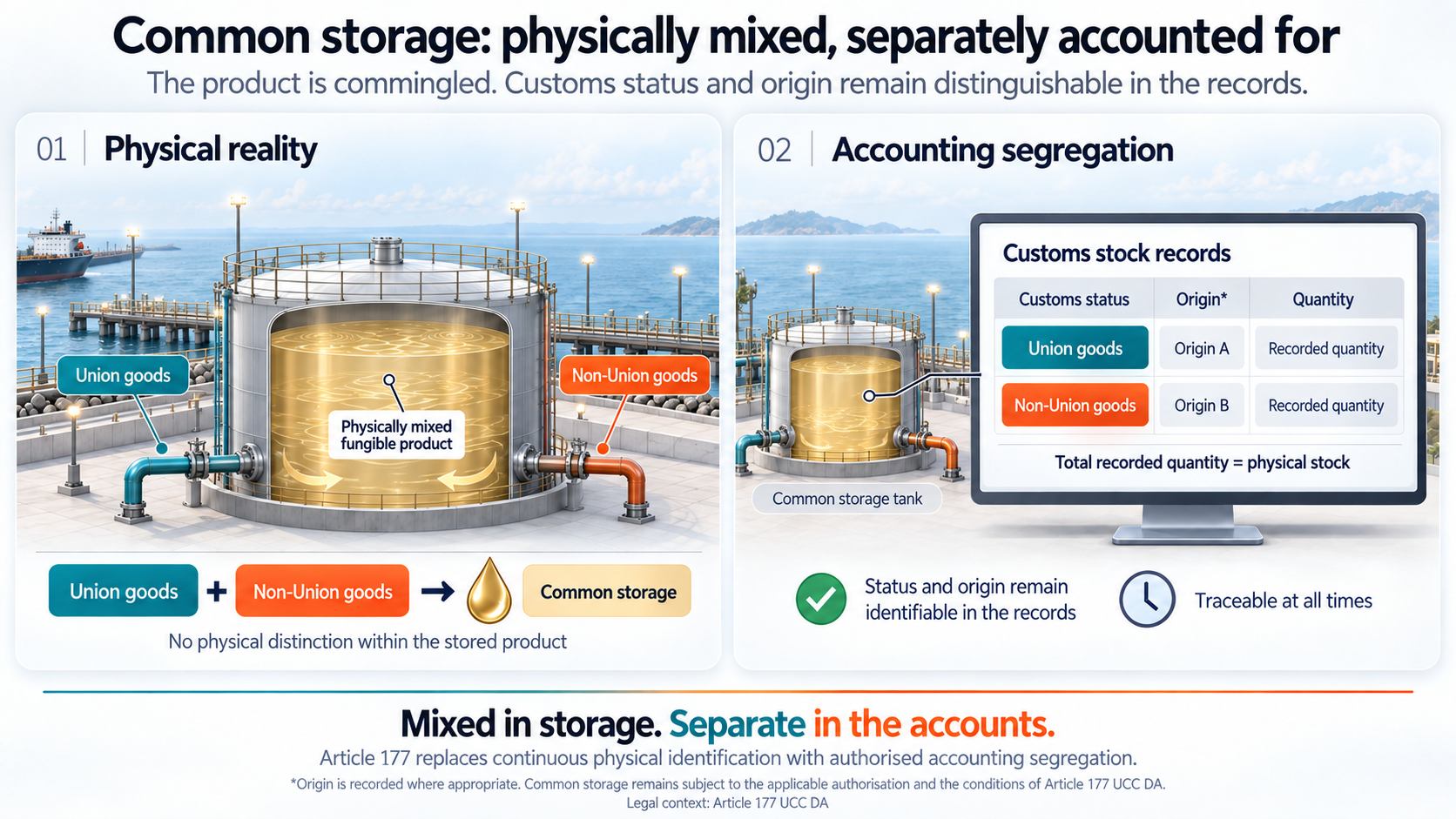
Common storage and accounting segregation are closely connected, but they are not the same. Common storage concerns the actual storage of goods. Accounting segregation subsequently maintains the distinction in the records by type of goods, customs status and, where applicable, origin. It safeguards customs supervision despite the inability to physically distinguish the goods at all times. The records therefore do not independently establish common storage; they make the authorised arrangement auditable. European Commission, guidance, pp. 49–50 and 120
Upon loading, customs status is allocated on the basis of the relevant customs warehouse records. To the extent that the authorised common storage encompasses the integrated configuration, the available stock of qualifying goods within that storage facility forms the basis for allocation. No greater quantity may be allocated than is actually present in the customs warehouse with the relevant status. A separate customs-status balance for each individual tank is therefore not automatically the allocation limit. Dutch Customs Handbook, section 6.4
Historical policy and current European guidance support this approach. For mineral oils, the former Handbook expressly took the boundaries of the tank site as the starting point and permitted, subject to conditions, the substitution of equivalent consignments between tanks. Under the UCC, the European “tank pit” example confirms that common storage may encompass several connected tanks, provided they contain the same product with the same CN code, commercial quality and technical characteristics. The core function—replacing physical differentiation with accountability through the records—has therefore been preserved, without all the former policy conditions necessarily having been carried forward unchanged. Former Dutch Customs Handbook, sections 8.2–8.2.3 European Commission, guidance, p. 122
The biodiesel judgments define the limits of this arrangement, but do not reject it as a general principle. In ECLI:NL:RBNHO:2023:8715, the court found that the consignments concerned were physically separated and individually identifiable. Residues in pipelines and tank heels did not justify treating all tank stocks as commonly stored. In ECLI:NL:GHAMS:2025:990, the Court of Appeal emphasises this physical separation as a particular feature of the case. The judgments therefore concern the administrative substitution of separated consignments, rather than an independent assessment of a terminal duly authorised under the UCC. District Court of Noord-Holland, paragraphs 47–53 Amsterdam Court of Appeal, paragraphs 4.4–4.6
Conclusion
There is a substantiated basis for continuing the arrangement described where the actual storage arrangements and flows of goods prevent physical identification at all times, the relevant common storage and accounting arrangements are covered by the authorisation, and compliance with stock limits can be verified. The biodiesel judgments do not, in themselves, provide grounds for rejecting this practice. Product equivalence and specific statutory restrictions, including those applicable to certain goods subject to anti-dumping or countervailing duties, continue to apply separately. The European guidance supports this interpretation but is not legally binding. European Commission, disclaimer and p. 120
Context and objective of article 177 DA UCC
Customs status: the starting point
The starting point is the distinction between Union and non-Union goods under Article 5(22)–(24) of Regulation (EU) No 952/2013 establishing the Union Customs Code (“UCC”). Article 5(23) defines the categories of goods qualifying as Union goods, including imported goods released for free circulation and goods obtained or produced in the Union exclusively from the Union-status goods specified in that provision. Goods falling outside those categories are non-Union goods under Article 5(24). Accordingly, where mixing Union and non-Union goods produces a resulting product incorporating non-Union material that has not been released for free circulation, that product does not qualify as Union goods merely because some of its constituent material had Union status. Subject to any applicable special arrangements, the resulting product is non-Union goods. UCC, Article 5

Common storage and accounting segregation
Article 177 of Commission Delegated Regulation (EU) 2015/2446 (“UCC DA”) establishes a specific framework for common storage of Union and non-Union goods in customs warehousing facilities. Where it is impossible, or possible only at disproportionate cost, to identify each type of goods at all times, the customs warehousing authorisation must require accounting segregation by type of goods, customs status and, where appropriate, origin. The provision thus permits accounting segregation to replace individual physical identification, subject to the applicable conditions. UCC DA, Article 177, as replaced by Regulation (EU) 2020/877
The purpose of this arrangement is to facilitate bulk storage without eliminating the legal distinction between Union and non-Union quantities. Article 237(3) UCC expressly provides that Union goods authorised to be stored in a customs warehousing facility are not regarded as being under the customs warehousing procedure. Consistently with that distinction, the Dutch Customs Handbook explains that the records for common storage must establish the quantities having Union and non-Union status. Authorised common storage should therefore not be characterised as an arrangement under which the entire stock necessarily becomes non-Union goods upon commingling. UCC, Article 237(3) Dutch Customs Handbook, sections 6.1–6.4
The broader wording applicable from 1 May 2016
Before the UCC framework became applicable on 1 May 2016, Article 534(2) of Regulation (EEC) No 2454/93 expressly required goods placed in common storage to share the same eight-digit Combined Nomenclature (“CN”) code, commercial quality and technical characteristics. Those three express conditions were omitted from the original wording of Article 177 UCC DA. Although the requirement for accounting segregation remained, the new provision was therefore textually broader than its predecessor. The subsequent Commission working paper records this difference, but does not establish that the omission reflected a deliberate policy decision to permit unrestricted mixing of different products. European Commission working paper, 25 October 2017, pp. 2–4
The consequences of that omission were expressly addressed in the Commission’s working paper Common storage, accounting segregation and usual forms of handling (UHF) in Special Procedures, dated 25 October 2017. The paper noted that several requirements under the former legislation no longer appeared in Article 177, specifically the requirements concerning CN classification, commercial quality and technical characteristics. It identified a potential for misuse where Union goods were stored together with non-Union goods subject, for example, to anti-dumping duties, and proposed restoring the former safeguards. The concern was therefore not simply that goods would physically mix. Physical commingling is an ordinary feature of bulk storage. The concern was that accounting segregation could be applied to goods whose differences mattered for their customs treatment, potentially producing fraud risks or unjustified import-duty advantages. European Commission working paper, pp. 2–4
Restoration of the safeguards in 2020
Commission Delegated Regulation (EU) 2020/877 replaced Article 177 with effect from 16 July 2020. The rationale is stated expressly in recital 30:
“In order to avoid any possible misuse of those rules, the storage of Union and non-Union goods together in a storage facility for customs warehousing (common storage) should only be allowed where the goods have the same CN code, commercial quality and technical characteristics.”
Article 177(2) accordingly restored the requirement that the Union and non-Union goods share the same eight-digit CN code, commercial quality and technical characteristics. The amendment thus reinstated the principal product-identity safeguards that had appeared in the pre-UCC legislation. Regulation (EU) 2020/877, recital 30 and Articles 1(25) and 4
The replacement provision also introduced specific safeguards concerning trade-defence measures. Under Article 177(3), non-Union goods subject to the specified duties or measures at the intended time of common storage are deemed not to have the same commercial quality as the Union goods. Article 177(4) provides an exception where the Union goods to be stored with them were previously released for free circulation and the relevant duties were paid. The provision therefore does not impose an unqualified prohibition on common storage involving goods subject to trade-defence duties; its operation depends on the conditions laid down in those paragraphs. Regulation (EU) 2020/877, Article 1(25)
Interpretative significance
The legislative history supports reading Article 177 as a controlled facilitation of common storage, rather than a general authorisation to blend different products or interchange their customs status. Its purpose is to accommodate the practical realities of bulk storage while preserving, through accounting segregation, the quantities attributable to each customs status and safeguarding the customs treatment applicable to the goods concerned.
The relevant distinction is therefore between, on the one hand, a resulting product incorporating non-Union material whose status must be assessed under Article 5 UCC and, on the other hand, goods held within a valid common-storage arrangement under Article 177 UCC DA. In the latter case, physical commingling does not, by itself, require the entire stock to be treated as non-Union goods. Whether a particular operation falls within that framework depends on the applicable authorisation, the characteristics of the goods and compliance with the accounting-segregation requirements.
Conclusion: the objective of Article 177 UCC DA
Article 177 UCC DA should be understood in the context of the UCC’s objectives of facilitating legitimate trade and simplifying customs administration while safeguarding the financial interests of the Union and its Member States. Recital 10 emphasises effective administrative simplification, while recitals 11 and 15 address the protection of financial interests and the fight against fraud. Article 3 gives operative expression to this balance by requiring customs authorities to protect those financial interests while maintaining a proper balance between customs controls and the facilitation of legitimate trade. UCC, recitals 10, 11 and 15 and Article 3
The wording of Article 177(1) reflects that balance. The reference to “a disproportionate cost” expressly recognises that maintaining individual identification may be technically possible but economically unreasonable. The provision is therefore not confined to cases of absolute impossibility. The words “at all times” refer to the continuity of identification during storage, rather than merely the ability to identify goods upon receipt or withdrawal. Read together, these expressions support the conclusion that the provision accommodates storage arrangements in which continuous individual identification cannot reasonably be maintained, by requiring accounting segregation as the alternative means of distinguishing the relevant quantities by type of goods, customs status and, where appropriate, origin. Article 177(1) UCC DA, as replaced by Regulation 2020/877
This facilitation does not dispense with customs supervision or the substantive conditions governing common storage. Rather, it changes the means by which the necessary distinctions are maintained: from individual physical identification to an authorised and verifiable accounting system. The product-identity conditions and trade-defence safeguards in Article 177(2)–(4) limit the arrangement to prevent misuse, as expressly stated in recital 30 of Regulation 2020/877. The legitimate cost savings arising from common storage must therefore be distinguished from unjustified customs-duty advantages obtained through misuse of accounting segregation. Regulation 2020/877, recital 30 and Article 1(25)

Historical Dutch customs policy for bulk storage
Continuity of purpose and relevance of the historical policy
The legislative development discussed above demonstrates that the core function and objective of the common-storage arrangement remained materially the same before and after 1 May 2016. Both former Article 534(2) of the Customs Code Implementing Provisions and current Article 177 UCC DA address situations in which Union and non-Union goods are stored together in a storage facility and it is impossible, or would be possible only at disproportionate cost, to maintain continuous physical identification of the goods concerned. Under both regimes, this practical difficulty is addressed by attributing customs status to quantities recorded in the accounts, subject to the requirement that customs supervision remains fully safeguarded.
The amendments introduced since 2016 did not abandon this fundamental function. After the original wording of Article 177 UCC DA had not expressly reproduced the former product-identity conditions, those conditions were codified again in 2020. Article 177(2) now expressly requires the Union and non-Union goods held in common storage to share the same eight-digit CN code, commercial quality and technical characteristics. According to recital 30 of Commission Delegated Regulation (EU) 2020/877, this amendment was introduced to prevent possible misuse of the arrangement, rather than to abolish the practical facilitation of common storage itself EUR-Lex.
The legislature also codified a specific safeguard for goods subject to trade-defence measures. Under Article 177(3), non-Union goods which, at the intended time of common storage, would be subject to, among other measures, anti-dumping duties, countervailing duties, safeguard measures or specified additional duties are deemed not to have the same commercial quality as the Union goods concerned. Such goods are therefore excluded by law from the ordinary equivalence assessment, subject to the specific exception in Article 177(4) for Union goods in respect of which the relevant duties were previously paid.
These additional safeguards limit the arrangement where differences between the goods are relevant to their customs treatment or could give rise to unjustified duty advantages. They do not, however, alter the underlying premise that common storage and accounting segregation are intended to accommodate equivalent bulk goods whose physical identity and customs status cannot be tracked separately at all times during ordinary storage operations.
Against this background, the Dutch administrative policy applicable before 1 May 2016 remains relevant to the interpretation and practical application of the current arrangement. That policy cannot constitute an independent legal basis for operations under the present UCC framework, but it demonstrates how the Customs authorities previously gave practical effect to the continuing purpose of common storage in the bulk industry. This is particularly relevant to the assessment of equivalence, the tank location as the relevant operational unit, the administrative allocation of customs status and the treatment of unavoidable tank heels and pipeline residues. The former Customs Handbook expressly explained that common storage was made available for bulk goods because, in the ordinary course of business, it was not always possible to distinguish their status “at all times”, also referring to environmental considerations, security of energy supply and energy conservation former Dutch Customs Handbook, § 8.2.
The historical policy should therefore not be regarded merely as an obsolete departure from a fundamentally different present-day arrangement. Rather, it provides relevant context for determining how the same underlying facilitation can be applied in practice within an integrated and continuously operating bulk terminal, subject to the product-identity and trade-defence safeguards that have since been expressly codified.
The Dutch Customs Handbook applicable before 1 May 2016 contained various facilities tailored to the practical circumstances of the bulk industry. These arrangements recognised that, in the ordinary course of business, mineral oils are stored, moved and mixed within an integrated system of tanks and pipelines. Permanent physical segregation or identification of each original lot was not always possible or practical. Subject to certain conditions, the policy therefore allowed for the administrative allocation of customs status, the interchange of goods between tanks and special treatment of unavoidable residual stocks.
Equivalence of mineral oils
For the common storage of oil and oil products, the former Customs Handbook provided that products classifiable under the same CN code could be regarded as equivalent. The explanatory text referred to the designations, quality standards and technical characteristics customarily used in commercial trade and reflected in the CN classification. Subject to additional conditions for specific products, the same CN code therefore served as the practical starting point for determining equivalence.
These additional conditions were set out in Annex 3. Specific distinctions applied, among other things, to light oils with and without biofuel content, certain gas oils and lubricating oils. The approach therefore did not entail the unconditional equivalence of all goods falling under the same CN code, but neither did it require each lot to be identical in every analytical respect. The Customs Handbook illustrated this by reference to the common storage of Community and non-Community fuel oil with different sulphur contents but falling under the same CN code applicable at the time.
References: former Customs Handbook, 15.50.00, § 8.2.2; Annex 3 to section 15.50.00; 15.00.00, Annex 7, § 13.2.1.
The tank location as the unit for allocating customs status
For oil and oil products, the former Customs Handbook expressly identified the tank location, rather than the individual tank, as the relevant boundary for determining customs status:
“For these types of goods, the boundaries of the tank location are decisive for determining customs status.”
It was expressly permissible to interchange equivalent lots held in different tanks, provided that the goods belonged to the same owner and were located at the same site. Their customs status had to be demonstrable, and goods located elsewhere or still in transit could not be taken into account in anticipation of their arrival. A location could consist of several adjoining cadastral plots within the same operational site; the presence of a public road crossing the site did not necessarily prevent it from being treated as a single location.
This arrangement was consistent with the general explanation that, for certain flows of goods in the ordinary course of business, it was not always possible to distinguish their status “at all times”. In addition to practical considerations, the Customs Handbook referred to environmental considerations, security of energy supply and energy conservation. Customs status was therefore linked to the quantity accounted for in the records.
Reference: former Customs Handbook, 15.50.00, §§ 8.2 and 8.2.2.
Special treatment of tank heels and pipeline residues
The former policy recognised that storage tanks are not completely empty following ordinary deliveries. A limited residual quantity, referred to as the tank heel or permanent stock, remains in the tank and can generally be removed only when the tank is fully cleaned.
Subject to cumulative conditions, this tank heel could be excluded from the records maintained for the customs facilities concerned. The actual residual stock could not exceed 0.5% of the tank’s total storage capacity, could not result in a change to the CN code of goods subsequently discharged into the tank and could not increase as a result of parts of new receipts being omitted from the records. In principle, the tank heel had non-Community status, unless only Community mineral oils had been stored in the tank since it was last fully cleaned. The 0.5% threshold was not a fixed allowance: only the residual quantity actually present, up to that maximum, could be excluded from the records.
Of particular relevance is that Community goods falling under a different CN code could be stored on top of this residual stock. In such circumstances, the conditions for common storage were deemed to have been met, provided that the tank was otherwise empty and the CN code, commercial quality and technical characteristics of the goods discharged into the tank did not change.
The Customs Handbook also contained a specific exception for the unintended contamination of light oil by residual product containing biofuel, expressly referring to product remaining in a pipeline as an example. This exception was likewise subject to conditions concerning the product and the quantities involved.
These provisions did not constitute a general exemption for residual stocks. They nevertheless demonstrate that unavoidable physical mixing with residual product did not necessarily result in the entire subsequent lot losing its customs status.
References: former Customs Handbook, 15.00.00, Annex 7, § 13.5; 15.50.00, Annex 3, section on light oils.
Common storage and usual forms of handling
The former Customs Handbook distinguished between common storage and mixing as a usual form of handling.
Common storage was also permitted where its purpose was to bring the product within specification. The Customs Handbook stated that no single new lot arose in such circumstances, even where the product was brought within specification. The original quantities continued to exist administratively with their respective customs statuses. A worked example permitted the available quantity of Community goods to be written off first upon removal, with import formalities being completed only for the excess quantity.
A different approach applied, in the version of the Customs Handbook identified, to mixing as a usual form of handling. A mixture obtained from Community and non-Community components was treated as entirely non-Community; the customs status could not be allocated proportionately to the constituent components. However, for the purpose of calculating import duties, it was possible, upon request, to determine the nature, customs value and quantity of the goods as though the usual form of handling had not taken place. This made it possible to avoid the imposition of duties on the Community component.
This adjustment to the calculation of duties must be distinguished from the preservation of the Community status of the component itself. A potentially earlier policy under which the status of individual components could also be preserved following a usual form of handling has not yet been substantiated by an original dated source and is therefore not presented as an established part of this analysis.
References: former Customs Handbook, 15.00.00, Annex 7, §§ 13.2.1, 13.3.1, 13.3.2 and 13.4.1; 15.50.00, §§ 7.3–7.4.
Relevance to the current assessment
The common thread running through these historical arrangements is that physical mixing was not automatically equated with the loss of customs status. The policy allowed the necessary distinctions to be maintained administratively, taking account of product equivalence, the boundaries of the storage location, unavoidable residual stocks and accurate quantitative stock records.
This development in policy is relevant to the interpretation of Article 177 UCC DA, in particular the terms “storage facility”, “at all times” and “disproportionate cost”. It supports an assessment that considers the full operational cycle of a bulk terminal rather than focusing exclusively on the temporary physical distribution of goods among individual tanks.
The historical policy does not, however, constitute an independent legal basis for continuing every facility that existed under the former arrangements. Whether a particular arrangement is permissible today must be assessed by reference to the applicable EU customs legislation, the relevant authorisation and the specific facts. The historical provisions primarily demonstrate that location-based allocation of customs status and solutions for residual mixing were explicit and controlled elements of Dutch customs policy, rather than merely practices developed by the industry.
The cited sources form part of the official collection entitled “Customs Handbook (HD), valid until 30 April 2016.”
Pratical examples
Shared pipelines
"Physical identification is not possible at all times, (...).”

- Starting position: Tank 1 contains Union goods (T2), Tank 2 contains the same product as non-Union goods (T1), and the shared pipeline contains a known T1 linefill.
- Allocation restricted to a single tank: The T1 linefill reaches the barge before the T2 product from Tank 1. Consequently, loading cannot proceed as the nominated T2 loading without additional measures.
- Accounting segregation at storage-site level: Before loading, the quantity in the pipeline is administratively reallocated from T1 to T2, and an identical quantity in Tank 1 is reallocated from T2 to T1. The total T1 and T2 quantities remain unchanged before loading, and all T1 goods remain under customs supervision.
Tank heel resulting in a loss of customs status
“Physical identification (...) would only be possible at disproportionate cost.”
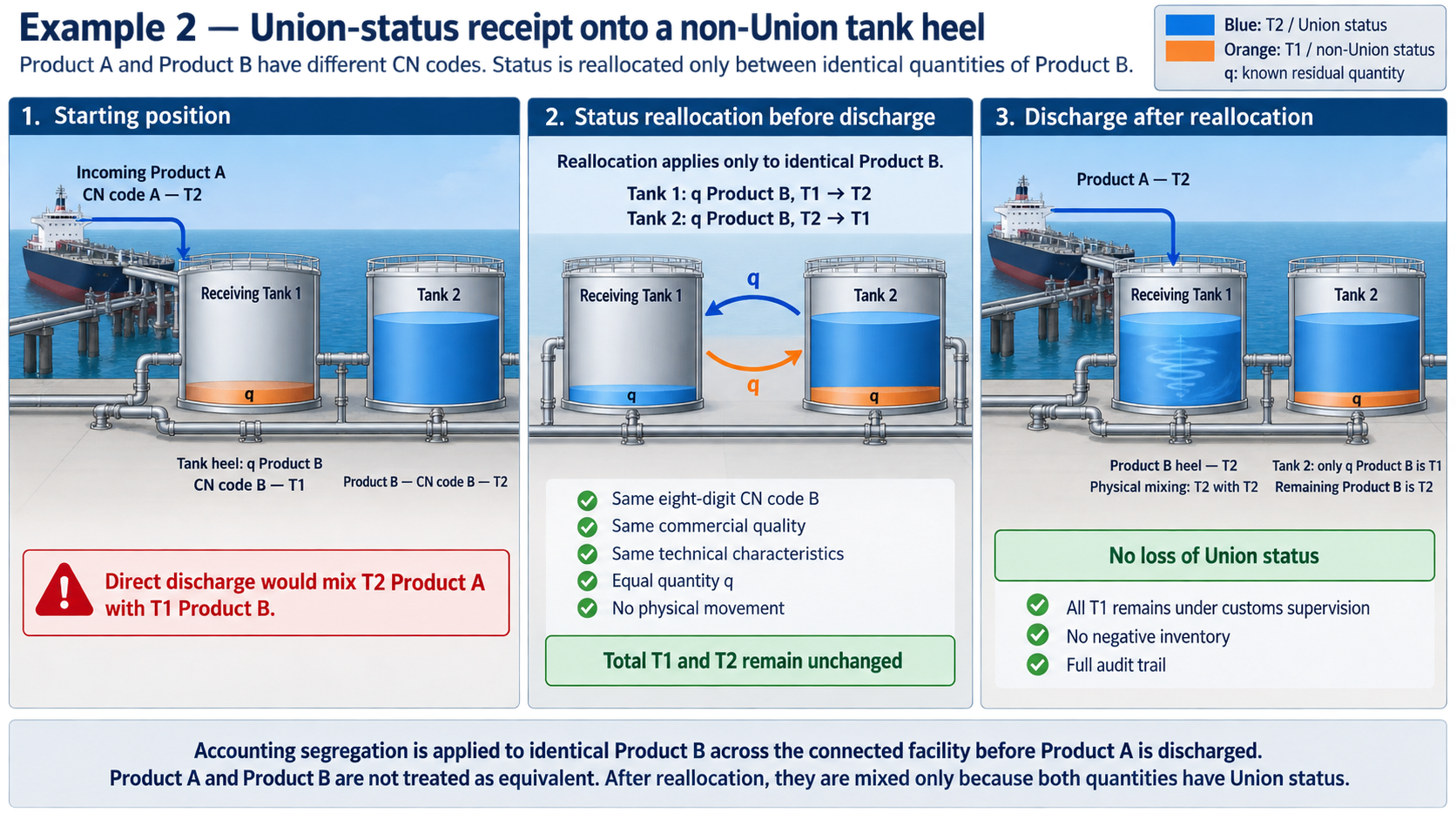
- Starting position: T2 product A, classified under CN code A, is to be received into Tank 1, which still contains a heel of T1 product B, classified under CN code B.
- Reallocation: This takes place exclusively between identical quantities of product B:
- Tank 1: A quantity of product B is reallocated from T1 to T2.
- Tank 2: The same quantity of product B is reallocated from T2 to T1.
- Discharge: Product A is subsequently discharged as T2 onto the heel of product B, which has by then also been recorded as T2. In Tank 2, only the corresponding quantity is recorded as T1; the remaining stock remains T2.
No unnecessary physical operations solely for administrative purposes
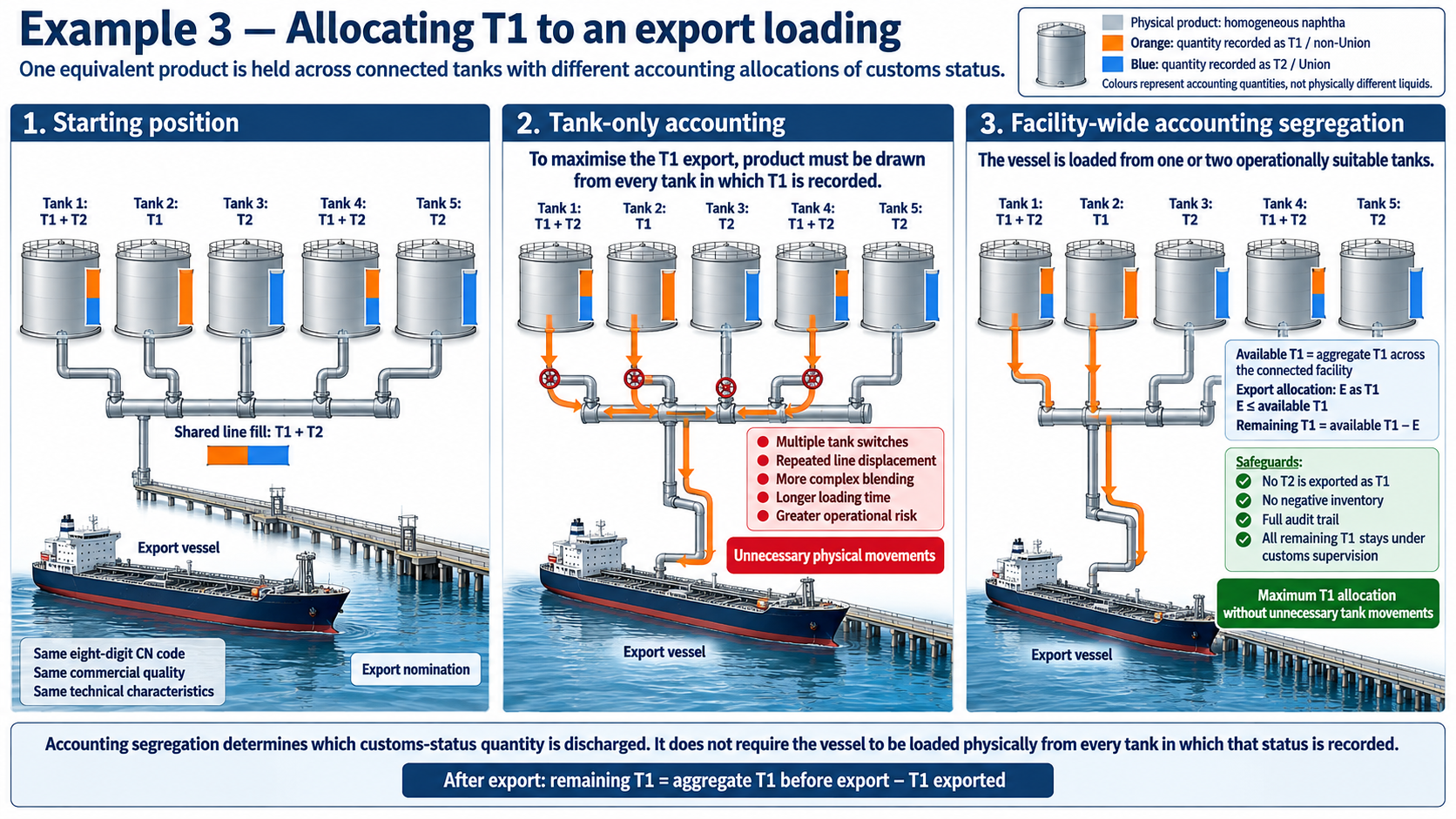
- Starting position: The same equivalent product is distributed across five connected tanks. Some tanks contain quantities administratively recorded as both T1 and T2, while others contain only T1 or T2. The known linefill also comprises quantities administratively recorded as T1 and T2.
- Tank-specific accounting: To export as much T1 as possible, product must physically be loaded from several tanks. This requires switching between tanks, displacing line contents and a more complex loading operation.
- Facility-wide accounting segregation: The vessel is physically loaded from one or two operationally suitable tanks. The export is administratively allocated to the total available T1 stock within the connected facility.
Evaluation of the biodiesel judgments
1. The judgments concern physically separated and identifiable consignments of biodiesel
In ECLI:NL:GHAMS:2025:990, the Court of Appeal confirms that the common storage arrangement could not justify the specific practice whereby physically separated biodiesel from third countries was administratively substituted for EU biodiesel. In paragraph 4.5, the Court expressly links its conclusion to the “particular characteristics of this case”, especially the physical separation. The substantive assessment concerns transactions under the Community Customs Code and its Implementing Provisions (CCC/CCIP), not an authorisation for an integrated tank pit under the current Union Customs Code (UCC). Amsterdam Court of Appeal, paragraphs 2.9 and 4.4–4.6
2. The District Court recognises the separate policy for mineral oils
The former Handbook therefore provides a relevant interpretative reference point. It reflected normal bulk-storage operations, in which customs status cannot always be physically distinguished. For petroleum and petroleum products, the boundaries of the tank site were decisive. Substitution between tanks was possible for equivalent goods belonging to the same owner at the same location, without anticipating future arrivals. Former Dutch Customs Handbook, sections 8.2–8.2.3
3. Current European guidance supports common storage across multiple tanks
Under the UCC, this site-based approach receives specific support from the example “Common storage in different tanks connected with each other” in the European Commission’s guidance.
The example describes a group of interconnected tanks—a “tank pit”—in which products with different customs statuses are stored. The Commission confirms that common storage may be authorised under Article 177 of the UCC Delegated Regulation where all tanks contain the same Union and non-Union product, with the same CN code, technical characteristics and commercial quality. An individual tank therefore does not necessarily define the boundary of common storage. European Commission, Special Procedures Guidance, revision 26, p. 122
The arrangement’s core function has therefore been preserved: where identification at all times is impossible, or would only be possible at disproportionate cost, accounting segregation enables customs supervision.
4. Common storage and accounting segregation are closely connected, but they are not the same
Common storage concerns the actual storage of qualifying goods. Accounting segregation concerns the recording and accounting of quantities by type of goods, customs status and, where applicable, origin.
The records therefore preserve the legal distinction where that distinction cannot be made physically at all times. They do not necessarily require separate physical stocks or independent customs-status balances for each tank. Conversely, a fully reconciled set of records does not, by itself, establish authorisation for common storage. European Commission, guidance, pp. 49–50 and 120
5. Customs status is allocated on the basis of the relevant customs warehouse records
The current Handbook provides that, in authorised common storage, the authorisation holder is free to choose the customs status allocated. However, the quantity allocated may not exceed the quantity present in the customs warehouse with that status. The quantitative limit is therefore not automatically applied to each individual tank. Current Dutch Customs Handbook, section 6.4
Where the authorised common storage encompasses the integrated tank site, the relevant stock records for that site form the basis for allocation. Upon loading, the quantity allocated to a particular status cannot exceed the quantity of qualifying goods actually available with that status.
Conclusion
The biodiesel judgments do not generally call into question a duly authorised practice of common storage and accounting segregation. The former policy for mineral oils and the current European tank-pit example support the proposition that common storage may encompass several connected tanks and that customs status is subsequently allocated on the basis of the relevant customs warehouse stock.
This conclusion nevertheless depends on a demonstrable difference from the circumstances adjudicated: the decisive factors are actual common storage and the inability to physically distinguish the goods at all times, not merely connected pipelines or a single authorisation. The tanks in the biodiesel case were also connected by pipelines; this was insufficient because the consignments concerned remained physically separated.
Subject to those factual and authorisation-related conditions, there is a substantiated basis for continuing the practice described. Specific statutory restrictions, including Article 177(3) of the UCC Delegated Regulation for certain goods subject to anti-dumping or countervailing duties, continue to apply separately. European Commission, disclaimer and p. 120
The same commercial quality and technical characteristics: assessment in the biodiesel judgments
1. District Court: comparable basic properties and the same use are key considerations
It identifies the following supporting considerations:
- Comparable basic physical, chemical and technical properties.
- Use for the same purposes.
- Differences in feedstock and production processes do not necessarily alter the product’s basic definition and properties.
- The way market participants regard the product also supports its comparability.
2. Differences in individual specifications do not automatically preclude equivalence
- CFPP — cold filter plugging point;
- oxidation stability;
- relative density;
- did not necessarily result in different commercial quality or technical characteristics.
For CFPP, the District Court also refers to the Commission: the difference between US and European biodiesel identified in the anti-dumping investigation was minimal, could be compensated for by blending or additives, and was of little relevance to most blends sold on the EU market. This is not a general finding that every CFPP difference is insignificant, but support for the comparability of the products examined. District Court of Noord-Holland, paragraph 41
3. The same CN code is a separate requirement, not a complete quality assessment
4. Court of Appeal: no definitive ruling on equivalence
However, in paragraph 4.6, the Court expressly leaves unanswered whether these products have the same commercial quality and technical characteristics, and whether it is bound by the parties’ unanimous position on that issue. According to the Court, the specific practice was already impermissible because of the physical separation and subsequent removal of the goods. The Court therefore neither independently confirms equivalence nor definitively rules that equivalence is absent. Amsterdam Court of Appeal, paragraphs 2.4 and 4.4–4.6
Summary
The District Court’s judgment indicates that differences in feedstock or individual product specifications do not automatically mean that products have different commercial quality or technical characteristics. The accepted comparability was based primarily on their corresponding basic properties, the same intended uses, and the significance of the differences in commercial practice.