Pages
To do

Types of To-do’s
BzCtrl. supports four types of To-do’s:
Tasks – Regular action items.
Incidents – Issues that need attention or resolution.
Forms – Structured inputs or reports.
Documents – File-based tasks or references (entry via Files Page only).
Creating a To-do
-
Workspace Selected:
When a Workspace is selected in the Navigation Tree (top-right), BzCtrl. knows where to store the To-do. A Quick Entry section appears at the top of the page:-
Select the type of To-do.
-
Enter a title.
-
Press Enter.
The To-do is immediately created in the selected Workspace.
-

-
Domain Selected:
When a Domain (instead of a Workspace) is selected, the Quick Entry section is not available, because the system cannot determine where to store the To-do.-
In this case, create a To-do via the Plus (+) button in the top-right corner.
-
Specify the details, including which Workspace the To-do belongs to.
-

Filters & Options
The Filters & Options button, located in the top-right corner of BzCtrl., gives users control over how data is displayed and provides additional functionalities to make work more efficient.

Filters
-
Apply filters to narrow down the To-do’s or data shown on the current Page.
-
Filters can be saved for future use, so you don’t need to reapply them every time.
Options
-
Export to Excel: Download the currently displayed data in Excel format for reporting or further analysis.
-
Guide Tour: Launch an on-screen walkthrough where buttons and features are explained, helping new users understand the tool quickly.
-
Save Filter: Save the current filter settings for quick access later.
Filters and Options allow you to customize your View and access helpful tools that make managing to-do's, data, and processes simpler and more efficient.
Views
BzCtrl. offers five different Views to display your To-do’s, each designed to support different ways of working and tracking progress. You can switch between Views to find the perspective that best suits your task or project.
| View | Icon / Screenshot | Purpose | Best Use Case |
|---|---|---|---|
| List View |  | Shows extensive details and filters | Data-heavy work requiring full information |
| Cards View (Kanban) |  | Visualizes workflow in columns: To-do / In Progress / Done / Expired | Team meetings and collaborative task tracking |
| Gantt View | [Insert screenshot/icon] | Plots To-do’s on a timeline; highlights status and risks with colors | Monitoring projects, control plans, or time-sensitive tasks |
| Tile View | 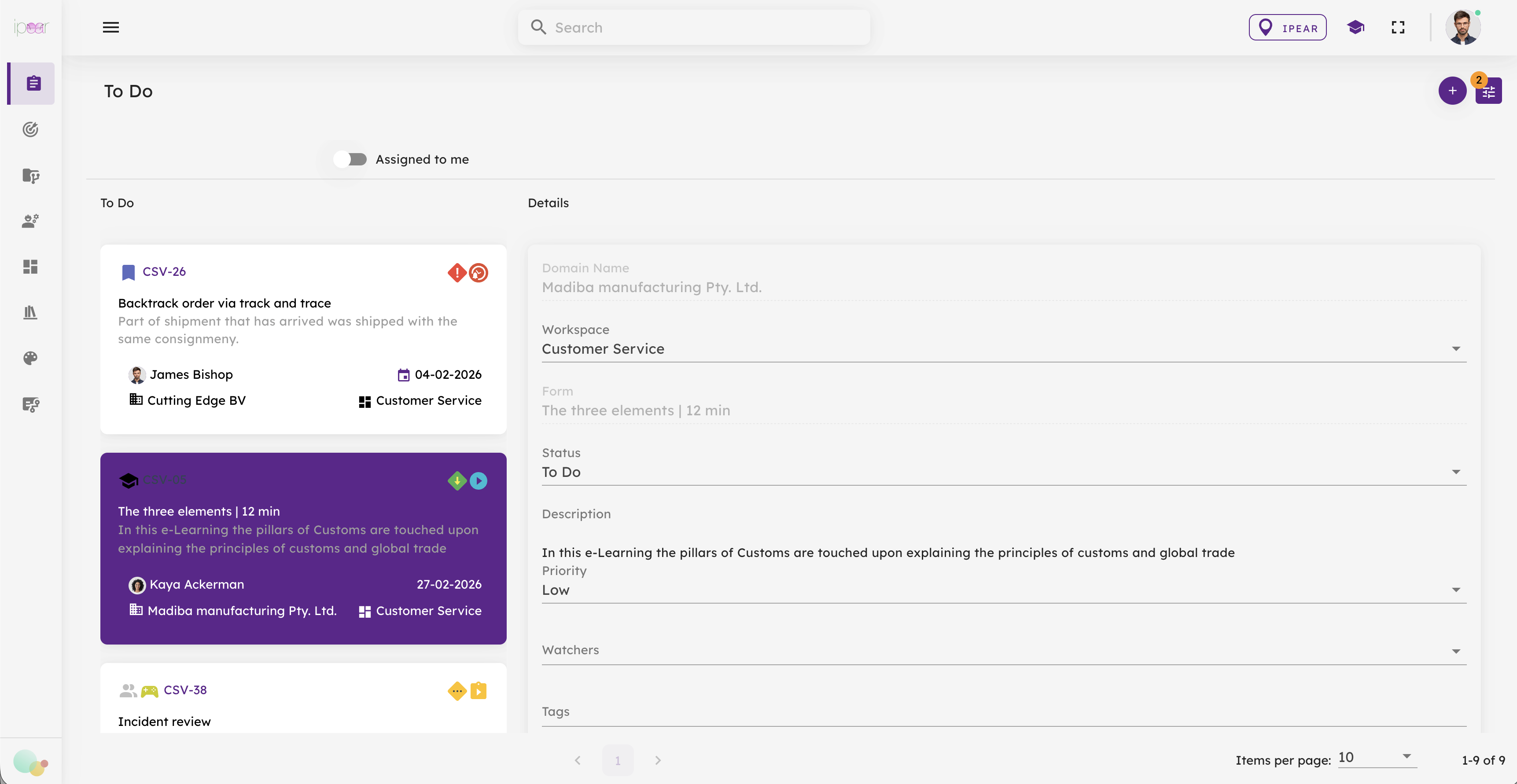 | Displays To-do’s as Tiles; click to view details alongside overview | Tasks needing context and relationships between items |
| Calendar View |  | Shows To-do’s by Due Date; Week and Month views | Planning workloads and tracking deadlines |
1. List View
-
Purpose: Provides the most detailed view of your To-do’s.
-
Strength: Highly effective for seeing extensive details, filters, and statuses.
-
Look & Feel: Simple and functional, less visually appealing, but very practical for data-heavy work.
2. Cards View (Kanban)
-
Purpose: Visualize your workflow in a Kanban-style board.
-
Strength: Ideal for team meetings—shows To-do, In Progress, Done, and Expired at a glance.
-
Use Case: Tracking task status and collaboration across a team.
3. Gantt View
-
Purpose: Plot To-do’s on a timeline, showing deadlines, progress, and risks.
-
Strength: Advanced coloring system highlights status and risk levels.
-
Use Case: Perfect for monitoring control plans, projects, or time-sensitive tasks.
4. Tile View
-
Purpose: Offers context-rich, easy-to-read Tiles for your To-do’s.
-
Strength: Clicking a Tile shows its details alongside the overview, maintaining context while exploring individual items.
-
Use Case: Ideal when you want both detail and an overview of relationships between To-do’s.
5. Calendar View
-
Purpose: Display To-do’s by their Due Date.
-
Strength: Offers Week and Month views for scheduling and planning.
-
Use Case: Planning workloads or tracking deadlines over time.
Configure Workspace
Files
Organise
Dashboards
Risk Register
The Risk Register Page in BzCtrl. allows users to identify, document, and manage risks, including the actions taken to mitigate them. It provides a centralized overview of all risks and supports linking them to relevant activities and assets within the system.
Registering a Risk
Users can create and maintain risks by:
- Defining a Risk Key (unique reference)
- Providing a Title and Description of the risk
- Describing Mitigating Actions
- Assigning a Priority and Status
Risk Overview (Table View)
The main table provides a clear overview of all registered risks, including:
- Risk Key
- Title
- Description
- Priority
- Status
Selecting the Risk Key opens the detailed view of that specific risk.
Risk Details Page
The Details Page provides a complete overview of the selected risk and allows users to:
- View and update the risk description
- Define and maintain mitigating actions
- Link To-do categories (Tasks and Incidents) so that related To-do’s are automatically associated with the risk
-
Connect relevant assets within BzCtrl., such as:
- HandBookR’s
- Canvases
- Forms
This ensures that all activities, documentation, and controls related to the risk are consolidated in one place.
Risk Matrix
In addition to the table view, a Risk Matrix subpage is currently under development.
- The Risk Matrix visualizes risks in a graph based on Impact and Likelihood.
- Each risk is plotted according to its assessed impact and the likelihood derived from related Incidents and Forms.
- This view helps users quickly identify high-risk areas and prioritize mitigating actions.
Risk Matrix score calculation

HandBookR
HandBookR is an embedded documentation feature within BzCtrl., designed to structure, manage, and share knowledge in a clear and accessible way. It enables users to create and maintain structured documentation that is directly linked to business processes and controls.
Structured Documentation
HandBookR organizes information in a logical, hierarchical structure:
- Books – High-level topics or areas
- Chapters – Subsections within a Book
- Pages – Individual content items
This structure ensures clarity and makes documentation easy to navigate and maintain.
Content Creation & Editing
- Create and edit content using a user-friendly editor
- Apply rich text formatting, including images, links, and structured layouts
- Maintain documentation collaboratively with other users
Search & Navigation
- Quickly find information using search functionality
- Navigate easily through Books, Chapters, and Pages
- Link content across pages for better context and connectivity
Version Control
- Automatic tracking of content changes
- View and restore previous versions
- Maintain full visibility over updates
Diagrams & Process Flows
HandBookR allows users to easily include diagrams and process flows within documentation.
- Create visual representations such as flowcharts, process diagrams, and system overviews
- Use drag-and-drop elements, shapes, and connectors to build clear visual structures
- Diagrams can be edited directly within HandBookR
This functionality is powered by the same Canvas capability available elsewhere in BzCtrl., enabling users to combine written documentation with visual process design in one place.
Access Control
- Manage who can view, create, or edit content
- Align permissions with roles defined in BzCtrl.
Integration within BzCtrl.
HandBookR can be linked to other elements in BzCtrl., such as:
- Risks (as part of mitigating actions)
- To-do’s (Tasks, Incidents, Forms, Documents)
This ensures that documentation is directly connected to operational activities and compliance processes.
Canvas
Canvas in BzCtrl. is a visual diagramming feature that allows users to design, document, and share processes, workflows, and structures in a clear graphical format. It is used to complement written documentation (for example in HandBookR) by translating complex information into easy-to-understand visuals.
Core Functionality
Canvas provides a flexible diagramming workspace where users can:
- Create process flows, flowcharts, and diagrams
- Drag and drop shapes, connectors, and elements onto a visual workspace
- Connect elements to represent relationships, sequences, and dependencies
- Structure complex processes in a clear, visual format
- Edit diagrams directly within the tool with instant updates
Typical Use Cases
Canvas is commonly used for:
- Process mapping (end-to-end workflows)
- Control frameworks and compliance flows
- Organizational structures
- System and data flow diagrams
- Visual explanations of procedures or risks
Key Features
- Drag-and-drop editor: Easily build diagrams without technical skills
- Predefined shapes: Standard flowchart and diagram elements available
- Connectors: Link elements to show logic, flow, or dependencies
- Layering and grouping: Structure complex diagrams clearly
- Scalability: From simple flows to highly detailed process maps
- Export & reuse: Diagrams can be reused in documentation or shared across BzCtrl.
Role within BzCtrl.
Canvas is fully integrated into BzCtrl. and can be used directly from documentation (such as HandBookR) or other functional areas. This allows users to combine textual documentation and visual process design in a single environment, ensuring better understanding and alignment across teams.