
**Required licenses**
•Uitbunkeren in transito (T1 bunkering). License required to load T1 (non-EU) bunker fuel in The Netherlands and to supply it as bunker fuel in The Netherlands
•Fictitious excise warehouse (Fictief AGP). License required to load T2 (EU) bunker fuel in The Netherlands and to supply it as bunker fuel in The Netherlands
Scope of the licenses
These licenses only allow loading bunker fuels in The Netherlands and supplying these as bunkers to sea going vessels in The Netherlands. Cross border bunkering is not allowed.
There is 1 exception that requires further investigation; this simplified procedure cannot be used to bunker vessels at locations mentioned in article 2:1-3 ADR (anchorage locations). That requires an additional license called “Toestemming provianderen binnen territorial wateren”.
Export/re-export declaration
•This is not required when using the T1 bunkering simplification (uitbunkeren in transito)
•For all supplied bunker fuels an export (T2) or re-export (T1) is required if the T1 bunkering simplification cannot be used. The requirement to submit the export declaration before departure has been waived in relation to bunker supplies.
Transit (T1 bunkering)
•Under the simplified T1 bunker procedure, bunker fuel on board of the bunker barge is covered by a NCTS Transit document. The bunker supplier has toplace the goods under Transit when loading. This can be outsourced to a customs broker.
Supply to other bunker suppliers (T1 bunkering)
•Contrary to the simplified cross border procedure, the domestic T1 bunker procedure allows the supply of bunker fuel from one bunker trader to the other via ship to ship operation.
•This does not extend the validity period of the original transit document.
**Formalities during supply (T1 and T2 bunkering)**
•Advance notification. Customs needs to be notified of each bunker supply at least 2 hours before the expected time of supply.
•Document type: ZZZ in case of the T1 bunkering simplification or EX in other cases
•EORI number of Vitol Bunkers BV
•Name and IMO number of the seagoing vessel that will be supplied
•Expected time of supply
•The advance notification has to be submitted as an electronic “PRO message” using single window maritime platform.
•Point of attention: Registration electronic messages (registratieelektronischberichtenverkeer) required.
Clearance of the procedure (T1 bunkering)
•The T1 bunker procedure is properly cleared when within its validity period there are bunker receipts attached to the Transit document covering the full quantity.
•If this is done too late or not for the full quantity, there is a non-clearance which gives rise to assessing import duties and excise duties.
**Bunker receipt (T1 and T2 bunkering)**
The bunker receipt is a critical document in the bunkering process. It serves as evidence of the fact that the fuel mentioned on the bunker receipt has been supplied to a sea going vessel. As such it serves as evidence that the goods have left EU customs territory. The bunker receipt clears the duty suspension procedures that apply to the fuel before the bunker supply is made. Without a bunker receipt duties will become payable over the uncleared quantities.
•For each bunker supply a bunker receipt has to be issued (2 copies)
•Language: Dutch, English, German or French
•No required format, list of minimal data content provided by customs
•Bunker receipt must get a unique and sequential number
•Bunker receipt must be signed by an authorized crew member of the receiving sea going vessel
•One copy remains on board of the sea going vessel, one copy is on board of the bunker barge until the BGD quantity to which it belongs has been fully supplied to sea going vessels. It allowed to replace the original bunker receipt on board of the bunker barge for a copy.
•The bunker receipts have to be kept in the records of the bunker supplier for at least 7 years.
E-AD document (T2 bunkers)
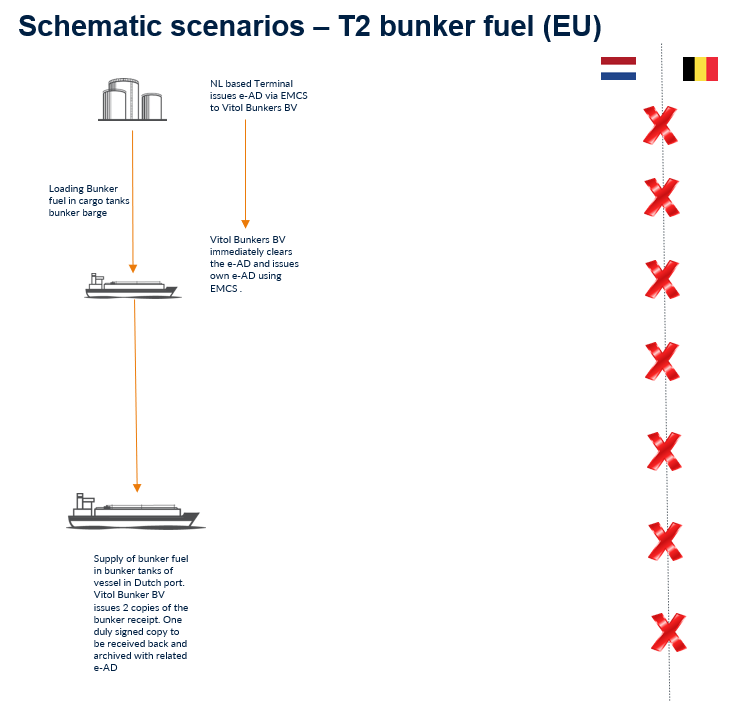
•EU bunker fuel on board of the bunker barge is covered by an e-AD document (equivalent of the Transit document for T1 bunkers).
•The loading terminals issued an e-AD via EMCS to the bunker supplier
•This e-AD is immediately and fully cleared and replaced by an e-AD issued by the bunker supplier to cover the T2 bunker fuel on board of its bunker barge.
•This e-AD is cleared by attaching bunker receipts to it, similar as the clearance of the Transit document.