AOIC | VTTI Terminals II B.V.
- Document governance, purpose and scope
- Definitions, abbreviations and acronyms
- Introduction
- Terminal operating model and goods flows
- Customs and excise
- Customs and Excise Authorisations
- Customs procedures
- Customs declarations and discharge of customs procedures
- Customs and excise data elements
- Safety & Security
- Customer governance
- Risk and Control Framework
- Organization personnel
- Competence and professional qualifications
- Risk register
- Incident registration
- Computerization and administration
- Schematic overview
- Control activities, monitoring and testing
Document governance, purpose and scope
- The terminal operations;
- The customs and excise concepts relevant in the context of these operations;
- The processes implemented for properly determining and maintaining customs data elements;
- Safety and security aspects;
- The customer governance setup (i.e., customer screening, onboarding, monitoring);
- The control framework, consisting of the combination of procedures, systems and measures implemented to keep the terminal operations up with AEO-standards;
- Internal control (i.e., the controls implemented to monitor compliance).
Definitions, abbreviations and acronyms

| AO/IC | Document describing the Administrative Organization and Measures of Internal Control. Which is this document itself |
| BzCtrl. | Cloud based control tool to perform business controls in a structured and efficient manner |
| CS | Customer Services team |
| ERP | Enterprise Resource Planning system (Tomcat rebranded and upgraded to ATLAS) |
| GT&Cs | General Terms and Conditions |
| HQ | Headquarters |
| OPS | Operations team |
| QOL | Quality Online |
| C&E | Customs and excise |
| EU | Customs territory of the EU |
| HS | Harmonised System, the global framework for commodity codes |
| CN | Combined Nomenclature, the EU implementation of the HS |
| CMS | Customs Management System - software module with automated business rules, linked via an interface with ERP. Used for customs declaration purposes |
| HSE | Health, Safety and Environment |
| CGT | HQ Customs and Global Trade team |
The orange colored callouts in this document refer to a specific compliance risk. Each risk identified is included in VTTI’s Risk Register in BzCtrl. The risk register shows which measures have been implemented to mitigate the respective risk.
The blue colored callouts in this document refer to a procedure or other document that covers the relevant topic in more detail.
Introduction
Statutory relations are included here
3198LS Europoort Rotterdam
The Netherlands
1041 AD Amsterdam
The Netherlands
More details on how the C&E function for terminal services is organized from a group perspective is included here
Terminal operating model and goods flows
Operations
- Arrival of incoming product at the terminal by a Mode of Transport (i.e. vessel, barge, truck, rail, or pipeline);
- Receipt of the product and transfer between the mode of transport and the storage tank;
- Storage of the product and, where applicable, blending, tank-to-tank transfers, or other limited handling operations;
- Loading of the product from the storage tank to the designated mode of transport for onward shipment;
- Dispatch of outgoing product from the terminal.
.png)
The goods handled at the terminals comprise petroleum products, chemicals, and other energy-related commodities. These goods are generally classified under Chapters 22, 27, 29, and 38 of the Harmonized System (HS) and Combined Nomenclature (CN).
Customs and excise
Customs and Excise Authorisations
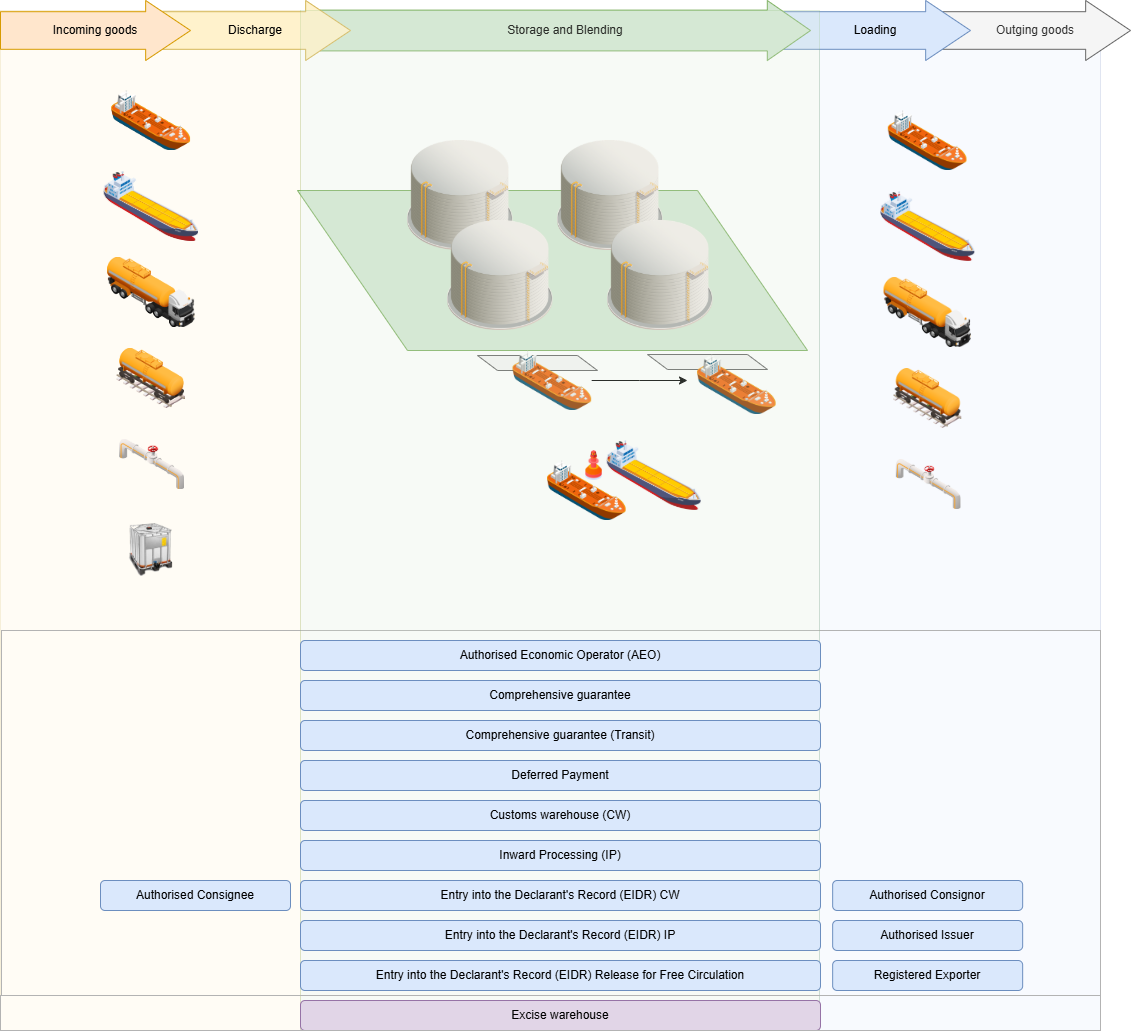
Copies of the customs and excise authorisations are maintained in BzCtrl under the VTTI Terminals II B.V. section (Files → Customs and Excise Licenses).
The practical application of equivalent goods, including the related control measures, is described in VTTI’s “Equivalent Goods” procedure.
The customs and excise authorisations are crucial to the continuity of VTTI's terminal operations. Their scope determines which operations the terminals can and cannot execute (e.g. which products can be stored or blended). As such, VTTI has implemented measures to prevent non-compliance with authorisation requirements, activities outside the scope of the authorisations, and the unintended expiry of an authorisation.
See Risk R-01 in the Risk Register.
Customs procedures
General principles
The customs and excise procedures applied at the terminals are aligned with the operational lifecycle of the goods involved. The operational processes are described in the Operations section of this AO/IC. This chapter describes the customs and excise procedures governing the movement, storage, processing and dispatch of the goods.
Throughout the terminal process, goods may be subject to customs supervision, excise duty suspension or be in free circulation, depending on their customs and excise status. The initial customs and excise treatment is determined upon first arrival at the terminal and may subsequently change during the lifecycle of the goods as a result of storage, blending, manufacturing, transshipment, importation or dispatch activities.
The customs and excise procedures described in this chapter are performed under the authorisations described in the preceding Customs and Excise Authorisations section.
Systems and User involvement
The administration and monitoring of customs and excise procedures is supported by an integrated process involving VTTI’s ERP System, its Customs Module and the relevant VTTI Users. Users register and maintain the operational activities and customs and excise-relevant data in the ERP System. Based on this information and predefined business rules, the Customs Module determines the applicable customs and excise treatment, performs compliance validations and initiates the required customs declarations, excise formalities and record-keeping actions.
Users review and follow up on the resulting system feedback, with Customs Specialists at the terminal or HQ providing support and specialist assessment where required by the nature or complexity of the transaction.
Incoming goods and goods receipt
Upon arrival, goods may enter the terminal under coverage of a Transit document (T1) or an electronic Administrative Document (e-AD). Union goods that are not subject to excise control may arrive without such a document. Goods arriving directly from locations outside the European Union may also arrive without a preceding customs or excise movement document and will be subject to the appropriate customs formalities upon arrival.
During the goods receipt process, VTTI records the arrival of the goods and performs the customs and excise actions associated with the preceding movement procedure. This may include the discharge or closure of transit procedures or excise movements and the registration of the goods and their customs and excise status within the terminal administration.
Storage and processing
Following receipt, the goods are assigned to the customs and excise treatment applicable to their status and intended storage and handling. Non-Union goods are generally placed under the Customs Warehousing procedure, Union goods subject to excise duty suspension are entered into the Excise Warehouse, and other Union goods are recorded in the Free Warehouse.
The terminal location is authorised as a customs warehouse, comprising of the complete infrastructure of tanks, pipelines, jetties and refinery. To optimize storage capacity and avoid disproportionate costs, accounting segregation is applied and non-Union and Union goods are commonly stored.
Non-Union goods may instead, or at a later stage, be released for free circulation. Following their release, the goods are entered into the Excise Warehouse or recorded in the Free Warehouse, depending on whether they are subject to excise duty suspension.
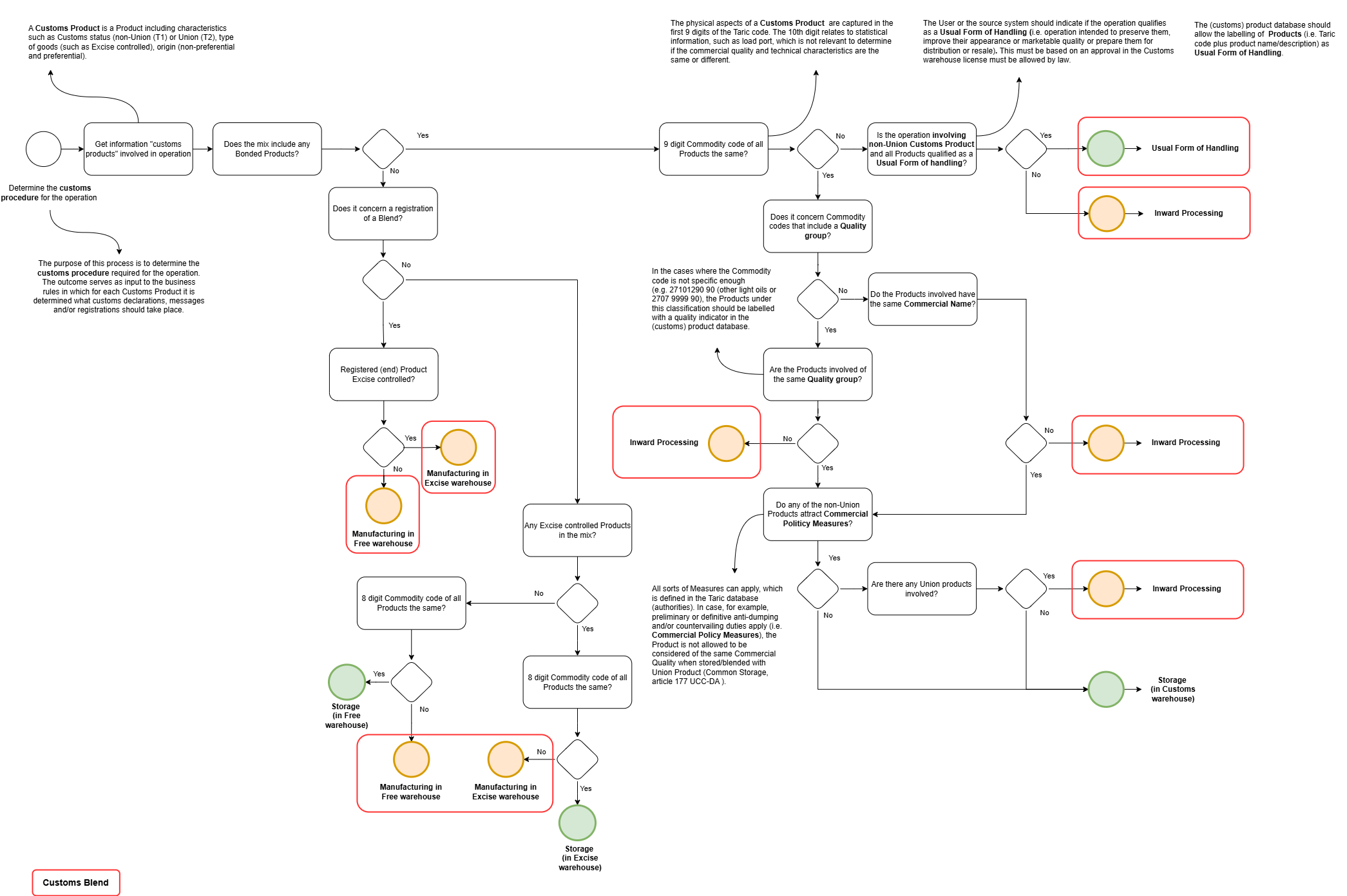
Where goods are blended, manufactured or otherwise processed, the applicable customs and excise treatment is determined based on the customs and excise status and technical characteristics of the goods involved, as well as the nature of the operation. Depending on the outcome of this assessment, the operation may be treated as storage, manufacturing in the Excise Warehouse or Free Warehouse, Usual Forms of Handling under the Customs Warehousing procedure, or Inward Processing.
Outgoing goods
Upon dispatch from the terminal, goods may leave under excise duty suspension covered by an e-AD, under the transit procedure covered by a T1 document, under an export or re-export procedure, or as Union goods in free circulation, where applicable. The required customs declarations, excise messages and supporting records are generated and maintained in accordance with the applicable legal requirements and authorisations.
The detailed functional and technical design of the ERP System and Customs Module, including the Parcel administration model, procedure determination logic, business rules and declaration processes, is described in Annex AO/IC ATLAS-CMS.
The flow chart below provides an overview of the customs and excise procedures that may apply throughout the lifecycle of goods handled at a VTTI terminal.
Customs declarations and discharge of customs procedures
Nomination
Declaration
- Presentation of the goods;
- Entry in the declarant's records;
- Submission of the supplementary declaration.
Presentation of the goods is the legal act of making goods available to Customs for control, while the presentation notification is the electronic message used to inform Customs that the goods have been presented. A presentation notification is lodged whenever goods are placed under a customs procedure requiring presentation of the goods. When goods are placed under successive customs procedures, Customs may waive the obligation to lodge a presentation notification. Dutch Customs waives this obligation at the second and further placements, provided that the goods are fully traceable in a single administration. This waiver is referred to as the Chain Arrangement (ketenregeling). The principal advantage of the Chain Arrangement is that physical customs controls (if any) can generally be limited to the arrival of the goods at the terminal when they are placed under the first customs procedure in the chain. A key condition for the application of the Chain Arrangement is that, at the first link in the chain, sufficient information and supporting documentation is available to enable Customs to perform any controls that may be required at later stages in the chain. For example, where goods are ultimately intended to be released for free circulation, Customs must be able to verify at the first placement in the chain that all relevant import requirements have been met.
The supplementary declaration is lodged via the customs declaration system and must be submitted no later than 10 days after the goods have been entered into the declarant's records. The reference period is one calendar day, meaning that all goods entered into the records on a particular day must be covered by supplementary declarations submitted 10 days later. For example, goods entered into the records on 1 January must be covered by supplementary declarations submitted on 11 January. Failure to submit a supplementary declaration within the prescribed deadline constitutes a breach of the conditions of the EIDR authorisation. Depending on the circumstances, Customs may require corrective action, impose administrative penalties, increase compliance monitoring, or, in cases of repeated or serious non-compliance, suspend or revoke the authorisation.
Monitoring and discharge of customs and excise procedures
VTTI monitors the timely and correct discharge or closure of customs procedures, movements and declarations in which it is involved. This includes, among other things, monitoring confirmations of exit for export and re-export declarations, the discharge of transit movements and e-ADs, and the discharge of the inward processing procedure.
Monitoring and discharge of customs procedures is to a large extent automated and embedded in VTTI’s ERP system and CMS. The systems register the relevant customs procedures and movements, process messages received from the customs authorities, and identify procedures or movements that have not been discharged or closed within the applicable or expected period. For inward processing, declarations entering the procedure are linked to the subsequent declarations or records by which the procedure is discharged.
Open, overdue or otherwise exceptional items are made available for review by the user. The user investigates such items and, where required, obtains supporting information from the customer or other parties involved, submits follow-up messages or evidence to the competent authorities, and takes or initiates corrective action. Items remain subject to monitoring until they have been resolved or otherwise appropriately accounted for.
Automation
Review procedures
The detailed functional and technical design of the ERP System and Customs Module, including the Parcel administration model, procedure determination logic, business rules and declaration processes, is described in Annex AO/IC ATLAS-CMS.
Customs and excise data elements
Introduction
Accurate and complete customs data is essential for maintaining VTTI’s customs records and preparing customs declarations. This chapter describes how the most important customs data elements are established and controlled.
When considering the allocation of risk and responsibility for determining these customs data elements, a distinction should be made between the public law and private law perspectives.
From a public law perspective, more specifically customs and excise legislation, VTTI bears responsibility towards the customs authorities for the accuracy and completeness of the information contained in any customs declaration it lodges and for the authenticity, accuracy and validity of the documents supporting the declaration. This responsibility applies regardless of whether the declaration is lodged in VTTI’s own name or on behalf of a customer under customs representation.
From a private law perspective, the customer is responsible for providing VTTI, in a timely manner, with the information and documentation required to determine the relevant customs data elements and to prepare a complete, correct and timely customs declaration. This responsibility is reflected in the general terms and conditions applicable between VTTI and its customers.
VTTI is generally not the owner, seller, purchaser, manufacturer or producer of the goods. Consequently, VTTI has limited independent visibility of the characteristics and composition of the goods, the underlying supply chain and transactions, the contractual arrangements between the parties involved, and the production or sourcing circumstances relevant to the determination of customs classification, value and origin. VTTI therefore necessarily relies to a significant extent on information and documentation provided by the customer.
From a practical perspective, the determination of customs data elements therefore requires cooperation between VTTI and the customer. The customer provides the relevant information and supporting documentation through the nomination process. On the basis of this information, VTTI determines or records the customs data elements required for its customs records and declarations in accordance with the procedures described in this chapter.
CS performs predefined completeness, consistency, sanity and reasonableness checks on the information and documentation provided by the customer. The nature and extent of these checks depend on the customs data element concerned, the information reasonably available to VTTI and the circumstances of the transaction. These checks do not replace the customer’s responsibility for assessing and substantiating facts and circumstances that are known to the customer but cannot reasonably be independently established by VTTI.
The relevant customs data elements, supporting information and documentation are recorded or archived in VTTI’s ERP system and CMS. These systems provide an audit trail between the customer’s nomination, the customs data used in VTTI’s administration and the resulting customs declarations.
Classification
A link to VTTI's "C&E Classification" procedure is included here
A link to VTTI's “IT – Product masterdata” procedure is included here.
Customs value
When a parcel is registered in the terminal's ERP system, the value of that parcel is recorded by CS in line with the current market value. As such, all parcels registered in the ERP system are accompanied by a value.The value becomes relevant for customs purposes when an import declaration is submitted. Where the applicable import duty rate is 0%, the goods qualify for preferential treatment upon import, or where a specific duty applies (i.e., duties are not calculated over the value but over another factor such as weight), the customs value declared serves a purely statistical purpose and has no financial impact. In such cases, VTTI has agreed with the customs authorities to use the market value registered for the parcel as the customs value.If the import duty rate exceeds 0%, no preferential treatment applies or customs duties due are calculated on an ad valorem basis, the customs value will be determined in accordance with the general customs valuation framework of the UCC. This means that the customs value will in principle be determined in line with the transaction value method.More practical details on customs valuation are included in VTTI's "Customs valuation procedure", which can be found here.
Origin
When an incoming parcel is registered in the terminal’s ERP system, the country of non-preferential origin indicated by the customer in the nomination is recorded by CS. The country of non-preferential origin must be provided before the goods can be accepted at the terminal. Any origin documentation provided by the customer is retained in the Document Management System and linked to the relevant parcel. CS performs a reasonableness check on the origin information and supporting documentation before relying on it for customs or compliance purposes.
Non-preferential origin is relevant for customs declarations and for the application of commercial policy measures, such as sanctions and anti-dumping duties. Where goods leave the terminal without having undergone processing or blending that may affect their origin, VTTI uses the non-preferential origin recorded for the relevant incoming parcel or parcels. Where goods have been blended or otherwise processed at the terminal, VTTI determines the non-preferential origin of the resulting product on the basis of the applicable origin rules and the information available in the terminal’s systems. Until that determination has been completed, no specific country of origin may be used for the resulting product.
Preferential origin becomes relevant where preferential tariff treatment is claimed upon import or where the customer requests a proof of preferential origin for an outbound shipment. For incoming goods, preferential tariff treatment is only claimed where the normally applicable import duty rate exceeds 0%, a preferential arrangement applies and a valid proof of origin is available. For outgoing goods, VTTI only issues, makes out or facilitates a proof of preferential origin where the originating status of the product has been established and substantiated under the applicable preferential arrangement. Where goods have been blended or processed at the terminal, this requires a separate assessment under the product-specific origin rules of the relevant arrangement.
VTTI relies on the origin information and supporting documentation provided by the customer for the goods and materials before their arrival at the terminal. VTTI supplements this information with its own records of the storage, movement, blending and processing activities performed at the terminal. Where the available information is incomplete, inconsistent or gives rise to doubt, VTTI will request clarification or additional supporting documentation. VTTI will not use an origin for customs or compliance purposes, claim preferential tariff treatment or issue, make out or facilitate origin documentation while material concerns remain unresolved.
Quantities
A link to VTTI's "C&E - OPS Measurements" procedure is included here.
Safety & Security
Certifications
Both ETT and ETA hold various safety and security certifications.
ETT holds certifications such as:
- ISO 9001:2015 approved by Lloyd’s Register
- RBI conform EEMUA 159
- ISPS by Rotterdam Port Authority
- ISCC EU & Plus Certification
ETA holds certifications such as:
- ISO 45001:2018 approved by Lloyd’s Register
- ISO 14001:2015 approved by Lloyd’s Register
- ISO 9001:2015 approved by Lloyd’s Register
- RBI conform EEMUA 159
- Port Security Certificate issued by The Mayor of Amsterdam
Customer governance
Customer onboarding process
- hoe worden werkafspraken gemaakt?
- Client screening?
- etc.
Contractual relations
Part of VTTI’s services is handling customs and excise formalities on behalf of VTTI’s customers. To enable VTTI to handle these formalities in a compliant manner, the customer is required to provide VTTI timely with the correct and complete data needed to lodge a particular customs or excise declaration (article 17.2 GT&Cs).
VTTI's General Terms & Conditions are included here.
Customs representation
- Customs warehouse
- Inward processing
- Import via VTTI’s EIDR authorisation.
- Declarations for release for free circulation via the “normal declaration procedure” (i.e., the declaration is not lodged via EIDR, but directly in the declaration system of the Customs Authorities);
- (Re-)export.
- Declarations for customers not established in the EU will always be filed under indirect customs representation, as EU customs legislation requires the declarant to be established in the EU. Indirect customs representation means that the declaration is filed on behalf of the customer, but in VTTI’s own name.
- Declarations for customers established in the EU can be filed under direct customs representation. Direct customs representation means that the declaration is filed on behalf of and in the name of the customer.
Risk and Control Framework
Organization personnel
More details on how the C&E function for terminal services is organized from a group perspective is included here.
Competence and professional qualifications
- For less experienced employees: Training programs at recognized educational establishments, such as Evofenedex or similar;
- For all employees involved in customs matters: Annual internal customs and excise training, organized by CGT;
- For all employees involved in customs matters: Internal toolbox training sessions (organized by CGT in case of relevant legislative changes or other relevant developments);
- For all employees involved in customs matters: E-learning program in BzCtrl;
- For all employees involved in customs matters: Webinars organized by Customs and other relevant authorities;
- For all employees involved in customs matters: External conferences concerning customs matters.
Risk register
All customs and excise compliance risks identified by VTTI are centrally captured in a risk register. For each identified risk, appropriate mitigating measures are implemented. The risk register provides a clear overview of the relationship between risks and their corresponding controls, enabling visibility of both the identified risks and the measures in place to manage them at a glance. Mitigating measures may include internal controls, automated checks or validations within ERP systems, or specific work instructions.
The risk register is included here
Incident registration
Computerization and administration
ERP
A detailed description of the process governed through ATLAS and CMS is included here.
A detailed description of the IT Authorisation procedure is included here
A detailed description of the Data security procedure is included here
A detailed description of the Technical data procedure is included here
Quality online
- storage of work instructions
- HSE
BzCtrl.
- Domains and workspaces – BzCtrl. is structured into multiple domains and workspaces, allowing user‑specific access rights to be defined so that only elements relevant to a particular user are visible.
- Risk register – All identified customs-related risks are centrally documented. The risk register plays a central role in VTTI’s control framework. Each risk is mitigated through measures designed to keep the risk manageable.
- Document management – The AO/IC, procedures, work instructions, and other relevant customs & excise documents can be accessed and updated centrally in BzCtrl. BzCtrl includes a revision history function, allowing updates to be monitored and earlier versions to be retrieved. Access rights and authorization to make updates can be granted to specific individuals, or documents can be marked as private, limiting access to a defined group of colleagues.
- Internal controls – Customs and excise related ICs are integrated in BzCtrl. They can be assigned to a specific user, including a fixed recurrence term, deadline and reviewer. The results of internal controls are made accessible via BzCtrl.’s dashboard function.
- Incident register – Customs compliance incidents (at HQ or at one of the terminals) are registered centrally in BzCtrl, providing the CGT team with real-time insight, and enabling the team to take measures as needed.
- Archiving – Documents relevant for customs & excise can be stored in the system.
- E-learnings – BzCtrl. is VTTI’s central tool for customs- and excise-related e‑learnings, which can be assigned to specific users based on content and role.
- To-do – BzCtrl’s to‑do function makes the system suitable for use as a project management tool, enabling the tracking of actions, the setting of deadlines, and the assignment of actions to specific users.
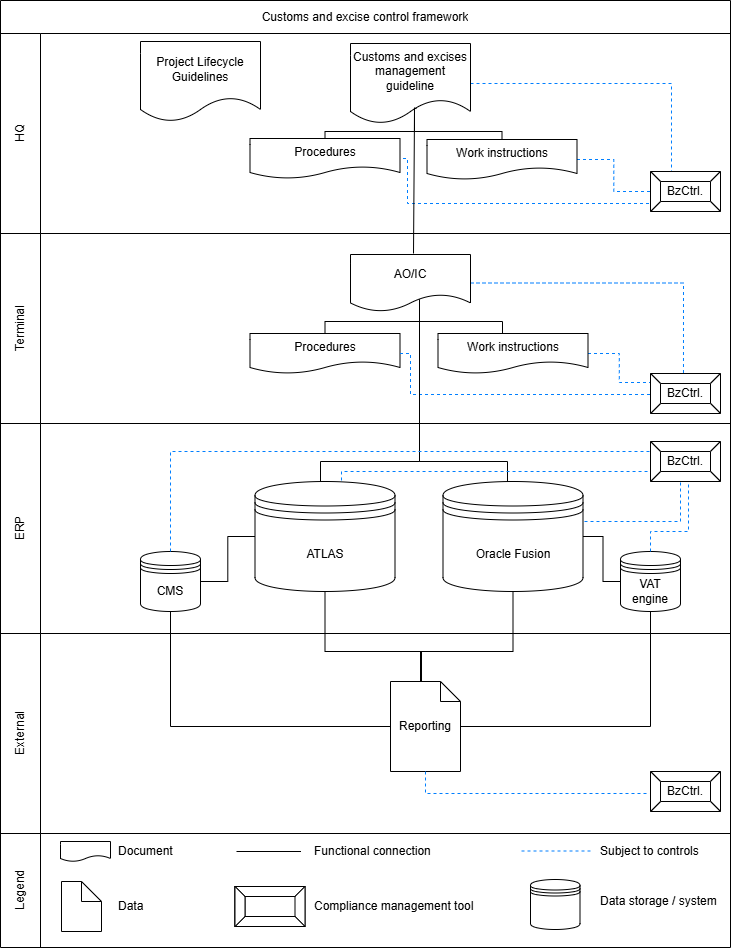
Schematic overview
Control activities, monitoring and testing
Automated controls
The automated controls and relating business rules are described in this annex.
Manual controls
A link to VTTI's "C&E - Customs monthly declaration GPA" procedure is included here.
A link to "Work agreements GPA VTTI Terminals II BV" is included here.
AEO/self-monitoring and continuous improvement
| Audit trail | The availability of an adequate audit trail to ensure an efficient and effective audit based customs control. Separation Union from non-Union goods. SAQrev6 3.1 ISO 9001:2015, section 6. SAQrev6 3.2.2. |
| Accounting system | A satisfactory system of managing commercial and where appropriate, transport records, which allows appropriate customs controls (Articles 39 (b) UCC and 25 UCC IA). SAQrev6 - 3.2; ISO 9001:2015, section 6. |
| Compliance record | An appropriate record of compliance with customs requirements (Articles 39 (a) UCC and 24 UCC IA). Section 2 from the SAQrev6. |
| Customs routines | Ensuring compliance with regard to applying the appropriate customs procedures (Subsection 3.5 from SAQ rev6) and non-fiscal measures (Subsection 3.5.4 from SAQ rev6) |
| Flow of goods | A satisfactory system of managing the appropriate customs treatment of goods handled. SAQrev6 - 3.4; ISO 9001:2015, sections 6,and 7 |
| General information | The purpose of this control is to verify that no crucial changes took place in relation to the organisation, operational licenses and measures of internal control. SAQrev6 Section 1.1 TAXUD/B2/047/2011-REV6 |
| Information security | Procedures as regards back-up, recovery and fall-back and archiving options (Subsection 3.6 from SAQ), protection of computer systems (Subsection 3.7 from SAQrev6) and documentation security (Subsection 3.8 from SAQrev6). |
| Practical standards of competence or professional qualifications | Practical standards of competence or professional qualifications directly related to the activity carried out (Article 39 (d) UCC, Article 27 UCC IA, AEO Guidelines Part 2 Section IV) |
| Proven financial solvency | The purpose of this control is to validate that the company continues to meet the criteria around financial solvency. (Article 39 (c) UCC, Article 26 UCC IA, AEO Guidelines Part 2 Section III) |