Customs and excise
- Customs and Excise Authorisations
- Customs procedures
- Customs declarations and discharge of customs procedures
Customs and Excise Authorisations
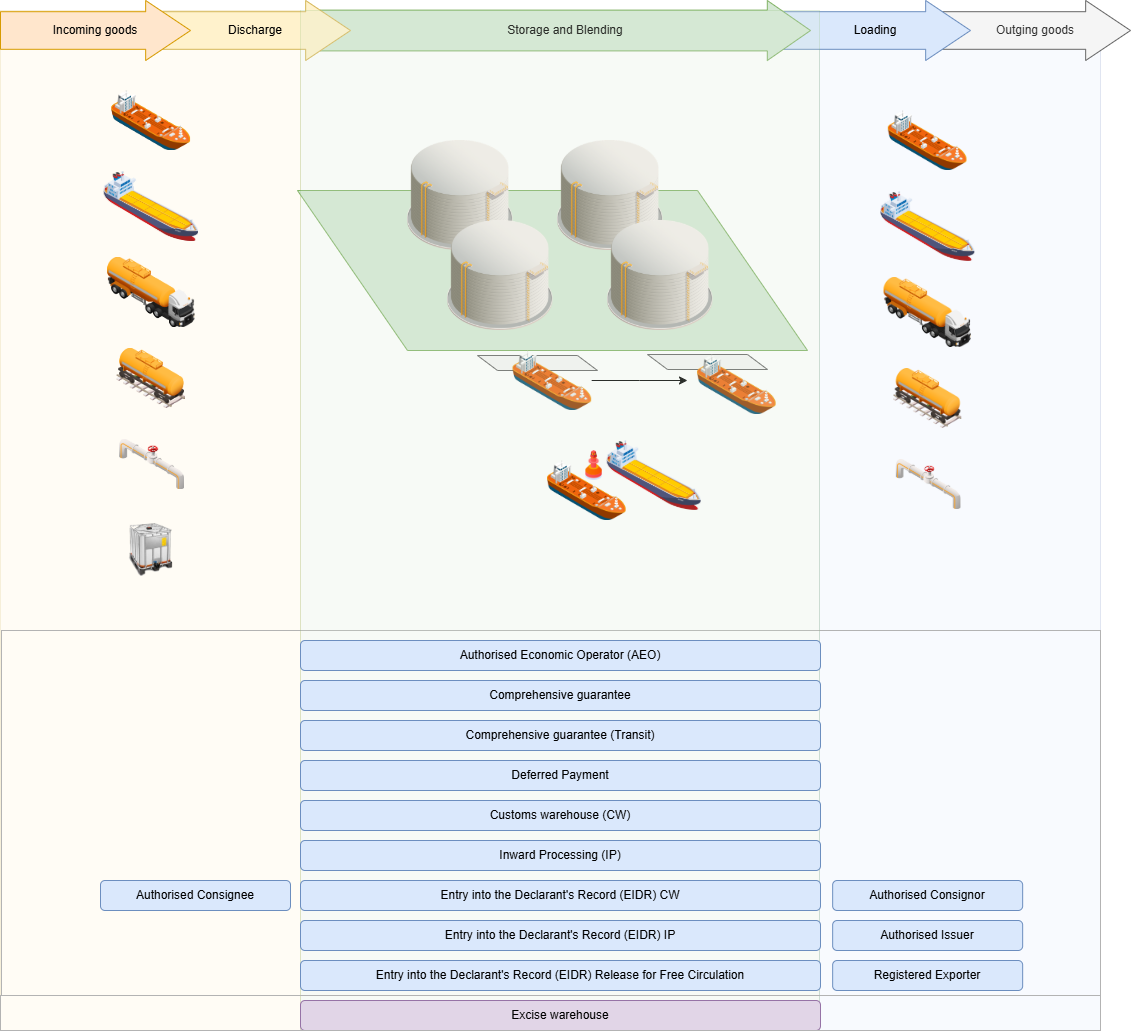
Copies of the customs and excise authorisations are maintained in BzCtrl under the VTTI Terminals II B.V. section (Files → Customs and Excise Licenses).
The practical application of equivalent goods, including the related control measures, is described in VTTI’s “Equivalent Goods” procedure.
The customs and excise authorisations are crucial to the continuity of VTTI's terminal operations. Their scope determines which operations the terminals can and cannot execute (e.g. which products can be stored or blended). As such, VTTI has implemented measures to prevent non-compliance with authorisation requirements, activities outside the scope of the authorisations, and the unintended expiry of an authorisation.
See Risk R-01 in the Risk Register.
Customs procedures
General principles
The customs and excise procedures applied at the terminals are aligned with the operational lifecycle of the goods involved. The operational processes are described in the Operations section of this AO/IC. This chapter describes the customs and excise procedures governing the movement, storage, processing and dispatch of the goods.
Throughout the terminal process, goods may be subject to customs supervision, excise duty suspension or be in free circulation, depending on their customs and excise status. The initial customs and excise treatment is determined upon first arrival at the terminal and may subsequently change during the lifecycle of the goods as a result of storage, blending, manufacturing, transshipment, importation or dispatch activities.
The customs and excise procedures described in this chapter are performed under the authorisations described in the preceding Customs and Excise Authorisations section.
Systems and User involvement
The administration and monitoring of customs and excise procedures is supported by an integrated process involving VTTI’s ERP System, its Customs Module and the relevant VTTI Users. Users register and maintain the operational activities and customs and excise-relevant data in the ERP System. Based on this information and predefined business rules, the Customs Module determines the applicable customs and excise treatment, performs compliance validations and initiates the required customs declarations, excise formalities and record-keeping actions.
Users review and follow up on the resulting system feedback, with Customs Specialists at the terminal or HQ providing support and specialist assessment where required by the nature or complexity of the transaction.
Incoming goods and goods receipt
Upon arrival, goods may enter the terminal under coverage of a Transit document (T1) or an electronic Administrative Document (e-AD). Union goods that are not subject to excise control may arrive without such a document. Goods arriving directly from locations outside the European Union may also arrive without a preceding customs or excise movement document and will be subject to the appropriate customs formalities upon arrival.
During the goods receipt process, VTTI records the arrival of the goods and performs the customs and excise actions associated with the preceding movement procedure. This may include the discharge or closure of transit procedures or excise movements and the registration of the goods and their customs and excise status within the terminal administration.
Storage and processing
Following receipt, the goods are assigned to the customs and excise treatment applicable to their status and intended storage and handling. Non-Union goods are generally placed under the Customs Warehousing procedure, Union goods subject to excise duty suspension are entered into the Excise Warehouse, and other Union goods are recorded in the Free Warehouse.
The terminal location is authorised as a customs warehouse, comprising of the complete infrastructure of tanks, pipelines, jetties and refinery. To optimize storage capacity and avoid disproportionate costs, accounting segregation is applied and non-Union and Union goods are commonly stored.
Non-Union goods may instead, or at a later stage, be released for free circulation. Following their release, the goods are entered into the Excise Warehouse or recorded in the Free Warehouse, depending on whether they are subject to excise duty suspension.
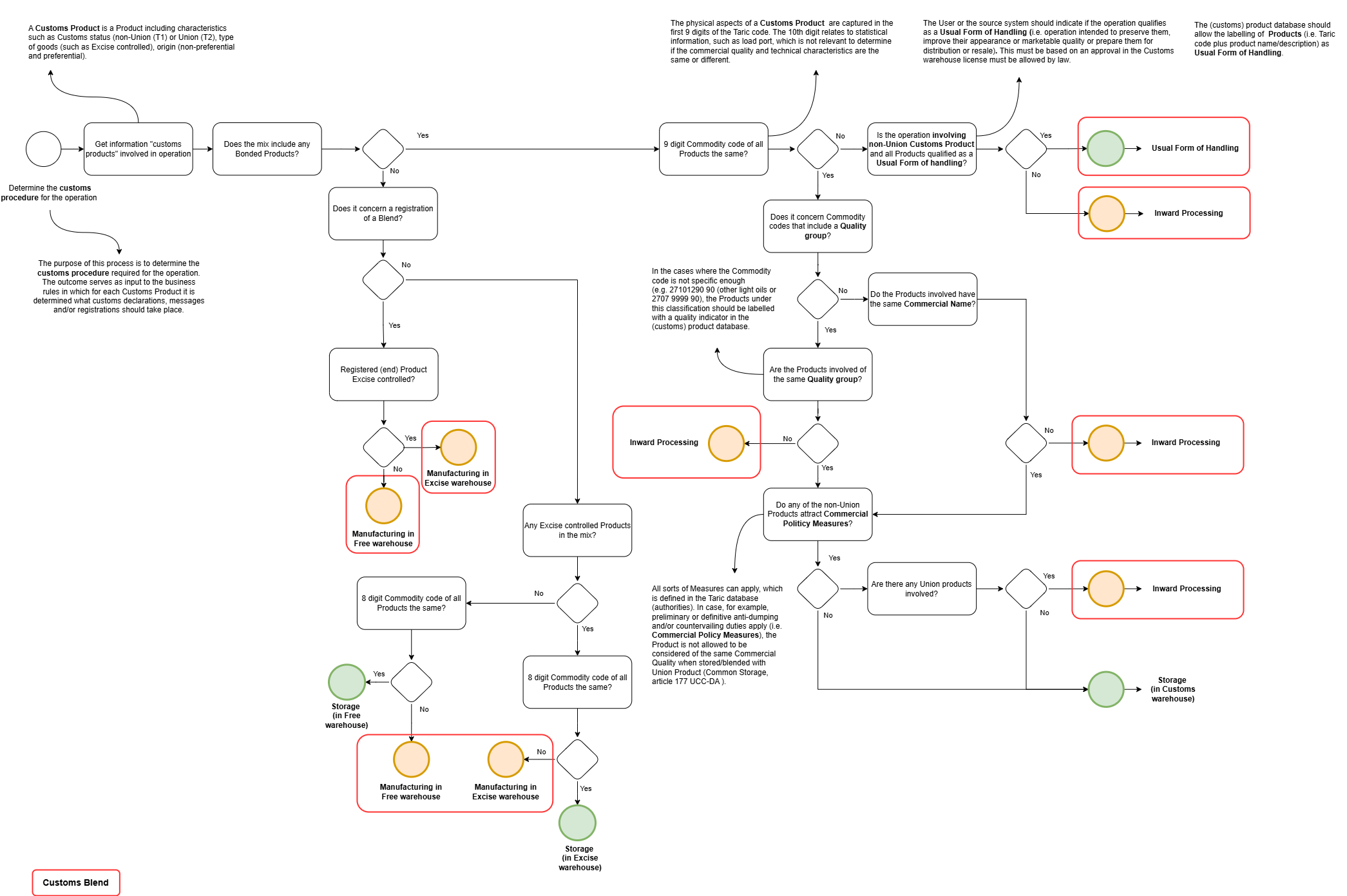
Where goods are blended, manufactured or otherwise processed, the applicable customs and excise treatment is determined based on the customs and excise status and technical characteristics of the goods involved, as well as the nature of the operation. Depending on the outcome of this assessment, the operation may be treated as storage, manufacturing in the Excise Warehouse or Free Warehouse, Usual Forms of Handling under the Customs Warehousing procedure, or Inward Processing.
Outgoing goods
Upon dispatch from the terminal, goods may leave under excise duty suspension covered by an e-AD, under the transit procedure covered by a T1 document, under an export or re-export procedure, or as Union goods in free circulation, where applicable. The required customs declarations, excise messages and supporting records are generated and maintained in accordance with the applicable legal requirements and authorisations.
The detailed functional and technical design of the ERP System and Customs Module, including the Parcel administration model, procedure determination logic, business rules and declaration processes, is described in Annex AO/IC ATLAS-CMS.
The flow chart below provides an overview of the customs and excise procedures that may apply throughout the lifecycle of goods handled at a VTTI terminal.
Customs declarations and discharge of customs procedures
Nomination
Declaration
- Presentation of the goods;
- Entry in the declarant's records;
- Submission of the supplementary declaration.
Presentation of the goods is the legal act of making goods available to Customs for control, while the presentation notification is the electronic message used to inform Customs that the goods have been presented. A presentation notification is lodged whenever goods are placed under a customs procedure requiring presentation of the goods. When goods are placed under successive customs procedures, Customs may waive the obligation to lodge a presentation notification. Dutch Customs waives this obligation at the second and further placements, provided that the goods are fully traceable in a single administration. This waiver is referred to as the Chain Arrangement (ketenregeling). The principal advantage of the Chain Arrangement is that physical customs controls (if any) can generally be limited to the arrival of the goods at the terminal when they are placed under the first customs procedure in the chain. A key condition for the application of the Chain Arrangement is that, at the first link in the chain, sufficient information and supporting documentation is available to enable Customs to perform any controls that may be required at later stages in the chain. For example, where goods are ultimately intended to be released for free circulation, Customs must be able to verify at the first placement in the chain that all relevant import requirements have been met.
The supplementary declaration is lodged via the customs declaration system and must be submitted no later than 10 days after the goods have been entered into the declarant's records. The reference period is one calendar day, meaning that all goods entered into the records on a particular day must be covered by supplementary declarations submitted 10 days later. For example, goods entered into the records on 1 January must be covered by supplementary declarations submitted on 11 January. Failure to submit a supplementary declaration within the prescribed deadline constitutes a breach of the conditions of the EIDR authorisation. Depending on the circumstances, Customs may require corrective action, impose administrative penalties, increase compliance monitoring, or, in cases of repeated or serious non-compliance, suspend or revoke the authorisation.
Monitoring and discharge of customs and excise procedures
VTTI monitors the timely and correct discharge or closure of customs procedures, movements and declarations in which it is involved. This includes, among other things, monitoring confirmations of exit for export and re-export declarations, the discharge of transit movements and e-ADs, and the discharge of the inward processing procedure.
Monitoring and discharge of customs procedures is to a large extent automated and embedded in VTTI’s ERP system and CMS. The systems register the relevant customs procedures and movements, process messages received from the customs authorities, and identify procedures or movements that have not been discharged or closed within the applicable or expected period. For inward processing, declarations entering the procedure are linked to the subsequent declarations or records by which the procedure is discharged.
Open, overdue or otherwise exceptional items are made available for review by the user. The user investigates such items and, where required, obtains supporting information from the customer or other parties involved, submits follow-up messages or evidence to the competent authorities, and takes or initiates corrective action. Items remain subject to monitoring until they have been resolved or otherwise appropriately accounted for.
Automation
Review procedures
The detailed functional and technical design of the ERP System and Customs Module, including the Parcel administration model, procedure determination logic, business rules and declaration processes, is described in Annex AO/IC ATLAS-CMS.