Control Framework
- Organization personnel
- Competence and professional qualifications
- Risk register
- Incident registration
- Computerization and administration
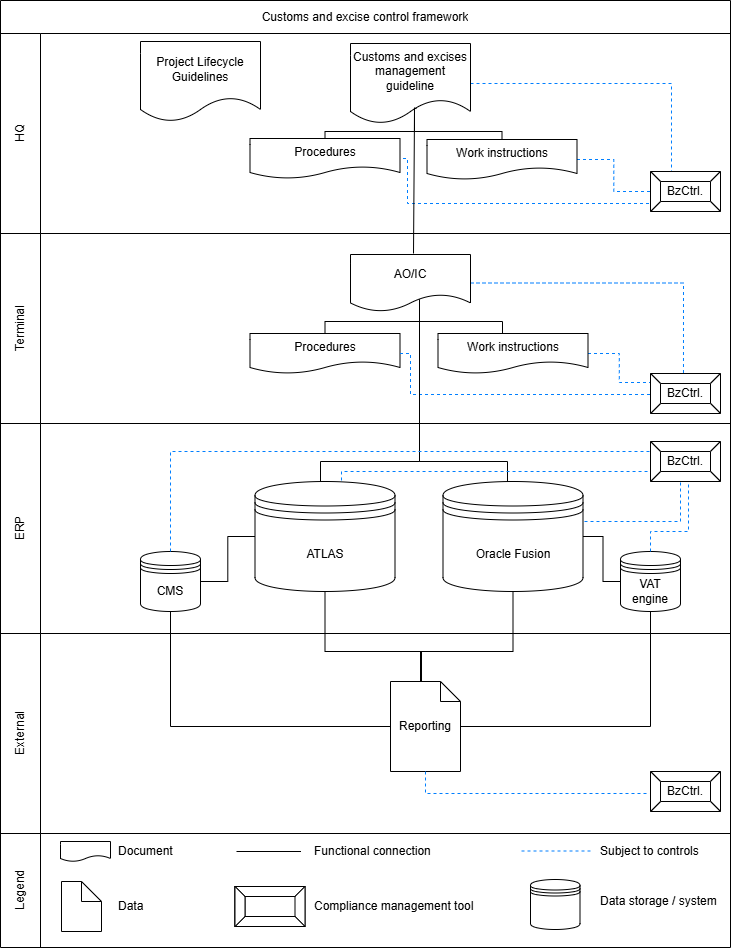
- Schematic overview
Organization personnel
More details on how the C&E function for terminal services is organized from a group perspective is included here.
Competence and professional qualifications
- For less experienced employees: Training programs at recognized educational establishments, such as Evofenedex or similar;
- For all employees involved in customs matters: Annual internal customs and excise training, organized by CGT;
- For all employees involved in customs matters: Internal toolbox training sessions (organized by CGT in case of relevant legislative changes or other relevant developments);
- For all employees involved in customs matters: E-learning program in BzCtrl;
- For all employees involved in customs matters: Webinars organized by Customs and other relevant authorities;
- For all employees involved in customs matters: External conferences concerning customs matters.
Risk register
All customs and excise compliance risks identified by VTTI are centrally captured in a risk register. For each identified risk, appropriate mitigating measures are implemented. The risk register provides a clear overview of the relationship between risks and their corresponding controls, enabling visibility of both the identified risks and the measures in place to manage them at a glance. Mitigating measures may include internal controls, automated checks or validations within ERP systems, or specific work instructions.
The risk register is included here
Incident registration
Computerization and administration
ERP
A detailed description of the process governed through ATLAS and CMS is included here.
A detailed description of the IT Authorisation procedure is included here
A detailed description of the Data security procedure is included here
A detailed description of the Technical data procedure is included here
Quality online
- storage of work instructions
- HSE
BzCtrl.
- Domains and workspaces – BzCtrl. is structured into multiple domains and workspaces, allowing user‑specific access rights to be defined so that only elements relevant to a particular user are visible.
- Risk register – All identified customs-related risks are centrally documented. The risk register plays a central role in VTTI’s control framework. Each risk is mitigated through measures designed to keep the risk manageable.
- Document management – The AO/IC, procedures, work instructions, and other relevant customs & excise documents can be accessed and updated centrally in BzCtrl. BzCtrl includes a revision history function, allowing updates to be monitored and earlier versions to be retrieved. Access rights and authorization to make updates can be granted to specific individuals, or documents can be marked as private, limiting access to a defined group of colleagues.
- Internal controls – Customs and excise related ICs are integrated in BzCtrl. They can be assigned to a specific user, including a fixed recurrence term, deadline and reviewer. The results of internal controls are made accessible via BzCtrl.’s dashboard function.
- Incident register – Customs compliance incidents (at HQ or at one of the terminals) are registered centrally in BzCtrl, providing the CGT team with real-time insight, and enabling the team to take measures as needed.
- Archiving – Documents relevant for customs & excise can be stored in the system.
- E-learnings – BzCtrl. is VTTI’s central tool for customs- and excise-related e‑learnings, which can be assigned to specific users based on content and role.
- To-do – BzCtrl’s to‑do function makes the system suitable for use as a project management tool, enabling the tracking of actions, the setting of deadlines, and the assignment of actions to specific users.
Schematic overview